 Boniface Kilonzo/ TEDDY MULEI
For over a decade, the name Julius Yego has echoed across Kenya as more than just a champion but a symbol of hope, sacrifice and possibility.
In a nation globally revered for its dominance on the track and roads, Yego tore up the script and hurled Kenya into the field events' spotlight with the force of his javelin.
Suddenly, the conversation shifted; Kenya was no longer just about distance running; it had found a new frontier.
His thunderous 91.39m throw at the 2015 Birmingham British Grand Prix was not just a personal statement but a national awakening. Months later in Beijing, he went even further, launching 92.72m to clinch world gold and cement his place among the sport’s greats.
An Olympic silver medal followed in Rio in 2016, his 88.24m effort carving his name into history books as Kenya’s first Olympic medallist in javelin.
But time, as ever in sport, waits for no one. At 37, the curtain is slowly beginning to fall on Yego’s glittering career, and with it looms a quiet fear that Kenya might lose the foothold it fought so hard to establish in the field events arena.
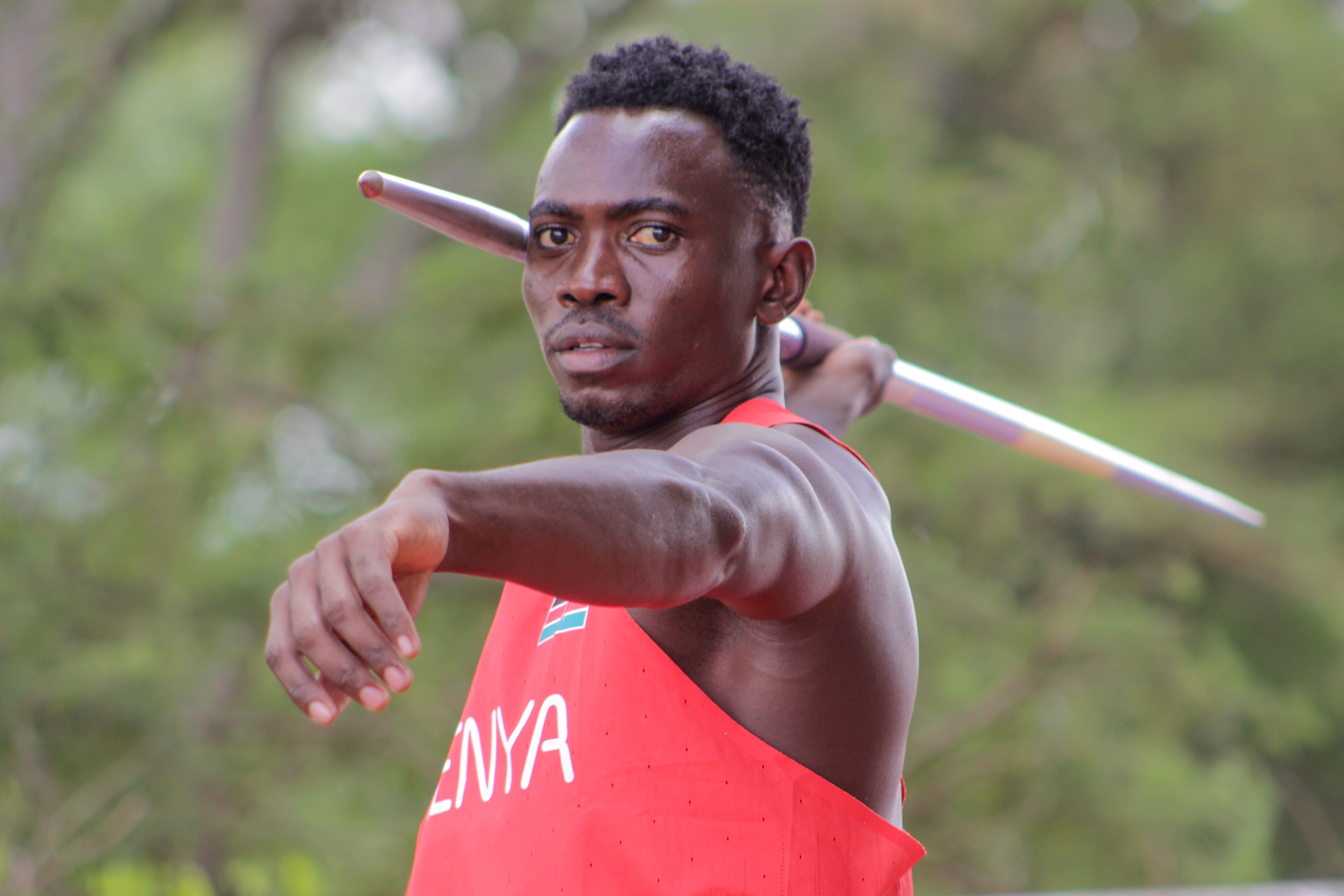
Yet, deep within that towering shadow, a new force is stirring. Boniface Kilonzo is not just emerging; he is rising with intent, with hunger and with a story etched in resilience.
A sturdy, relentless figure, he is carving his own path, step by step, throw by throw. Fittingly, the very man whose shadow he seeks to step out of has been instrumental in lighting his way.
“Yego has played a big part in my javelin career. He has been correcting me and showing me what to do. I have been constantly calling him to talk about my throws; sometimes the calls go until midnight, and we have to cut it short. I also share videos of my throws, and he looks at them and then guides me, tells me what exactly I ought to do,” Kilonzo says.
It is a passing of knowledge as much as it is a passing of the torch. For Kilonzo, 2026 has burst into life with the energy of a man ready to announce himself.
His season began across the border in Uganda at the first National Trials at Mandela Stadium in Kampala, and what followed was a statement. A monstrous 73.38m throw not only secured victory but shattered the stadium record, slicing through his previous personal best of 70.62m set in May 2025.
He left Uganda’s Johnson Mwaka (54.10m) and Mark Otwal (54.09m) trailing in his wake. Yet even in triumph, there was disbelief.
“My target going to Uganda was to get a good throw as I prepare for the African Championships and Commonwealth Games trials,” Kilonzo said.
“I did not expect to throw that far because my last competition was the national championships, where I had thrown almost 70m. But during the nationals, there was a throw where I had surpassed that 70m, but I went over the line, so it did not count.”
“Heading to Uganda, I expected over 70m, but I did not expect it to be 73m.”
At the 2025 National Championships, he had finished fourth with 69.30m behind Yego (79.27m), Alex Kiprotich (72.93m) and Duncan Kinyanchui (72.88m).
For Kilonzo, Uganda changed everything. “I did not even know that I had set a stadium record. It was while I was at the border of Kenya and Uganda, coming back home, that I started receiving calls from people telling me that I had broken the stadium record.”
From there, the work intensified, focus sharpened, and belief deepened, with his sights set on the Athletics Kenya combined trials at the Ulinzi Sports Complex on April 9-11.
“That performance in Uganda really made me happy, and it gave me a lot of confidence in training. I knew I had a bigger throw in me.”
“Before the African trials in training, I was throwing over the 73m I had set. I only had to work on my technique. In my throws, I was putting in too much power while throwing, and that would make me step on the foul line,” he said.
Under the watchful eye of seasoned coach Joseph Musonic, the raw power began to take shape.
“My coach told me to release the javelin earlier to prevent stepping on the line because I had proper power; the only challenge was my technique.”
At the AK Combined Trials at Ulinzi Sports Complex, Kilonzo delivered a performance of authority, unleashing a 76.76m personal best to claim victory and secure his maiden slot in Team Kenya for the African Championships in Accra. Kiprotich followed closely with 76.71m, while Kinyanchui settled for third at 70.06m.
And once again, Yego’s influence lingered in the background. “At the trials, Yego told me to relax my body because I was too stiff while throwing. He told me not to put my mind on a big throw and just be relaxed and let it come. He is such a talented athlete; he was also advising the rest of the javelin throwers at the trials.”
Further, his friendly rivalry with Kiprotich played a big role. “We were challenging each other, Kiprotich and I. He had told me before the trials that if he throws far, I should ensure I throw further so that we can push each other to attain the 80m mark. He told me that if we go to the African Championships, we must hit 80m.”
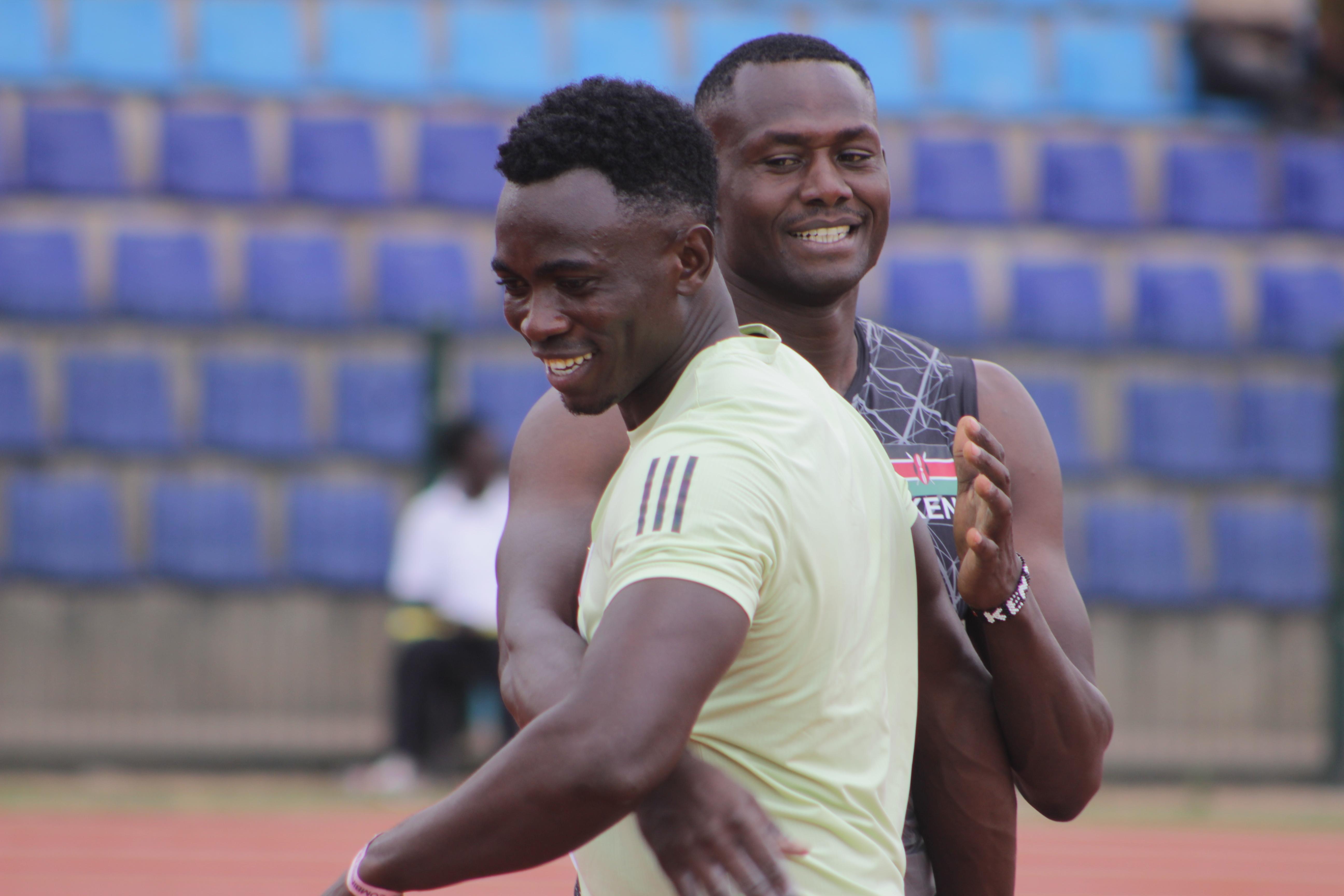 Boniface Kilonzo and Alex Kiprotich at the AK Combined trials/ TEDDY MULEI
Now, as he prepares to share the continental stage with a five-time African champion in Yego and a fierce competitor in Kiprotich, Kilonzo’s ambitions are to refine, sharpen and unleash even bigger throws.
“In javelin, you have to have technique, be flexible and also strong. Javelin is a technical event, and you have to use more technique than power. At the moment, with the strength I have, I am sure I can launch more than 85m; the only issue is the technique."
Javelin is a sport of precision as much as power and a violent harmony of speed, rhythm and control. Athletes sprint down a runway, build momentum through crossover steps and explode into an over-the-shoulder release, sending the spear slicing through the air to land tip-first within a narrow sector, all while fighting to stay behind the foul line.
“When throwing, you have to block your left foot before launching. You also have to approach the throw while leaning back slightly so that you may launch the javelin with maximum power.”
“If you fail to block your front foot, you won’t stop in time, and you won’t have maximum power output for the javelin.”
Kilonzo speaks the language of the craft learned, lived and refined through trial and error. “The runway distance is roughly 30m, so you can decide to run up to 20m or 25m, depending on your training. You also have to calculate your speed because if you start at a high speed, by the time you are throwing, you will not have sufficient power to throw, and you may be tired as well.”
“So you have to start slow, and in your final few steps, your reaction should be very high and use maximum power.”
Even the dive, that dramatic collapse after release, becomes a calculated survival instinct.
“There are people who know that with the speed they take off at the runway, they will not be able to brake their legs, which will cause them to cross the line. So they opt to dive to avoid touching the line.”
Behind the technique, however, lies a story far deeper than numbers and mechanics. Born on July 25, 1995, in Mutitu, Kitui East,to Kilonzo Kitema and Maria Kilonzo, he is the last-born in a family of seven children. Kilonzo’s journey began not with javelins, but with curiosity at Manyoeni Primary.
“In Primary I was doing the walking race, and there was a time I made it to the regional games. That is when I saw students participating in the javelin, and that really drew my interest. The students were using sticks, and they would launch the sticks, and they would slide on the ground, so it made me curious.”
“It was afterwards that I learned that when you throw the javelin, it is not supposed to slide on the ground and should actually plant itself at the specific spot,” he recalls.
At Yumbisye High School, that curiosity turned into an obsession, fuelled by a moment that changed everything. “I saw Julius Yego throwing the javelin in 2015 at the World Championships in Beijing, and that made me even more curious. I used to think that you use a stick, but I saw Yego using a metal rod, and from then on I loved the sport.”
His early steps were humble, almost improbable. At the 2016 national school games at Ruring’u Stadium in Nyeri, he finished eighth with a 51m throw, all while barefoot.
“I was also able to represent my school at the nationals, in which I finished eighth after throwing 51m, and I was also doing it barefoot.”
“The nationals were a different ball game for me; I had been used to the heat, but now Nyeri was so cold, and I had not even carried proper warm clothes.”
“I was also not even known people were selected to represent Kenya outside the country, my main aim getting into the javelin was to just get out of school and travel to just break that boredom of being in school constantly in high school,” Kilonzo shares.
The challenges ran deeper than competition. “No one in my family or even the entire area I am from has an interest in athletics. At first, they did not support me; my father was adamant that I focus more on school because in my area, sports are not a big priority.”
Still, Kilonzo persisted, and after high school, he moved to Nairobi, chasing both survival and a dream. “After high school, I came to Nairobi to try and get some work and also pursue javelin. I used to come to Kasarani to watch athletes do the javelin, and that is where I met coach Musonic.”
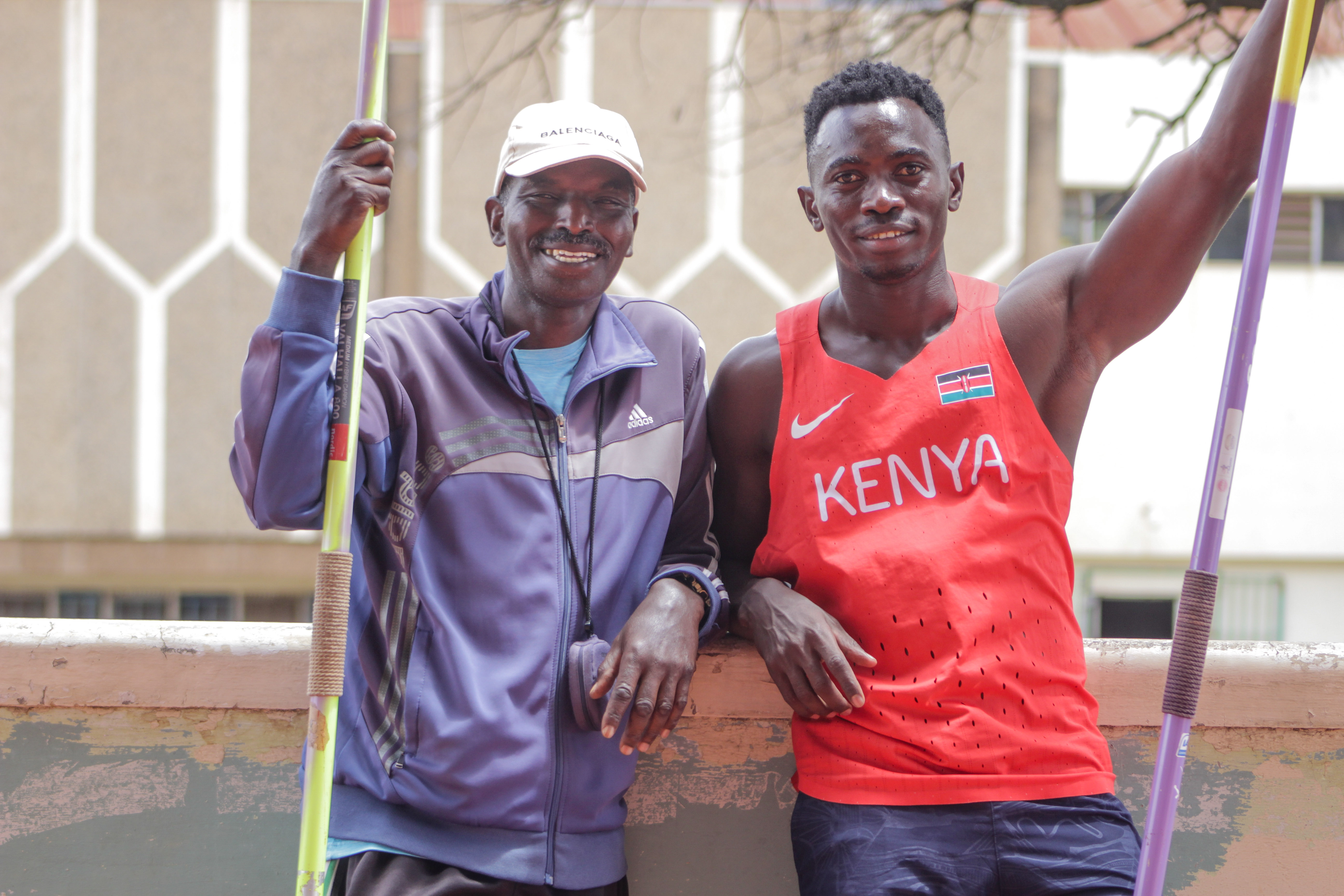 Boniface Kilonzo (R) with his coach Joseph Musonic/ TEDDY MULEI
Reality, however, hit hard.
“The first meeting, he told me that if I wanted to pursue the sport, I had to have proper shoes because I was just in normal sneakers.”
Javelin throwers use highly specialised footwear called javelin boots or spikes, distinct from those used by almost every other track and field athlete.
Specialised and expensive javelin spikes are still out of reach for Kilonzo, who is still trying to survive and navigate the big city.
“The shoes are really expensive, and at the time, I did not have the funds to secure the shoes. So I was just using normal spikes while saving up to buy the shoes.”
The average price for a new pair of professional javelin boots typically ranges between $140 and $170 (Sh18,000 to Sh22,000), though entry-level models and sales can bring costs down to around $90 (Sh11,500).
However, Kilonzo’s passion could not be halted. In 2021, he started reaping from his hard work after launching a 69.07m throw to finish third during an AK meeting.
However, another expense is the javelin itself, which is even costlier. For global-level competition, a professional javelin typically costs between Sh30,000 and over Sh250,000 ($250 to $2,000+), depending on its aerodynamic rating and construction materials.
A javelin thrower does not need to own their own javelin, particularly when starting, but owning one becomes necessary for serious training and competitive performance.
“For me, I do online writing, which does not bring in that much income and javelin is a sport that needs a lot of support. So for someone like me, it becomes very hard.”
“Also, most of my online writing work I do at night. So the next day, I am always very tired and often sleepy because I did not get enough sleep. The coach has scolded me several times,” he says with a smile. It is the quiet sacrifice behind the scenes, the unseen miles, which define him.
Through it all, Yego has remained a pillar. “Yego sometimes assists us with his javelins in some competitions, and also AK has some javelins that they provide for us, so that cushions the demand to have your own javelin.”
Coach Musonic sees what is coming. The flashes of brilliance already tell a story of another icon in the making.
“The mark he got at the trials was very encouraging, and now that we are preparing for Kip Keino, we are on the right track. We only need to work on a few areas.”
“I think Kilonzo and Kiprotich are the generation who will carry the torch from Yego; there are also some other young talents coming up,” he says.
But he also knows the fine margins. “Because of the work he does at night, sometimes he comes very sleepy for training, and that is not ideal because he has exceptional talent.”
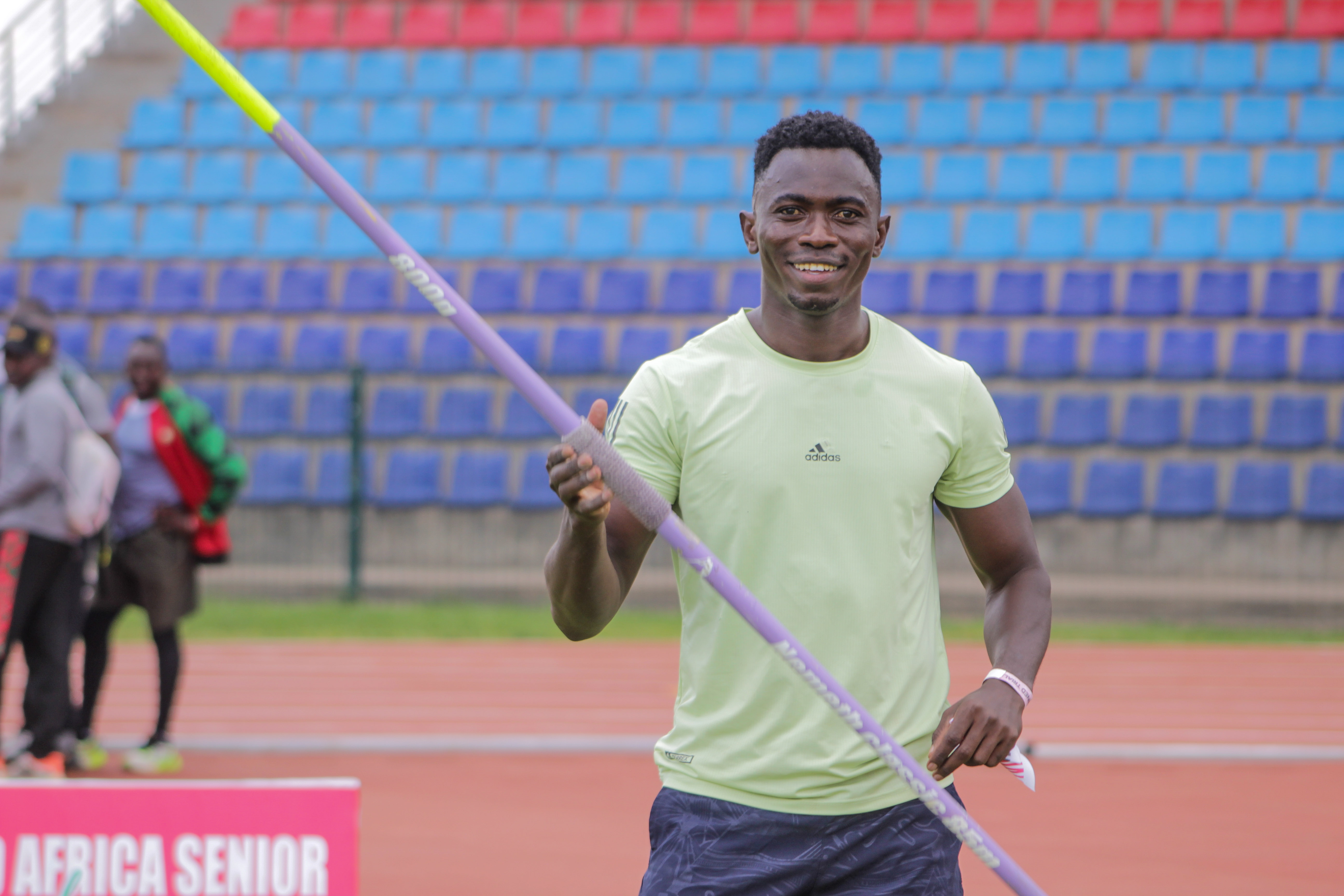 Boniface Kilonzo/ TEDDY MULEI
For Kilonzo, the Kip Keino Classic offers him a perfect platform to sharpen his craft, going up against the world's very best throwers.
He will be alongside his mentor, Yego, in the Kenyan ranks as they take on a world elite list led by 2016 Olympic champion Thomas Rohler of Germany.
“I am not afraid of the big names at Kip Keino Classic. The person with the biggest throw there is Yego, and I have competed with him more than 10 times. So there is no pressure.”
“When you are throwing against big names, you can always copy and paste, learn how they are throwing and implement it in your throw.”
“I desire to throw 80m during Kip Keino because that field is strong enough to push me to attain that mark,” he said.
His biggest ambitions for the year, however, remain the Commonwealth Games in Glasgow.
“The big target for me this year is the Commonwealth Games. I know I have to work extremely hard to get there. I have to be at my best during the Kip Keino Classic and African Championships if I am to be ready for the Commonwealth Games.”