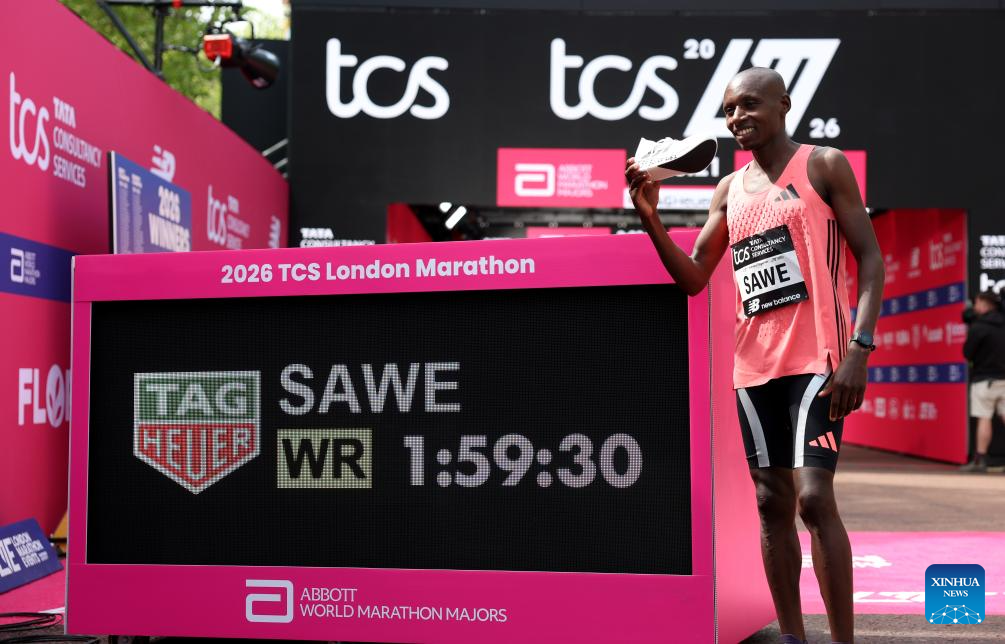
 Sebastian Sawe of Kenya poses with the record screen after the men's elite race at the London Marathon in London/ XINHUA
April 26, 2026, will go down in history as the day the whole sporting landscape changed. For years, Kenya has been revered as the nation of long-distance runners, claiming numerous global accolades and setting benchmarks that no other nation dares to match. For the past 15 years, no other nation has broken the men’s marathon world record apart from Kenya.
The first recorded world record for the men’s marathon was 2:55:18, set by American Johnny Hayes at the 1908 London Olympic Games. The first-ever sub-2:20 finish came in 1952 courtesy of Jim Peters, who clocked 2:18:40 at the Polytechnic Marathon in London, before shaving that mark even further to 2:17:39 the following year in the same event.
Ethiopia’s Abebe Bikila was the very first African to set a marathon world record after posting 2:12:11 at the 1964 Tokyo Olympics. It was in 1967 that the times started getting faster with the first sub-2:10 from Australia’s Derek Clayton, who posted 2:09:36.
In 2003, Paul Tergat made history as the first ever Kenyan to hold the marathon world record, posting 2:04:55 at the Berlin Marathon, a mark that stood for nearly four years.
His mark was eclipsed by Haile Gebrselassie in 2007 when he timed 2:04:26 in Berlin before bettering that mark again to 2:03:59 on the same course in 2008. What followed was total dominance by Kenyan distance runners.
Patrick Makau bettered Gebrselassie’s mark, posting 2:03:38 in Berlin 2011 before Wilson Kipsang shattered it by timing 2:03:23 at the same course in 2013.
The first sub-2:03 came through Dennis Kimetto, who posted 2:02:57 in Berlin 2014, with Kenyan great Eliud Kipchoge pushing the limits to set a new record of 2:01:39 in 2018 and 2:01:09 in Berlin in 2022.
The late Kelvin Kiptum became the first man in history to go under 2:01 after his 2:00:35 world record at the 2023 Chicago Marathon. With Kiptum having flirted with the sub-two-hour mark, talks of a sub-two-hour marathon began to catch fire.
However, that feat was not only deemed unreachable at the time but unattainable, too.
Then came Sebastian Sawe last weekend. Sawe tore through the streets of London to achieve an unimaginable feat, one that has now placed him among the greatest marathoners of all time.
At the London Marathon, Sawe breasted the tape in an unbelievable 1:59:30, the first man on the planet to run a marathon in under two hours. Running a marathon in under two hours was long deemed unachievable because it was viewed as the ultimate limit of human physiology, requiring a sustained pace previously thought impossible for the human body.
For decades, experts and athletes believed that the combination of speed, endurance, and cardiovascular efficiency required to run 42km in under 120 minutes surpassed the physical capability of human beings.
A sub-two-hour marathon requires maintaining an average pace of roughly 2:50 min/km for 42km. To put this in perspective, that pace equals consecutively running a 5K in 14:13, eight times. The human body generally runs out of stored glycogen long before 42km at that pace.
At that intensity, athletes risk “hitting the wall” as their bodies struggle to turn to less efficient fat burning to survive. For decades, it was believed no human could be efficient enough to overcome this loss of energy over such a long distance.
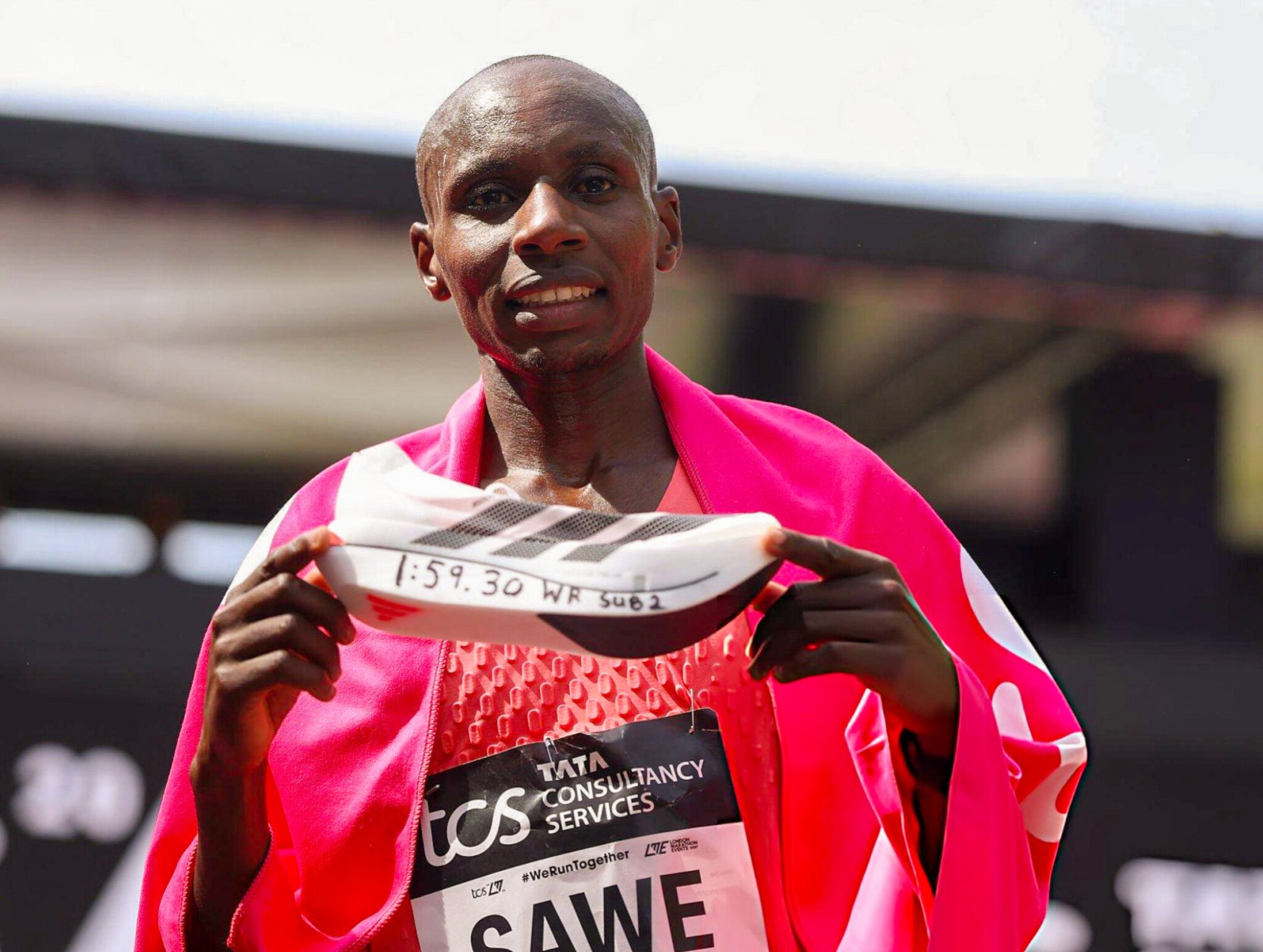 Sabastian Sawe after breaking the world record/ HANDOUT
Some scientists and runners believed that internal organs simply could not handle the physical pounding and extreme sustained intensity for that duration.
In 2019, however, Kipchoge showed the world that running a sub-two-hour marathon was indeed possible after timing 1:59:40 in the Ineos 1:59 Challenge.
Kipchoge’s exploit was not recognised as an official world record because the Ineos 1:59 Challenge was a specially designed exhibition, not an open competitive race, thus violating several World Athletics rules.
Key reasons included the use of rotating pacemakers, receiving hydration via bikes, and utilising a pace-setting car. On the streets of London last weekend, Sawe proved to the world that a sub-two-hour marathon was possible in normal marathon conditions. Sawe’s average speed for the London Marathon was 21.2 km/h, maintaining an average pace of 2:50 per kilometre.
He achieved this by running a negative split, completing the second half in 59:01 after a 1:00:29 first half —averaging a 100-metre time of 16.9 seconds for the entire distance.
He sustained a pace of 14:14 for the first 5km and accelerated to a blistering 13:42 split between 35-40km. Sawe’s time in London was faster than Kiptum’s 2023 record run, where he averaged 2:51 per kilometre. Kiptum ran the first half in 1:00:48 and accelerated through the second in 59:47.
Further, Sawe’s record-breaking run was supported by a precise, metronomic fueling strategy developed with Maurten, a Swedish sports nutrition company.
His strategy relied on front-loading energy and maintaining a consistent intake every 20 minutes. The protocol for the race included front-loaded 160ml of Drink Mix 320 at every station from 5K to 40K.
Maurten Drink Mix 320 is a carbohydrate sports fuel that uses Hydrogel Technology. It contains 80 grams of carbohydrates per 500ml of water. He also had a speciality intake at the 20km mark, where Gel 100 Caf 100 was added to his regular drink. Maurten Gel 100 Caf 100 encapsulates 25 grams of carbohydrates and 100 mg of caffeine in patented Hydrogel Technology.
Sawe also used the Maurten Bicarb System to manage muscle acidity and delay fatigue. The Maurten Bicarb System is a high-performance sports supplement designed for elite, high-intensity exercise, utilising patented hydrogel technology to encapsulate sodium bicarbonate.
It increases blood bicarbonate levels to buffer muscle acidity, delaying fatigue while significantly reducing the gastrointestinal distress commonly associated with traditional baking soda ingestion. Sawe also invested a lot into training before the London Marathon to ensure the world record was attained.
Sawe went through a highly specialised 12-month nutrition and gut-training protocol developed by Maurten, enabling him to consume a massive 115 grams of carbohydrates per hour.
Instead of the traditional 60–90g of carbs per hour, Maurten designed a protocol to train Sawe’s gut to handle over 115g/hour without gastrointestinal distress. Further, Maurten worked closely with Sawe’s team, analysing exogenous carbohydrate uptake as well as VO2 max and running economy.
VO2 max is the maximum amount of oxygen your body can utilise during intense exercise (aerobic capacity), representing your "engine size". Running economy is the oxygen cost of running at a submaximal pace, indicating how efficiently you use that energy.
Exogenous carbohydrate uptake refers to the process by which carbohydrates ingested during exercise (external sources) are digested, absorbed in the gut, transported through the bloodstream, and utilised as energy by working muscles.
At the London Marathon, Sawe not only pushed himself to greatness, but also the other two podium finishers, who all dipped under the previous world record.
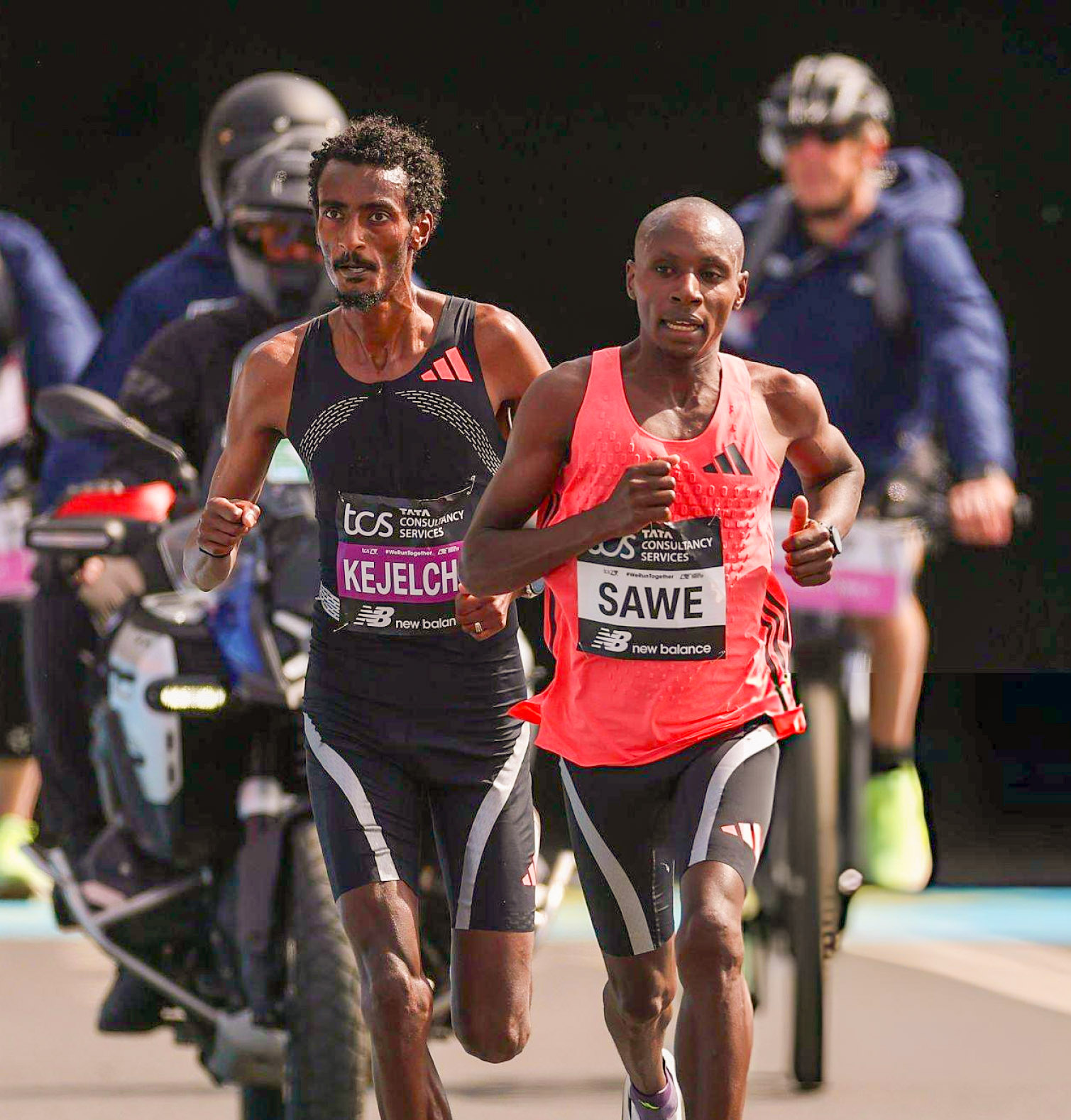 Sabastian Sawe (R) with Ethiopian Yomif Kejelcha at the London marathon/ HANDOUT
Yomif Kejelcha also broke the sub-two barrier, timing 1:59:41 for second place in his full marathon debut, as Jacob Kiplimo timed 2:00:28 for third place.
Interestingly, Sawe revealed that he only had two slices of bread before his race.
“I took two slices of bread with honey and tea,” Sawe said in his post-race interview.
Another contributing factor, according to him, was the Adidas shoes— technologically advanced to aid in his record-breaking feat. “The shoes are so cool and properly supportive and comfortable. The shoes played a big role in the performance,” Sawe said.
Sawe wore the Adidas Adizero Adios Pro Evo 3 to break the sub-two-hour marathon barrier at the 2026 London Marathon.
The shoes were exceptionally light at roughly 97 grams, making them the lightest racing shoes ever made. They feature an extra-thick midsole for maximum cushioning and a carbon-fibre plate (Energyrim) for energy return. The shoes were listed for approximately $500 (approx. Sh65,000) and are designed as elite, high-performance racing shoes.
The shoes are part of the latest, highly advanced "super shoe" technology aimed at increasing running efficiency by up to 16 per cent.
Born on March 16, 1995, in Uasin Gishu County, very few people knew about Sawe before the London Marathon record-breaking run. But for athletics enthusiasts, the distance ace first caught their attention at the 2023 World Half Marathon Championships when he struck gold.
That moment was particularly memorable as compatriot Daniel Ebenyo, who was leading towards the final metres, saluted him after he passed him with a strong finishing kick.
At that global showpiece held in Riga, Latvia, Sawe clocked 59:10 minutes to orchestrate a Kenyan podium sweep as Daniel Ebenyo (59:14) and Samwel Mailu (59:19) placed second and third.
Sawe then switched to the full marathon in 2024 and instantly made his intentions to leave a mark clear. On his debut over the classic distance at the Valencia Marathon 2024, he surged to victory in a world-leading 2:02:05, the second-fastest debut in history.
Only Kiptum had gone quicker in his debut, clocking 2:01:53 on the same course in 2022. Sawe carried that momentum into the London Marathon 2025, where he once again asserted his dominance, clinching victory in 2:02:27. He then set his sights on Berlin in September 2025, launching a bold assault on the world record at the Berlin Marathon 2025.
Though he fell short of the mark, Sawe still powered to victory in 2:02:16.
In the lead-up to that Berlin bid, Sawe took extraordinary steps to safeguard his credibility amid heightened scrutiny on Kenyan athletics.
In response to doping violations by other athletes, he underwent an unprecedented 25 out-of-competition tests conducted by the Athletics Integrity Unit (AIU).
His sponsor, Adidas, further backed the initiative, contributing $50,000 (Sh6.7 million) to fund his enhanced, independent testing programme, a powerful statement of transparency and trust.
Outside the roads, Sawe also won the World Athletics Out of Stadium Male Athlete of the Year award after his strong 2025 season. Sawe further paid homage to his coach Claudio Berardelli, his management Demadonna Athletics Promotions, as well as his training mates. Sawe is a key member of the 2Running Club, a camp based in Kapsabet, Nandi County, with around 30 elite runners.
Some of the other big names under the 2Running club include world 800m champion Emmanuel Wanyonyi, 2024 Olympic bronze medallist Benson Kipruto, two-time Boston Marathon champion Evans Chebet and 2022 London marathon champion Amos Kipruto.
Others include 2019 world 5,000m champion Margaret Chelimo, 2025 Diamond League finals winner Nelly Chepchirchir, as well as world U20 1,500m record holder Phanuel Koech. “My coach, management and training mates have done a lot in preparing me for this year’s London marathon. I thank them for the role they have played.”
His coach, Claudio, was himself surprised by Sawe’s time. “We did not expect the sub two, but Sebastian was well prepared and ready to do something good in London. Mainly, the big goal was to win, but eventually, with the way the race unfolded, it came out with an incredible time.”
The tactician revealed that he got emotional after Sawe cut the tape to win the race. “I was quite emotional, it was a very tough competition up to almost the last kilometres with Kejelcha, but then in the end it was a moment to remember.”
He revealed that London carried special memories because of how Sawe executed his race.
“London was unique because Sebastian was basically leading throughout the race; he followed the pace makers up to 27k and from there he took over the lead, dictating the pace with a lot of courage and determination.”
Sawe acknowledged that he knew he would win the race after dropping Kejelcha at the 40km mark. “At 40km, I knew I was going to win because my colleague from Ethiopia, who was so competitive, dropped back. That’s when I knew I would defend my title,” Sawe said.
“Yomif had a very strong debut; he showed me that he is also strong. We helped each other because I was doing my best, and he was pushing himself. At the end, I was stronger than him, so I won the race. If it were not for him, I don’t think the world record would have come.”
“I was ready to break the two hours because the pace was very fast. I knew something good was going to come.”
After his record attempt in Berlin, Claudio says the team retreated to the drawing board and because they knew Sawe was strong, a plan to attack the world record was mooted again.
“First of all, Berlin, the weather was not on our side; it was warm. We came out of Berlin with the idea of trying for the world record again. He is only growing and only getting stronger and aware of himself.”
He further said that the 2Running camp is his second family. “It is my second family, they are my boys and girls, we are with them together basically seven days a week and we know each other very well. We go through our ups and downs, and we continue learning together.”
He noted that Sawe has a normal diet with supplements taken only while he’s preparing for competition. “Sebastian has a normal diet, of course, Ugali, managu and the rest. We, however, have a little bit of supplementation, especially during competition with Carbohydrates.”
The late Kiptum’s strides in the marathon also motivated Sawe. “He encouraged me a lot because what he had done was thought impossible. I had hope one day that I would be able to run that world record time,” Sawe said.
The coach says Sawe will now take a break before they can strategise on his next race. “We have to sit down and plan what is next. Now he has to go and sit down with his family and kids.”
Sawe, however, believes his mark will not last for long, noting that it may soon be broken. “I think it is only a matter of time before we get even faster times than London.”
Sabastian Sawe is set to earn over $1 million (Sh129.2 million) total from his historic 2026 London Marathon win, including a direct $355,000 (Sh45.9 million) from prize money and performance bonuses, plus additional Adidas contractual bonuses.
His earnings stem from winning ($55,000 – Sh7.1 million), a sub-2:02:00 time bonus ($150,000 – Sh19.4 million), a world record bonus ($125,000 – Sh16.1 million) and a course record bonus ($25,000 – Sh3.2 million).