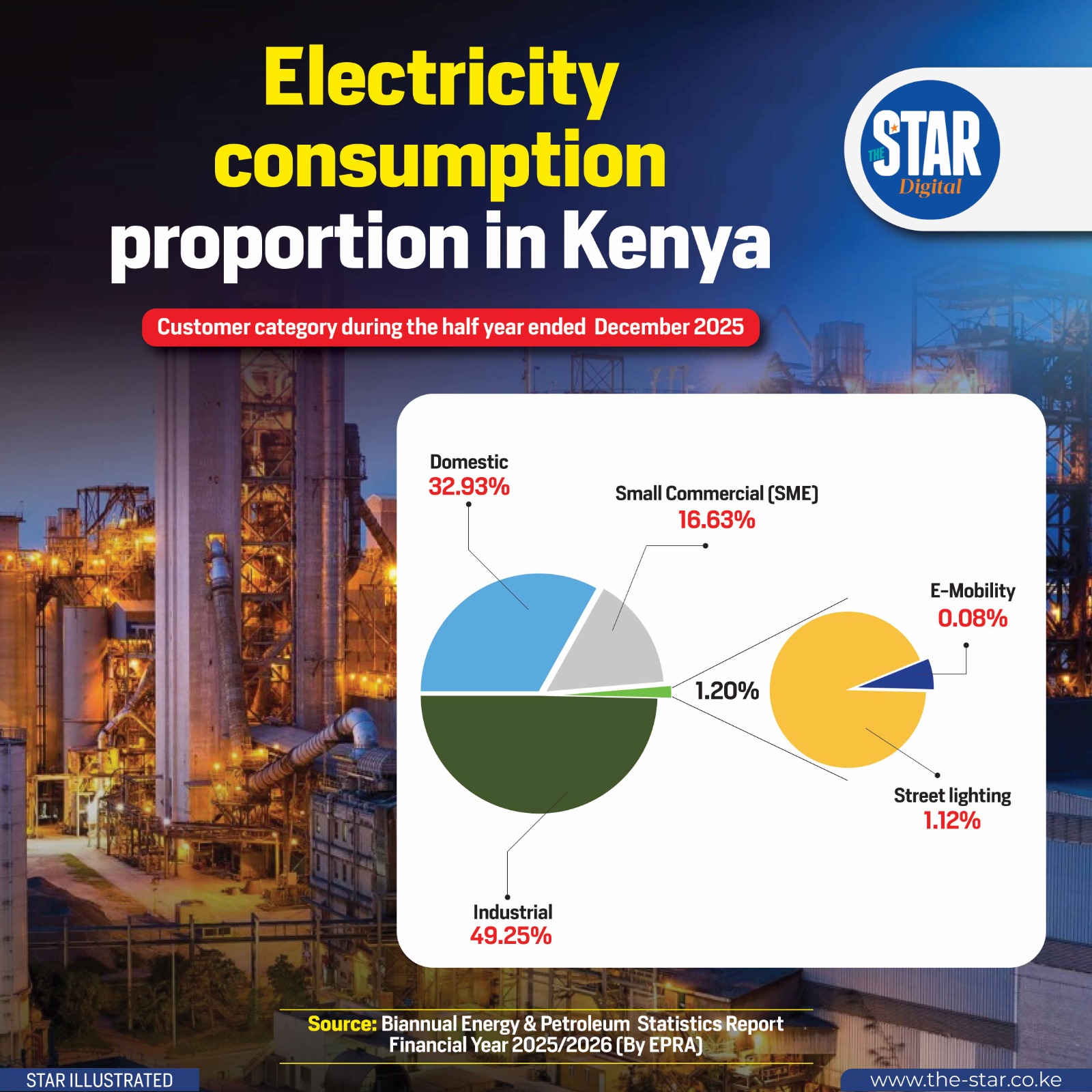
The industrial sector continues to be the primary driver of electricity demand in Kenya, accounting for nearly half of the nation's total consumption.
During the six-month period ending December 2025, industrial activities utilized 49.25% of the power supply. This dominant share underscores the heavy reliance of manufacturing and large-scale processing units on the national grid to sustain economic production.
Domestic consumers represent the second-largest category, responsible for 32.93% of the electricity used. This indicates that while industry fuels the economy, household demand remains a substantial portion of the energy load.
Meanwhile, Small and Medium Enterprises (SMEs), categorised as Small Commercial, accounted for 16.63% of consumption, highlighting their role as a significant, albeit smaller, contributor to the country’s energy profile.
Emerging and specialised sectors occupy a much smaller footprint in the current consumption landscape. Street lighting, essential for urban infrastructure and security, took up 1.12% of the total electricity.
Perhaps most notable is the nascent E-Mobility sector, which currently accounts for just 0.08% of national consumption. While still a fraction of the overall energy pie, the inclusion of electric vehicles in the national energy statistics marks a shift in the country's transport and energy intersection.
Together, these smaller categories, including other minor uses totaling 1.20%, round out a consumption profile that remains heavily skewed toward the industrial and residential sectors, as documented by the Energy and Petroleum Regulatory Authority (EPRA) for the 2025/2026 financial year.





Comments 0
Sign in to join the conversation
Sign In Create AccountNo comments yet. Be the first to share your thoughts!