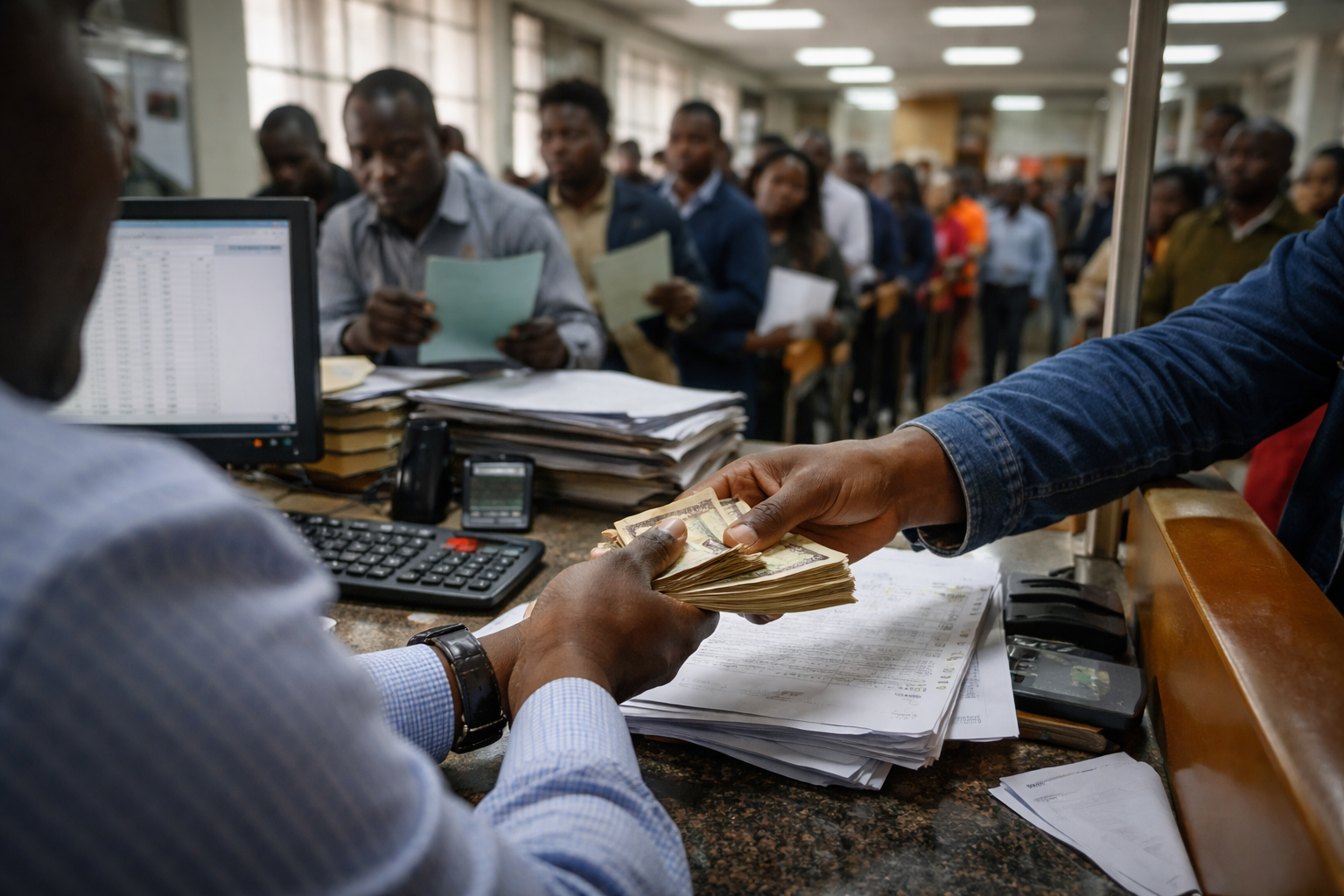
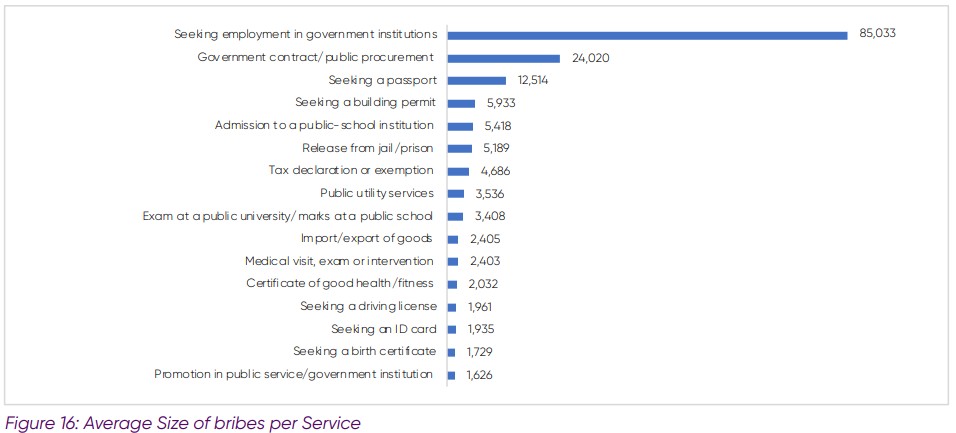
 According to the survey, the most frequent service attracting a bribe in public school institutions is admission, with a 2.9 per cent prevalence, posting an average bribe of Sh5,418. /EACC
A silent form of corruption has taken root within Kenya's public basic and higher education institutions, with a survey by the Ethics and Anti-Corruption Commission revealing that students pay thousands of shillings to lecturers as coercion to fix missing marks and other exam-related issues.
The findings point to a deeper, systemic problem in which lecturers wield significant gatekeeping power over academic outcomes, including marks, progression and graduation, creating conditions ripe for coercive bribery.
The nature of the services attracting bribes in the learning institutions also raises concerns about weak internal controls in examination management systems, as well as limited accountability mechanisms within academic departments.
The National Gender and Corruption Survey 2025, released on Thursday, shows that in the 12 months prior to the survey, the average bribe paid for exam or marks-related services at a public university or school stood at Sh3,408.
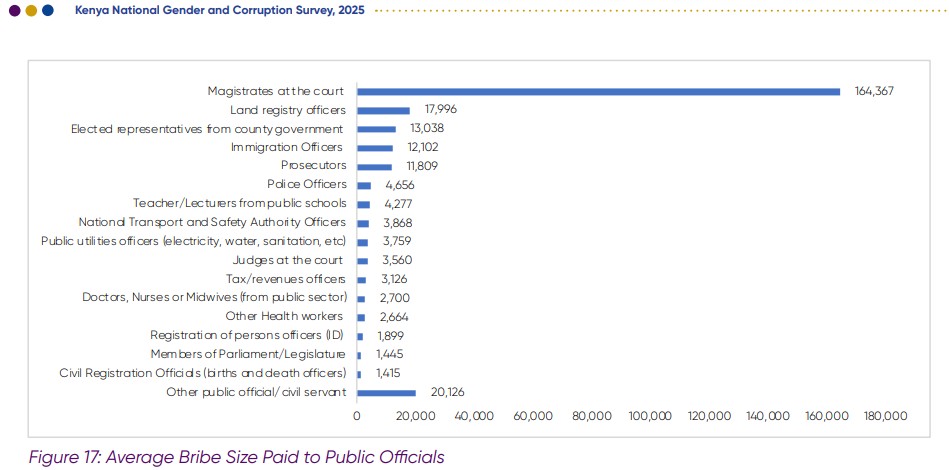
The survey indicates that although the prevalence of bribery involving lecturers and teachers in public learning institutions is relatively low at 2.2 per cent, the average bribe size paid to them stood at Sh4,277, making them the seventh most expensive public officials to bribe.
Magistrates recorded the highest average bribe at Sh164,367, while police officers, at 35.5 per cent, emerged as the most bribed public officials across the board.
The survey was conducted by the Ethics and Anti-Corruption Commission (EACC) in collaboration with the United Nations Office on Drugs and Crime – Regional Office in Eastern Africa (UNODC-ROEA), the National Gender and Equality Commission (NGEC), the Kenya National Bureau of Statistics (KNBS), and Transparency International Kenya.
It examined citizens’ interactions with public officers in the delivery of public services across all 47 counties using household questionnaires administered through face-to-face Computer-Assisted Personal Interviewing (CAPI).
A nationally representative sample of 1,467 clusters of Kenyan adults aged 18 and above, drawn proportionately from all 47 counties based on the 2019 population census, participated in the survey.
Out of 22,005 households sampled, 21,941 were reached, with 16,858 successfully interviewed.
According to the survey, the most frequent service attracting a bribe in public school institutions is admission, with a 2.9 per cent prevalence, posting an average bribe of Sh5,418.
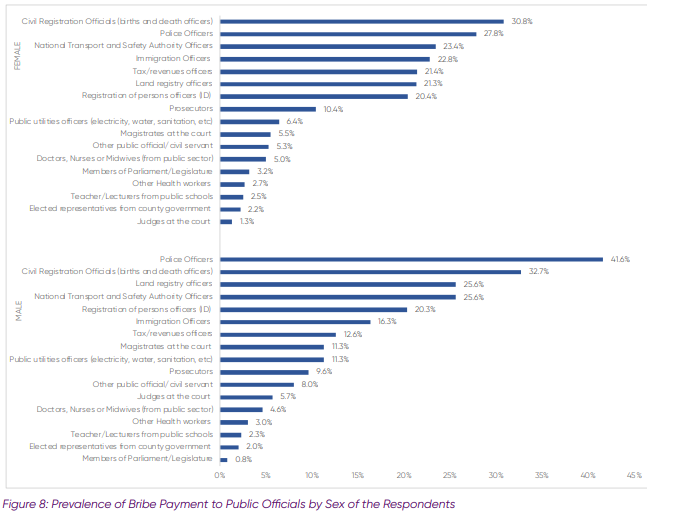
The study further shows that bribe payments to teachers and lecturers in public institutions were slightly more prevalent among female students at 2.5 per cent compared to 2.3 per cent among their male counterparts.
The pattern of payments also points to possible repeat victimisation or infraction of examination regulations, with a notable proportion of students reporting multiple bribery incidents.
Among female respondents, 6.3 per cent reported paying bribes more than 10 times, 5 per cent paid between four and nine times, 45.6 per cent bribed two to three times, while 43.1 per cent bribed just once.
In comparison, 4 per cent of male students paid bribes more than 10 times, 8.7 per cent paid between four and nine times, 29.8 per cent paid two to three times, while 57.6 per cent paid once.
“Corruption affects women more than men. The reason is simple—women are usually at the forefront when it comes to seeking service delivery. If you look at the sectors that people often mention as the most corrupt—health and education—you’ll notice that women are the ones most exposed," a respondent said.
Overall, the survey shows that public perception of corruption levels has worsened significantly, with 74.2 per cent of respondents rating corruption as high in 2025, up from 67.6 per cent in 2024.
The national average bribe paid to public officials increased from Sh3,257 in 2005 to Sh4,878 in 2024, before spiking by 38 per cent to Sh6,724 in 2025.
"The most concerning finding is that 98.6 per cent of Kenyans who paid bribes did not report their experience to any official institution," the report said.
The extremely high reporting deficit points to deep-seated mistrust in enforcement and protection mechanisms, with many victims perceiving reporting as futile or risky.
The report noted that among the 1.4 per cent who reported bribery incidents, the majority (57.2 per cent) were women, while 42.1 per cent were men.
Most respondents (49.7 per cent) who reported bribery incidents were aged 25 to 34 years, followed by those aged 35 to 49 years (27.7 per cent), those aged 65 years and above (14.1 per cent), and those aged 50 to 64 years (8.5 per cent).
Respondents aged 18 to 24 years—the cohort that largely falls within the university population—did not report any bribery incidents, further underscoring the vulnerability of students within the system.
More male respondents (34.5 per cent) than female respondents (31.8 per cent) said that the main reason for not reporting bribery is rooted in the belief that reporting is useless because no action would be taken.
Nearly twice as many women (12.7 per cent) as men (7.1 per cent) said they did not know where to report such incidents.
One quarter (24.8 per cent) of respondents aged 18 to 49 years indicated that they would not report bribery incidents in future.
"More men (30.4 per cent) than women (26.8 per cent) would prefer not to report any bribery incidents in future," the report said.
In its recommendations, EACC said it will establish secure, anonymous digital and mobile reporting platforms to encourage citizens to report bribery and sextortion without fear of retaliation.
The commission said the platforms will be accessible via USSD codes for non-smartphone users and will provide case tracking numbers to allow reporters to follow up on their complaints.
"The findings will serve as a foundational evidence base for designing interventions that protect vulnerable populations from corruption-related exploitation while dismantling the structural barriers that enable gendered corruption to persist," the report said.