

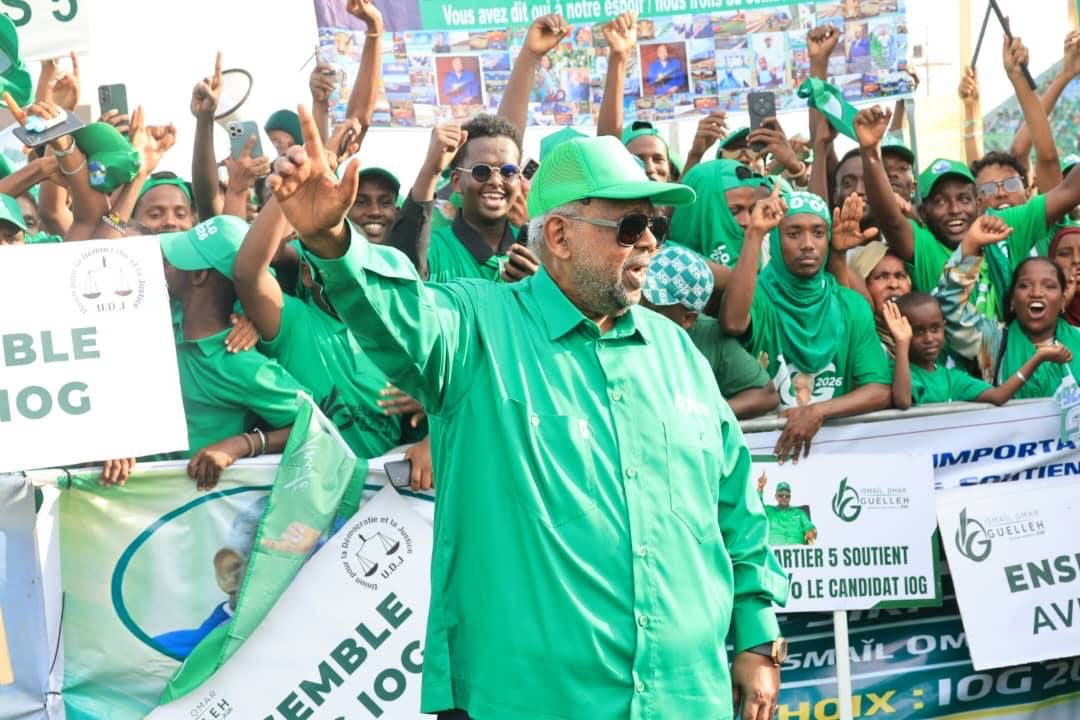
Djibouti President Ismail Omar Guelleh has secured another term in office after easily triumphing in the country’s election held on Friday.
According to the provisional results released by the Independent National Electoral Commission, the incumbent secured 97 per cent of the total votes cast, while the opposition candidates accounted for the remaining share.
The outcome affirms broad public support for his leadership and sets the stage for continuity in governance as Djibouti advances its national development agenda.
In his remarks following the announcement, the Head of State expressed gratitude to the electorate and emphasised unity and shared purpose.
“Tonight is a special night… a night filled with immense joy,” he said, adding that the victory belongs to the people of Djibouti.
He underscored the importance of collective effort in shaping the country’s future, calling for continued commitment to peace, progress, and national cohesion.
The President further highlighted his administration’s focus on strengthening Djibouti’s position on the global stage.
He reiterated the country’s resolve to overcome economic challenges through resilience, strategic planning, and a people-centered approach to development.
He said: “We want Djibouti to be visible on the world stage, and for us to become a small nation with economic challenges, but one that lives with a string heart and wise mind, determined to overcome all hardships ahead.”
The new mandate provides an opportunity for the government to sustain its ongoing economic transformation initiatives.
Djibouti has, in recent years, positioned itself as a key logistics and trade hub in the Horn of Africa, leveraging its strategic location along major international shipping routes.
Central to this vision is the expansion of regional connectivity through infrastructure projects, including an ambitious transport corridor linking Djibouti’s ports to Addis Ababa, Ethiopia’s capital, with further extension plans toward South Sudan and Uganda.
The corridor is expected to enhance trade flows and deepen economic integration across the region.
In addition to its economic ambitions, Djibouti continues to play a pivotal role in regional and global security.
The country hosts several international military bases, including those operated by China, the United States, and France, underscoring its strategic importance in maintaining stability in a vital maritime corridor.
Djibouti’s growing diplomatic influence has also been reflected in continental affairs. The recent election of Mahmoud Ali Youssef to a leading position within the African Union further signals the country’s expanding role in shaping regional policy and cooperation.







