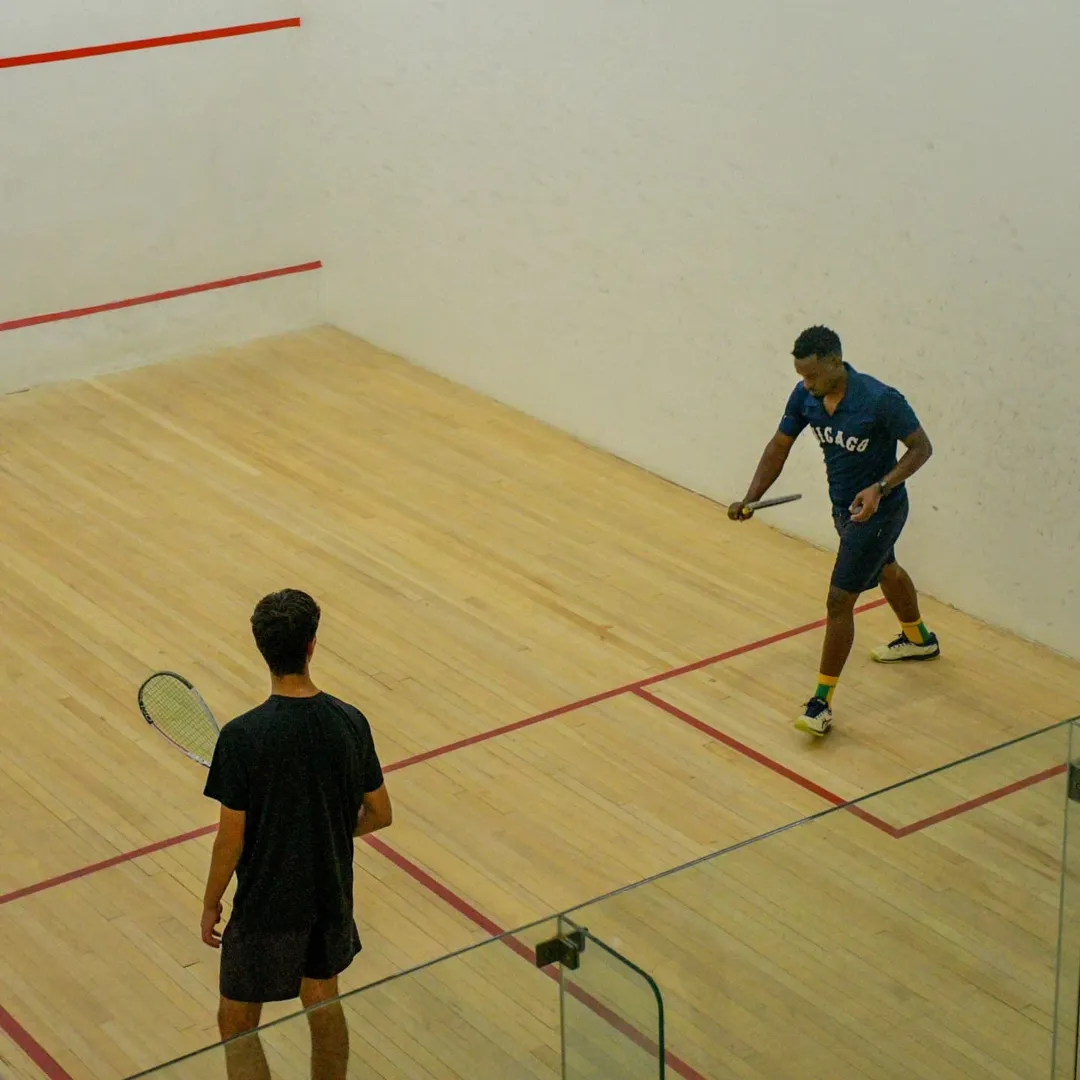
 Players at a previous squash tournament/ SQUASH KENYA
Squash is no longer a niche pursuit played behind closed doors, it is a sport on the surge, gathering pace both locally and globally as it gears up for a historic debut at the 2028 Los Angeles Olympic Games.
In this segment of Know Your Sport, we peel back the layers of a game defined by speed, precision and relentless intensity, a sport whose rapid rise mirrors the ferocity within its four walls.
At its core, squash is a high-octane racket sport played by either two players (singles) or four (doubles) inside a fully enclosed, four-walled court, using a small hollow rubber ball that demands sharp reflexes and tactical brilliance.
The court itself is a carefully structured arena, divided into three primary floor sections: the front half, lying ahead of the short line and two back quarters, left and right, positioned behind the short line.
These zones are crucial in dictating movement, positioning, and strategy.
Central to the court’s geometry is the “T”, the intersection of the half-court line and the short line, widely regarded as the most dominant position on the floor.
Service boxes sit neatly within each back quarter, marking where players must stand to initiate play.
Meanwhile, the “tin”, a 480mm strip at the base of the front wall, serves as the game’s unforgiving lower boundary, with the out lines tracing the upper limits along the walls.
The objective is deceptively simple yet brutally demanding, strike the ball against the front wall in alternating turns, ensuring your opponent cannot return it before it bounces twice.
The ball may ricochet off the side or back walls, provided it lands above the tin and below the outline, opening up a chess match of angles, deception and endurance.
Every rally carries weight under the Point-A-Rally (PAR) scoring system, whoever wins the exchange claims the point and the next serve.
Games are played to 11 points, but at 10-all, nerves of steel are required as players must carve out a two-point advantage to prevail.
The sport’s roots trace back to around 1830 at Harrow School in England, where pupils stumbled upon a softer, punctured rubber ball that “squashed” on impact, creating longer, more intricate rallies.
By 1865, the first purpose-built courts had been erected, ushering in a new chapter for the game.
From those humble beginnings, squash evolved into a global spectacle, particularly through the 1970s and 1980s, when professional structures took shape and marquee events like the World Open ignited international interest.
Today, the sport is played in over 185 countries, a testament to its universal appeal.
Kenya’s own squash journey dates back to the colonial era, with the national amateur championships first staged in 1947.
The sport has since been stewarded by the Squash Federation of Kenya, which continues to drive its growth and development across the country.