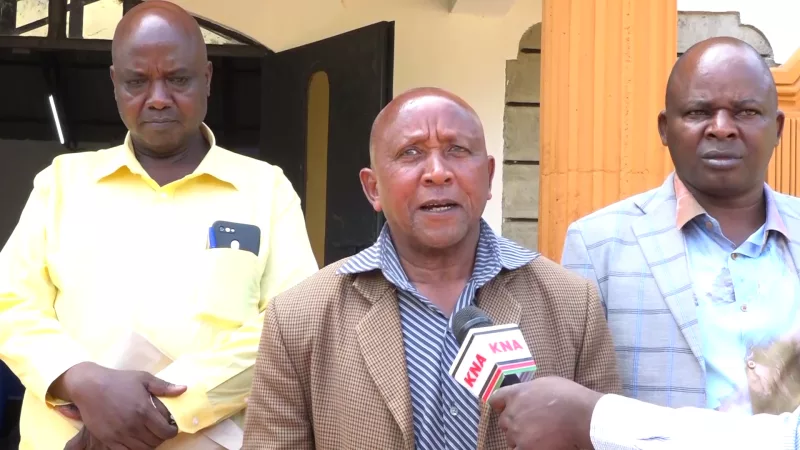
 Deputy President Kithure Kindiki, during a meeting with Maara grassroots leaders in Tharaka Nithi County/ALICE WAITHERA
Construction of the long-awaited Nithi Bridge is set to begin after months of delay, with Deputy President Kithure Kindiki confirming that all legal, financial and technical hurdles that had stalled the Sh7 billion project have been resolved.
He said the reconstitution of the National Land Commission has cleared the way for compensation of affected landowners, which has been a major bottleneck. The DP spoke in the Maara constituency.
“The money has already been allocated, and the contractor is ready. Initially, we didn’t have NLC, which assesses and compensates affected property.”
Kindiki explained that the absence of commissioners at the land agency had stalled compulsory acquisition processes.
He said the government also opted to revise the original design to meet higher safety and engineering standards, contributing to further delays but ultimately ensuring a more durable structure.
“Now every factor is in place. The commission is in place. The design is agreed upon and we have the money,” Kindiki said, signalling the state’s readiness to move to the construction phase.
The project will see the construction of what is projected to be Kenya’s second-longest bridge after the Dongo Kundu Bypass, stretching nearly three kilometres.
The bridge will be 800 metres long but the road leading to it will be reconstructed for a kilometre on either side of the bridge.
Initially, the construction of the bridge located a few kilometres from Chuka town on the Meru-Embu-Nairobi highway was scheduled to start by December last year.
Once complete, the bridge will span the notorious Nithi River valley, an area long associated with fatal road accidents due to its steep descent, sharp bends and brake failures, particularly among heavy commercial vehicles and passenger buses.
For decades, the Nithi blackspot has claimed hundreds of lives, with major accidents recorded as far back as the early 2000s.
One of the deadliest crashes occurred in 2000 when a bus plunged into the river killing dozens, setting off national concerns over the safety of the route.
Similar tragedies have been recorded over the years including multiple bus and matatu accidents blamed on brake failure along the steep stretch.
Despite intermittent safety interventions such as speed bumps, warning signage and police enforcement, the terrain has continued to pose a significant risk, reinforcing calls for a permanent engineering solution.
Kindiki said the new bridge that will include extended access roads to ease the gradient, is designed to eliminate the dangerous descent and significantly reduce accidents in the area.
He urged residents whose land will be affected to allow contractors early access to the site to fast-track implementation.
“There’s a procedure for compensation that includes a survey and valuation. It’s taking too long but not many people are affected. Let’s give the contractor early access to start construction works.”
The Deputy President also dismissed ongoing protests around the project, maintaining that the government’s focus is on delivering the bridge now that all prerequisites have been met.
“The bridge will be done, not because of demonstrations, but because we are able to do it now,” he said.
The project is expected to not only enhance road safety but also improve connectivity between Meru, Embu and Tharaka Nithi counties, easing transport for goods and passengers along the busy Meru-Nairobi highway.