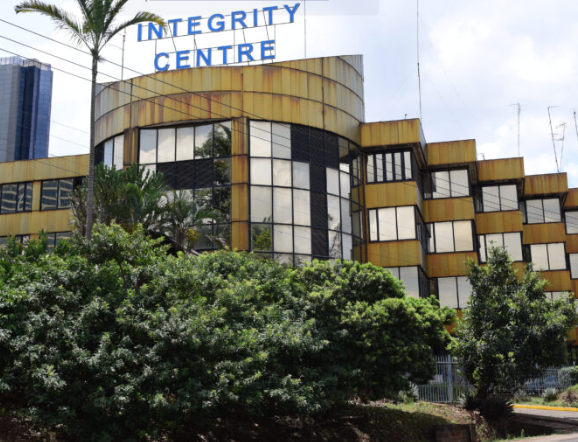
 EACC headquarters at Integrity Centre/FILE
A new survey has revealed stark gender differences in how Kenyans interact with corruption, with women more likely to bribe civil registration officials while men predominantly pay off police officers.
The findings are contained in the 2025 Kenya National Gender and Corruption Survey commissioned by the Ethics and Anti-Corruption Commission (EACC).
The survey sought to generate gender-disaggregated data to inform anti-corruption strategies and deepen understanding of how corruption affects men and women differently.
According to the report, 30.8 per cent of female respondents admitted to giving bribes to civil registration officials, compared to a significantly higher 41.6 per cent of male respondents who reported bribing police officers.
The data highlights a clear gendered pattern in the type of public officials most frequently associated with bribery.
“The survey findings reveal that corruption experiences are not uniform and are influenced by gender roles and interactions with public institutions,” the report states.
The study further breaks down bribery patterns by age, showing that young adults are among the most affected.
Among service seekers aged between 18 and 24 years, more than half-51.4 per cent-reported offering bribes to civil registration officials, while 41.6 per cent said they had bribed police officers.
A similar trend is evident in other age groups. Among those aged 25 to 34 years, 42.2 per cent reported bribing police officers, compared to 32.6 per cent who paid civil registration officials.
Respondents aged 50 to 64 years also followed this pattern, with 29.9 per cent bribing police and 26.4 per cent civil registration officials.
For those aged between 35 and 49 years, police officers remained the top recipients of bribes at 38.4 per cent, followed by land registry officials at 30 per cent.
Among older respondents aged 65 years and above, immigration officers were the most cited recipients of bribes at 37 per cent, followed by officials from the National Transport and Safety Authority (NTSA) at 33 per cent.
Despite the differences in where bribes are directed, the report notes that the financial burden is nearly identical for both genders.
Men pay an average bribe of Sh6,748, while women pay slightly less at Sh6,702.
“There is no significant disparity in the average cash bribe paid by men and women, suggesting that while experiences differ, the financial cost of corruption is equally burdensome,” the report notes.
The survey paints a broader picture of systemic corruption deeply embedded in service delivery. An overwhelming 84.3 per cent of bribes are paid before services are rendered, pointing to what the report describes as “gatekeeping corruption.”
Cash remains the dominant mode of bribery, accounting for 72.2 per cent of transactions, followed by mobile money transfers at 10.5 per cent.
The EACC warned that corruption continues to disproportionately affect the poor and vulnerable, who are often forced to part with a larger share of their income to access basic services.
Women, in particular, face compounded challenges. Beyond the financial burden, corruption limits their access to essential public services and reduces their participation in economic and political processes.
The survey adopted a cross-sectional mixed-methods design, combining quantitative and qualitative approaches, with data collected at a single point in time from Kenyan adults aged 18 and above using CAPI on CSPro-enabled tablets, complemented by 20 Focus Group Discussions across 10 counties.
Seven Key Informant Interviews, and secondary data, while a two-stage stratified cluster sampling design based on the Kenya Household Master Sample Frame produced a nationally representative sample of 22,005 households, with data cleaned, validated, and triangulated to support gender-disaggregated analysis.