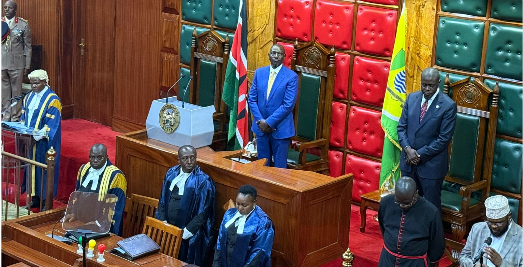
 President William Ruto addresses Nairobi county assembly /HANDOUT
President William Ruto on Thursday etched his name into Kenya’s devolution history books after becoming the first sitting head of state to formally address a county assembly since the advent of devolved governance in 2013.
His address of the Nairobi City County Assembly was termed more than ceremonial.
For the first time since the 2010 Constitution created 47 county governments and shifted significant power from the national executive to local administrations, a President stood before members of a county legislature to lay out a joint vision for the capital.
“Today marks 13 years after the birth of devolution under the constitution of Kenya, I stand before you as the first president and head of state to address the county assembly, ” Ruto said in a packed chamber at City Hall, Nairobi.
Devolution was designed to cure decades of over-centralisation by transferring resources, decision-making and accountability to counties.
Yet relations between national and county governments have often been marked by turf wars, funding disputes and political rivalry.
Ruto’s appearance before the assembly signalled an attempt to reset that relationship at least in the capital.
His address followed a cooperation agreement signed in February between the national government and Nairobi county, a framework he insisted was not a takeover of devolved functions but a structured partnership to fix long-standing urban challenges.
“Nairobi is the engine of our economy, the face of our nation and the standard by which much of the world judges Kenya,” he said, framing the capital’s renewal as a national duty rather than a county concern.
He announced the formation of intergovernmental sub-committees covering legal affairs, finance, governance, infrastructure, urban planning, environment, water and sanitation to align projects under the cooperation deal.
The President then rolled out an ambitious slate of interventions.
He said daily water supply would increase by 50,000 cubic metres through joint investments.
A 27-kilometre trunk sewer line along the Nairobi River corridor and a 60,000 cubic metre treatment plant are planned to strengthen sanitation.
On roads, Ruto cited a 247-kilometre urban upgrade programme, with 63 kilometres already under construction, alongside drainage works in flood-prone areas.
Solid waste management, long emblematic of Nairobi’s dysfunction, will receive Sh2 billion annually from the national government, he said, alongside the establishment of a 100-acre Material Recovery Facility and expanded transfer stations.
The core waste system, he added, should be operational within three months.
One of the most politically resonant pledges concerned Gikomba market, East Africa’s largest open-air trading hub. Ruto said traders had personally appealed for dignified infrastructure after years of flooding and fires.
The national government will invest Sh800 million in the first phase of its upgrade, followed by Sh3.8 billion and Sh5 billion in subsequent phases.
Beyond bricks and mortar, Ruto unveiled plans for a Nairobi Metropolitan Police framework featuring expanded CCTV coverage, digital occurrence books and the integration of data analytics and artificial intelligence into urban security management.
Throughout the speech, he challenged MCAs to support reforms and confront entrenched interests.
“Leadership is not tested when decisions are easy,” he said. “It is tested when they are right.”
Historically, presidents have addressed Parliament as the national legislative arm.
Thursday’s address extended that tradition into the devolved space, underscoring Nairobi’s unique political and economic weight.
As Kenya’s capital and commercial nerve centre, Nairobi contributes a significant share of the country’s GDP and hosts national institutions, diplomatic missions and regional headquarters.
Ruto’s appearance before the assembly therefore carried symbolic weight, a recognition that the success of devolution and the credibility of national leadership is closely tied to the fortunes of the capital.
Whether the promised transformation materialises will depend on execution, funding discipline and sustained cooperation.
But as a constitutional moment, Thursday’s address marked a visible bridging of two levels of government that have often operated in parallel.