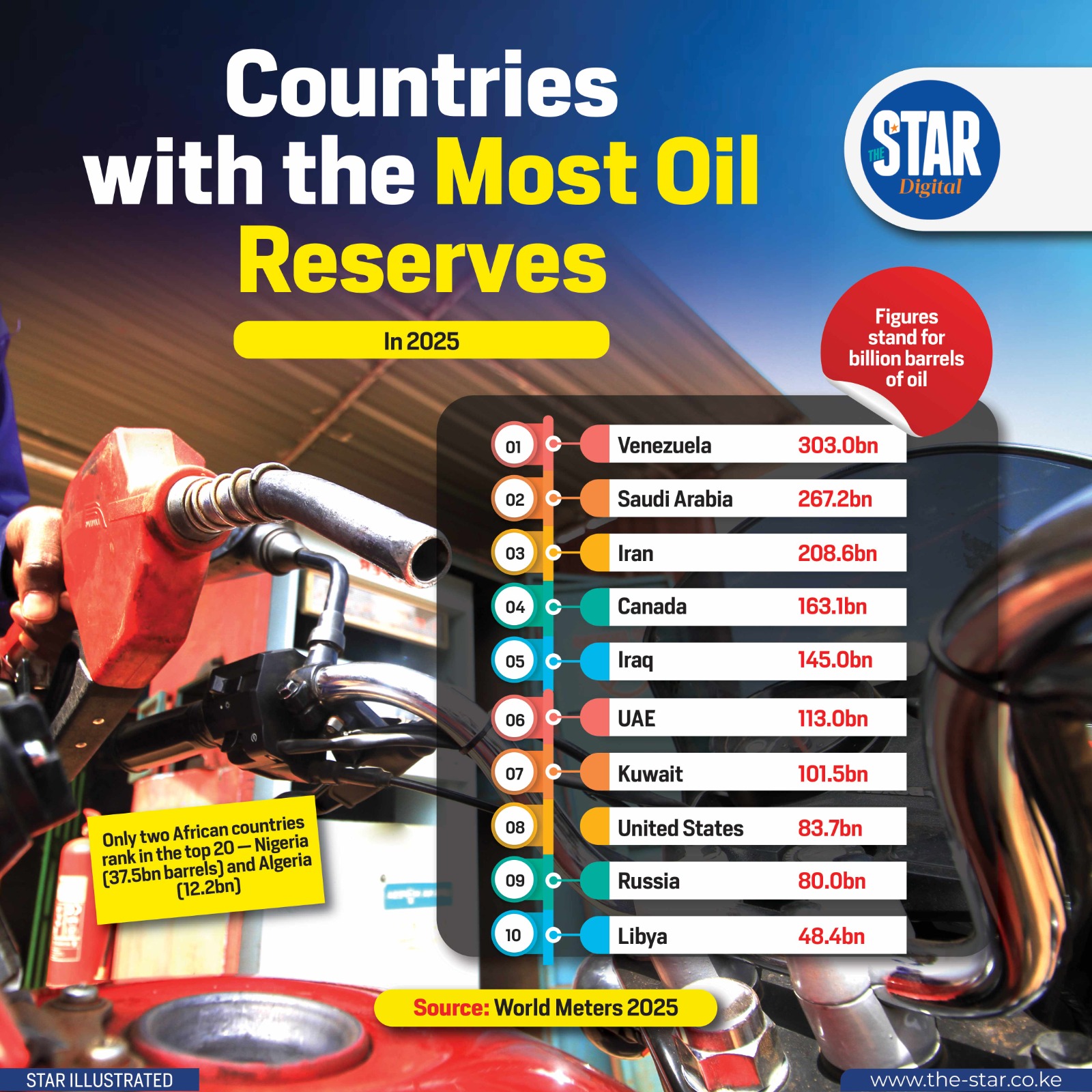
The global landscape of proven oil reserves remains concentrated in a handful of nations, with 2025 data revealing a stark hierarchy of energy wealth.
Venezuela continues to hold the world’s largest oil reserves at 303 billion barrels, closely followed by Saudi Arabia with 267.2 billion barrels.
Together, these two nations represent the pinnacle of global crude storage, though their ability to influence markets depends as much on infrastructure as it does on the oil beneath their soil.
Iran and Canada occupy the third and fourth positions, holding 208.6 billion and 163.1 billion barrels, respectively.
The remainder of the top ten is dominated by Middle Eastern producers—Iraq (145bn), the UAE (113bn), and Kuwait (101.5bn)—alongside the United States (83.7bn), Russia (80bn), and Libya (48.4bn).
From a continental perspective, the data highlight a significant gap for Africa. Despite the continent's vast size, only two African nations currently rank within the global top 20 for oil reserves.
Nigeria leads the continent’s contribution with 37.5 billion barrels, followed by Algeria with 12.2 billion barrels. This concentration of oil wealth in specific geographic pockets—primarily the Middle East and South America—continues to define the geopolitical leverage these nations hold in an era where fossil fuels remain the primary driver of global transport and industry.





Comments 0
Sign in to join the conversation
Sign In Create AccountNo comments yet. Be the first to share your thoughts!