Thirteen state agencies, including the State House, the Judiciary and the National Police Service, operated secret security funds with weak oversight, a fresh audit has revealed
The findings come as government spending on the security sector — the largest consumer of confidential expenditure — surges to record levels.
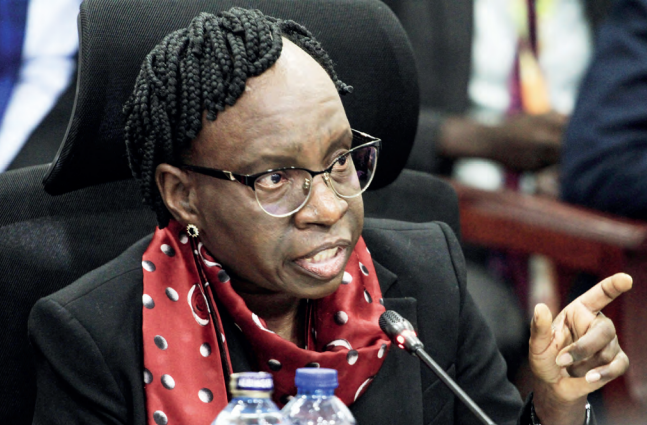
In a new report, Auditor General Nancy Gathungu says none of the agencies allocated confidential funds has implemented her previous recommendations aimed at tightening accountability over the billions.
The latest audit, covering the period to June 30, 2025, raises concerns over spending across the 13 state agencies, including the Office of the President.
Others cited are the Office of the Deputy President, the National Police Service, the State Department for Internal Security, the National Intelligence Service and the Ministry of Defence.
Also flagged are the State Department for Foreign Affairs, the Mining department, the Judicial Service Commission, the Ethics and Anti-Corruption Commission (EACC) and the Office of the Director of Public Prosecutions.
The revelations come just days after Parliament approved an additional Sh42 billion for security agencies, further fuelling concerns over rising allocations to the sector.
In the supplementary budget, the National Intelligence Service received an extra Sh10 billion, pushing its annual allocation to Sh61.4 billion — a 20 per cent increase.
The National Police Service was allocated an additional Sh7.5 billion, bringing its total budget to Sh135 billion.
In her report, Gathungu warns that the agencies are drawing from classified budgets with limited transparency and unclear accountability structures.
Confidential votes are funds set aside for sensitive security operations and are typically shielded from public disclosure.
The exact allocations to individual agencies remain unclear.
While such spending is legally permitted, the Auditor General says the governance framework guiding their use remains weak and poorly defined.
Confidential votes have in many parts of the world been an avenue for corruption.
The audit cautions that the funds are not adequately accounted for, raising the risk of misuse due to the absence of strict oversight rules.
Gathungu noted that the agencies had failed to act on recommendations made in the previous financial year, even as allocations continue to rise.
She called for a review of regulations to strengthen accountability, including clearly defining which agencies qualify for confidential security expenditure and what constitutes legitimate security-related operations.
The Auditor General also recommended the establishment of internal oversight mechanisms and called on agencies to provide detailed budget projections and post-operation financial reports.
These documents, meant to enhance accountability without compromising national security, were to be submitted to auditors alongside the requisite certification.
However, the latest audit shows that none of the agencies has complied, raising fresh concerns over the management of public funds.
“The measures were aimed at strengthening governance, fostering trust, and ensuring funds are utilised responsibly without compromising state security,” Gathungu said.
“As at the time of the audit, no action had been taken to implement the audit recommendations,” the auditor said in her report.
The latest audit reviews were conducted in November and December 2025.
According to the report, the expenditures were only backed by certificates of confidential expenditure and accounting officer declarations affirming compliance with the law.
She made the same conclusion for the Executive Office of the President, the Office of the Deputy President, State House, the National Police Service, the Internal Security Department, and the Defence Ministry.
Auditors established that the departments of Foreign Affairs and Mining had yet to implement the required measures.
It emerged that the Judiciary also incurred some expenditures on confidential security operations, but did not properly account for the same.
“In the circumstances, the measures that are aimed at strengthening governance, fostering trust, and ensuring funds are utilised responsibly without compromising state security could not be confirmed,” Gathungu said.
The report paints a picture of a system heavily reliant on trust, with minimal independent verification and no clear, standardised criteria across agencies.
The auditor says a review of the Public Finance Management (National Government) Regulations, 2015, to clearly define eligible entities is long overdue.
Spending under the confidential vote has ignited public scrutiny, with observers casting aspersions they could be diverted to other non-priority businesses.
The continued inaction now raises serious concerns about the state’s commitment to tightening oversight over billions of shillings in classified expenditure.
Concerns have been rife that the funds were prone to misuse by the recipients, including by Members of Parliament.
MPs have been pushing for members of the security committee to be granted access to details of the expenditures.
It remains unclear what each of the flagged entities received as confidential votes, but the amounts are usually masked as “other operating expenses”.
The budgetary allocations run into tens of billions, a chunk of which is held by the presidency and the security agencies.
The figures usually dwarf allocations to hospitality, travel, and sometimes salaries, even as auditors decry the trouble with accessing the books.
A bill is before MPs which seeks to, among others, remove the shield that the entities that enjoy the vote have been using to beat scrutiny.
The Finance Committee-backed Public Audit Bill of 2024 seeks to undo the lengthy bureaucratic processes set for the Auditor General to check the secret spending.
In the current dispensation, the auditor has to hold inception meetings “to agree (with the agencies) on the areas to audit”.
The meeting is to determine the appropriate audit approach and issues that touch on national security.
The law further provides that the reports touching on national security organs may be redacted to protect the identities of persons and assets.
Staff from the Office of the Auditor General dispatched to look at the books also have to be vetted.
Watchdog agencies such as Transparency International have cited the current provisions as unconstitutional.
In an earlier submission to Parliament, TI argued that the Auditor General is mandated to audit all state organs and public bodies funded by taxpayers.
TI said vetting auditors “could potentially compromise the independence and integrity of the audit process.”
The National Assembly Finance Committee, chaired by Molo MP Kuria Kimani, had recommended the changes, saying the current law ‘stifled auditors’ independence’.
A 2024 court ruling also agreed that the office of the Auditor General needed no permission to carry out audits.
The revelations are likely to trigger renewed scrutiny from public watchdogs and oversight committees tasked with monitoring public spending.
In many jurisdictions, confidential expenditures are reviewed by select parliamentary committees or independent bodies under strict secrecy rules.