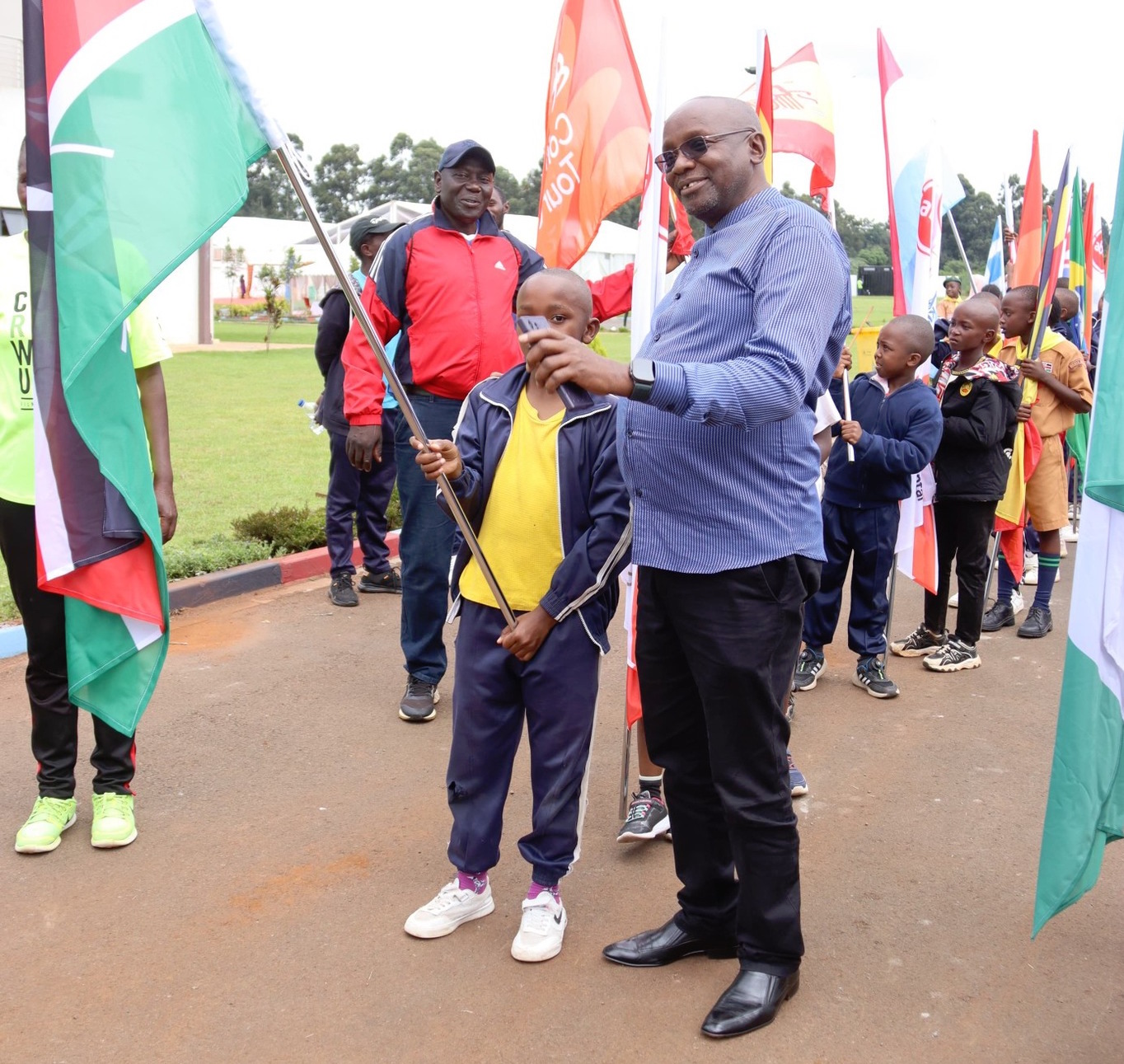
 Barnaba Korir with junior runners during a past event/HANDOUT
Balancing influence across two of Kenya’s most powerful sports bodies is no small task.
Yet for Barnaba Korir, who holds multiple roles across Athletics Kenya (AK) and the National Olympic Committee (Nock), the real challenge doesn’t lie in the titles but in delivering opportunities for young athletes within a system stretched by expectations, limited resources and growing scrutiny.
Korir is an executive committee member at AK, chairs the AK Youth Development Committee and is the AK Nairobi region boss. At Nock, he is one of two deputy presidents.
These roles put him at the intersection of grassroots development and elite sport, positions that offer influence — but also demand results.
“At the grassroots level, the biggest challenge is not identifying talent but in sustaining that talent and ensuring that young athletes move through the system up to the elite level,” he says.
And even though Kenya is globally renowned for its athletics dominance, Korir says the journey from schoolyard promise to international podium is far from guaranteed, pointing to structural gaps that continue to hinder progress, even as talent remains abundant.
“We have worked closely with the Ministry of Education to align school programmes with athletics development, and we have trained teachers to handle the sport at that level,” he says. “That has helped build a strong base.”
He observes that in addition to schools, communities have increasingly taken ownership of athletics development, with local competitions now drawing young athletes and senior runners, creating an environment where talent is nurtured and inspired at the grassroots.
In many areas, it is no longer just about schools. Communities are organising events themselves, and that is how you build awareness and interest,” he adds. Yet, even with these gains, the system faces persistent strain.
Korir is candid about the challenges: where funding, governance and structure are deeply intertwined—and none can be ignored. “All of them are important,” he says. "You cannot have one without the other. But governance is key because it determines how well the resources are utilised.”
Kenyan sport has long relied heavily on government funding, a model Korir believes is no longer sustainable. Delays in the disbursement of funds, he notes, often place sports events organisers under immense pressure—sometimes right up to the eve of championships.
“The most difficult moments are when resources come at the last minute. You are preparing a major event, everything is in place, but you are waiting for funding. That is always very stressful,” he admits.
To ease this burden, Korir is pushing for a shift toward stronger private sector partnerships.
“We must build trust with sponsors. They need to see that the money they give is used properly and that there are results,” he says. “If we can bring in sponsors, like we have Absa Bank at Kip Keino Classic, then we reduce the pressure on the government and create a more sustainable model.”
Korir says joining Nock has widened his scope beyond track and field. From this vantage point, he is championing a more collaborative approach across federations.
“The Olympic Committee is an umbrella body. Our role is not to control federations, but to guide and support them,” he explains. “We want every federation to grow and to share ideas, especially on grassroots development.”
Already, he notes, other sports are beginning to replicate athletics’ grassroots structures — an indication of the broader impact of these systems. “We are seeing more competition across the country, more participation, and more interest from the public. That is how sport grows," he says.
Despite his multiple roles, Korir insists there is no conflict — only the challenge of time management — with his leadership philosophy centred on delegation and empowerment.
“The roles complement each other,” he says. “The only challenge is time. But you solve that by empowering your teams. You cannot build a system that depends on one person.”
Within AK’s youth structures, he notes, programmes now run independently. “If I am not there, things will still move. That is how you build sustainability,” he adds.
Eve before ascending to his role at Nock, Korir has been involved in the organisation of numerous international championships in Kenya, including the 2017 World U20 Championships, the 2018 World U20 Championships, the Kip Keino Classic, the Nairobi City Marathon, and the Sirikwa Classic — a World Athletics Cross Country Gold Tour event.
Meanwhile, Korir observes that the smooth sail witnessed during these live broadcast events is often a result of long planning hours, sleepless nights and mobilisation efforts.
From coordinating international officials to assembling technical equipment under tight timelines, the process is fraught with risk. “People see a smooth event, but they don’t see what happens behind the scenes,” he says. “You are coordinating many moving parts, and sometimes you are dealing with issues just hours before the event.”
And while most believe success in sports must culminate in medals, Korir insists that a single metric measure is misinformed. It is a balance between participation, development and performance.
“You must have athletes qualifying, you must grow the talent base, but ultimately, you must win medals,” he says. He is confident Kenya is on the right path in development and uptake of sports, highlighting increased public interest, expanding infrastructure and a growing appreciation of sport as an economic and social tool. “If we invest properly in sport, it can transform lives, engage young people and even drive economic growth,” he says.
However, he is clear that one element remains crucial: the fans. “You can have the best athletes, but without fans in the stadium, it means nothing. We must build a culture where people come out to support sport.”