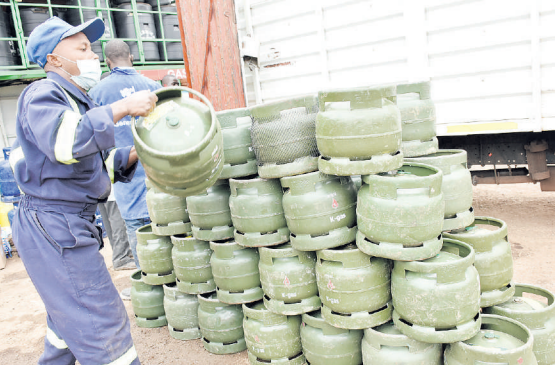
Kenya's push towards clean cooking is gaining momentum with liquefied petroleum gas (LPG) emerging as the fastest-growing fuel segment, petroleum sector data shows.
Latest data by the Petroleum Institute of East Africa (PIEA) shows that LPG consumption rose by 14.7 per cent to 475,943 metric tonnes in 2025, building on an equally strong 15.1 per cent growth recorded in 2024, when demand reached 414,861 tonnes.
Key drivers included government zero-rating of LPG and the National LPG Growth Strategy as well as household shift from kerosene or biomass.
Kerosene consumption has declined sharply in recent years for instance a 41 per cent drop in 2024 period.
“However in 2025, there was a marginal uptick (rare increase) of 18.9 per cent in 2025 driven by thermal power generation (Muhoroni plant). Not indicative of household demand recovery. Long-term decline of kerosene continues due to LPG uptake and electrification,” PIEA said in its Q1 2026 report.
Energy and Petroleum Regulatory Authority, director for petroleum and gas, Edward Kinyua, said the regulator continues to streamline the sector including curbing illegal refilling and increasing cylinder capacity by dealers while improving tractability.
“Whoever comes to the industry must show the level of seriousness that is desired so that, one, we can assure public safety, and two, we can assure business for the people who are within the system,’ Kinyua said, “The market is big. Today, we are talking about 7.6 kilos per capita.”
The government’s LPG agenda, which also targets lerning institutions and government installations, seeks to enhance penetration from the current 24 per cent to 70 per cent by 2028.
In 2023, Treasury exempted cooking gas from Value Added Tax (VAT), the 3.5 per cent Import Declaration Fee (IDF) and the two per cent Railway Development Levy (RDL) to promote its use and reduce reliance on charcoal.
“We are looking at doubling consumption so that we have at least 15 kilos per capita. Government is planning to introduce an additional 10 million cylinders in the market. Discussions on how those cylinders will be introduced are ongoing and how the distribution model will be,” said Kinyua.
However, industry players and consumer lobby groups now warn that recent tax increases risk undermining these gains, potentially reversing progress made under government-backed incentives.
The Consumer Federation of Kenya (Cofek) has strongly opposed the Petroleum Development Levy (Amendment) Order, 2025, which introduced a new tax regime on petroleum products, including LPG.
The levy imposes a charge of Sh5,400 per 1,000 kilograms of LPG—effectively increasing the cost of cooking gas for consumers.
COFEK secretary general Stephen Mutoro has criticised both the substance and the process behind the levy, arguing that it was introduced through a gazette notice without adequate public participation or parliamentary oversight.
“The inclusion of LPG at this punitive rate is a direct contradiction of the government’s own clean cooking policy,” Mutoro said, warning that higher prices could push low-income households back to charcoal and firewood.
The lobby group argues that the levy exacerbates the cost-of-living crisis by raising energy costs across the board.
Cofek notes that fuel is key input in transportation, agriculture and manufacturing—meaning higher taxes ripple through the entire economy, ultimately pushing up the price of goods and services.
Data from the Kenya National Bureau of Statistics consistently shows transport costs as a leading contributor to the Consumer Price Index, making fuel levies a sensitive policy lever.
By extending the Petroleum Development Levy to LPG, critics say the government risks undermining years of progress in promoting clean energy adoption.
The zero-rating policy had previously helped lower entry barriers, enabling more households to afford LPG cylinders and refills.
“There is a clear policy inconsistency,” Mutoto said, “On one hand, the government is incentivising LPG uptake and on the other, it is increasing the tax burden on the same product.”
The broader concern is that Kenya’s fiscal framework has become increasingly reliant on fuel taxes as a source of revenue.
The government has continued to squeeze taxpayers to meet its budgetary obligations with nine different taxes being levied on fuel, the highest being the Road Maintenance Levy, which was increased to Sh25 per litre from Sh18.
Consumers also pay excise duty, VAT, Petroleum Development Levy, Petroleum Regulatory Levy, anti-adulteration levy and merchant shipping levy.
While petroleum levies are relatively easy to collect, their widespread economic impact makes them a blunt instrument, disproportionately affecting lower-income households.
Among its key proposals are a comprehensive audit of all fuel-related taxes, mandatory parliamentary approval for future levy changes, and a return to zero-rating LPG to align with clean energy goals.