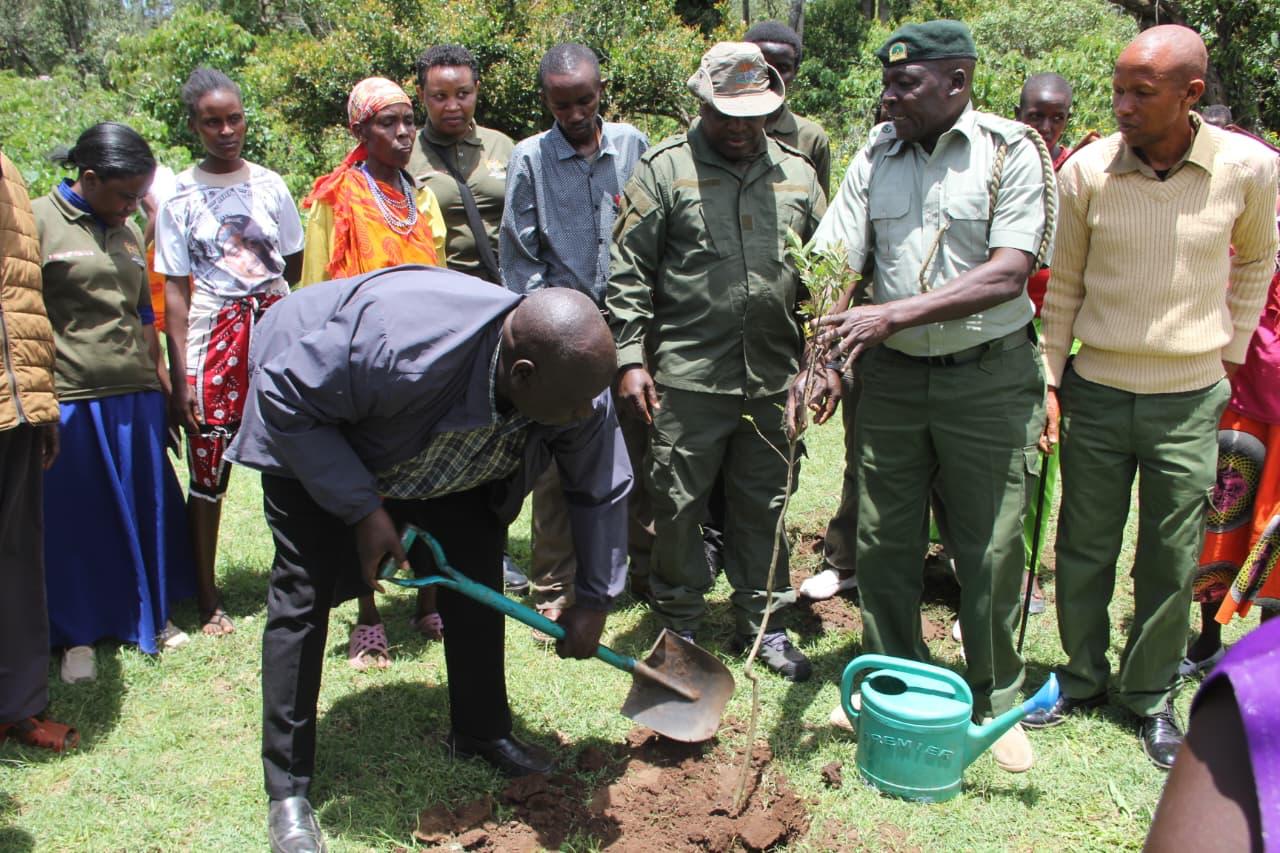
 A Laikipia resident plants a tree in Mukogodo forest during a conservation exercise aimed at restoring the forest as forest manager Kenneth Were (second right) helps on March 26, 2026/ ALICE WAITHERA
The government has launched an ambitious reforestation drive in Laikipia’s Mukogodo Forest, even as security agencies prepare a major operation to flush out bandits who have long used the vast woodland as a hideout.
At least 10,000 trees have been planted in the last two weeks in parts of the 74,000-acre indigenous forest, with officials warning that degradation caused by illegal occupation and destruction of tree cover threatens its ecological future.
“This forest is very critical. It’s a corridor for our wildlife linking the Mount Kenya ecosystem with the northern rangelands,” said Wildlife Principal Secretary Silvia Museiya.
Museiya described the forest as one of Kenya’s largest dry forests and a vital ecological bridge supporting buffaloes, leopards and over 200 bird species.
The drive is part of the state’s plan to upscale restoration efforts across the country and plant 15 billion trees by 2032.
During a tour of the forest earlier this week, Rift Valley Regional Commissioner Abdi Hassan issued a one-week ultimatum to all illegal occupants to vacate immediately ahead of a multi-agency crackdown spearheaded by the National Police Service (NPS) and the Kenya Defense Forces (KDF).
“Anyone found in the forest will be deemed a cattle rustler. These efforts are meant to restore security in this restive area and protect the forest from further destruction,” he said, vowing to make banditry a thing of the past.
The reforestation campaign spearheaded by the State Department for Wildlife under the Ministry of Tourism has brought together local communities, including the Yiaku, schools and the Community Forest Associations (CFA).
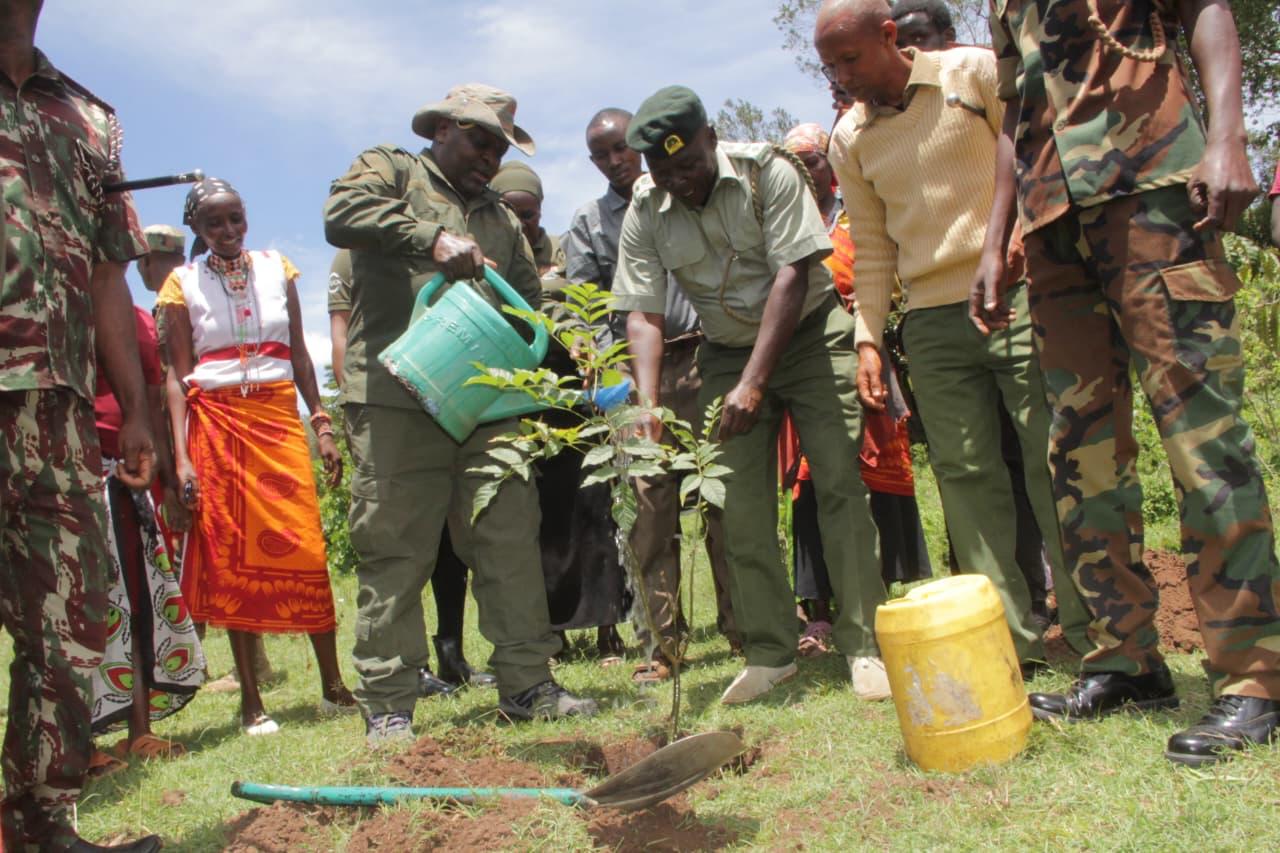 Vincent Ongere, the Director Administration in the state department for wildlife planting a tree in Mukogodo forest, Laikipia county/ ALICE WAITHERA
Vincent Ongere, the director of administration in the Wildlife Department, said the approach is aimed at ensuring conservation efforts are community-driven and sustainable.
Ongere added that similar initiatives have already been carried out in Lariak Forest and will extend to Chepalungu, Oloitoktok and Nyandarua forests.
“These are areas we are keen to conserve for the sake of our future,” he said.
Mukogodo Forest manager Kenneth Were underscored the uniqueness of the ecosystem, describing it as the only dry forest of its kind in the country.
“It is a complete ecosystem. It harbours wild animals, domestic animals and human beings. That is how unique it is,” he said.
Were noted that insecurity linked to banditry has hindered the development of eco-tourism potential within the forest but noted that the government’s effort to restore security will help accelerate the process.
The forest has seven sites that are yet to be developed and Were expressed confidence that investors will come in once security is restored as tourists will be able to carry out their activities freely.
Banditry in the forest has been part of a wider insecurity problem affecting parts of Laikipia county and the northern rangelands for years driven by a mix of cattle rustling, competition over resources and weak state presence in remote areas.
Mukogodo’s dense vegetation and vast size makes it an ideal hideout compounded by limited road access, allowing armed groups to operate with relative concealment.
Security agencies have repeatedly identified it as a base for bandits who launch attacks on nearby communities before retreating into the forest.
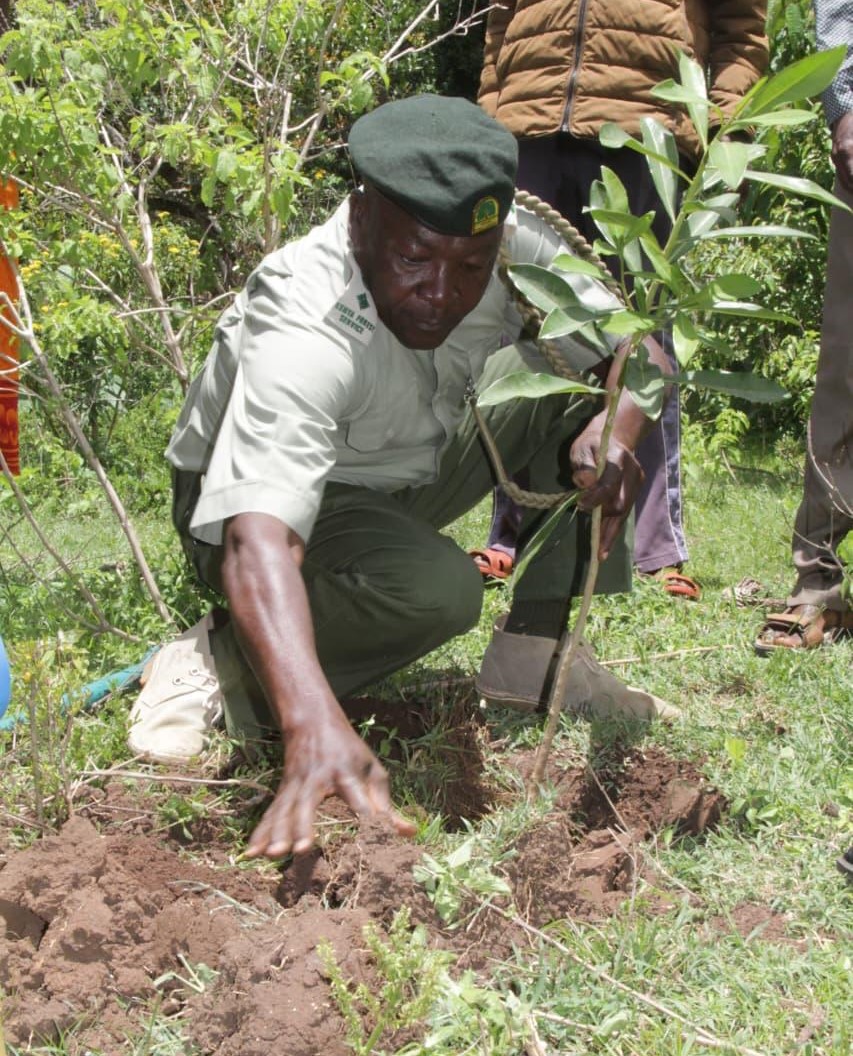 Mukogodo forest manager Kenneth Were planting a tree during a conservation exercise held on March 26, 2026/ ALICE WAITHERA
He also praised the Yiaku community for their role in conservation, citing their traditional knowledge systems.
“They live in harmony with the forest. If you destroy the forest, elders can curse you and this belief has helped conserve it,” he added, blaming external actors for illegal logging and sand harvesting.
The renewed conservation push builds on years of efforts to protect Mukogodo, a forest with deep historical and ecological significance.
The forest was first gazetted as a reserve in the early 20th century and formally protected under legal notices issued in the 1930s and 1960s.
It is one of Kenya’s few remaining dry forests and forms a critical wildlife corridor linking Laikipia, Samburu and the Mount Kenya ecosystems, supporting dozens of mammal species and hundreds of bird species.
For centuries, the forest has been home to the Yiaku, a minority hunter-gatherer community that depended on it for food, medicine and cultural practices before it was declared a state forest reserve in 1932.
Today, Mukogodo remains a rare example of coexistence between people, wildlife and forest ecosystems, though it faces mounting pressure from deforestation, overgrazing and insecurity.
“This is the habitat for our animals. It is where they get food and shelter. We’re working with the community to ensure they also participate and benefit from the forest,” Were added.
Namai Saikon, a member of the Yiaku community, confirmed that they lived in the forest for years, living in caves and feeding from the forest.
“We didn’t have houses. We’re happy that you have brought us trees so we can have more food in future. We will get fruits and honey out of it,” she said.