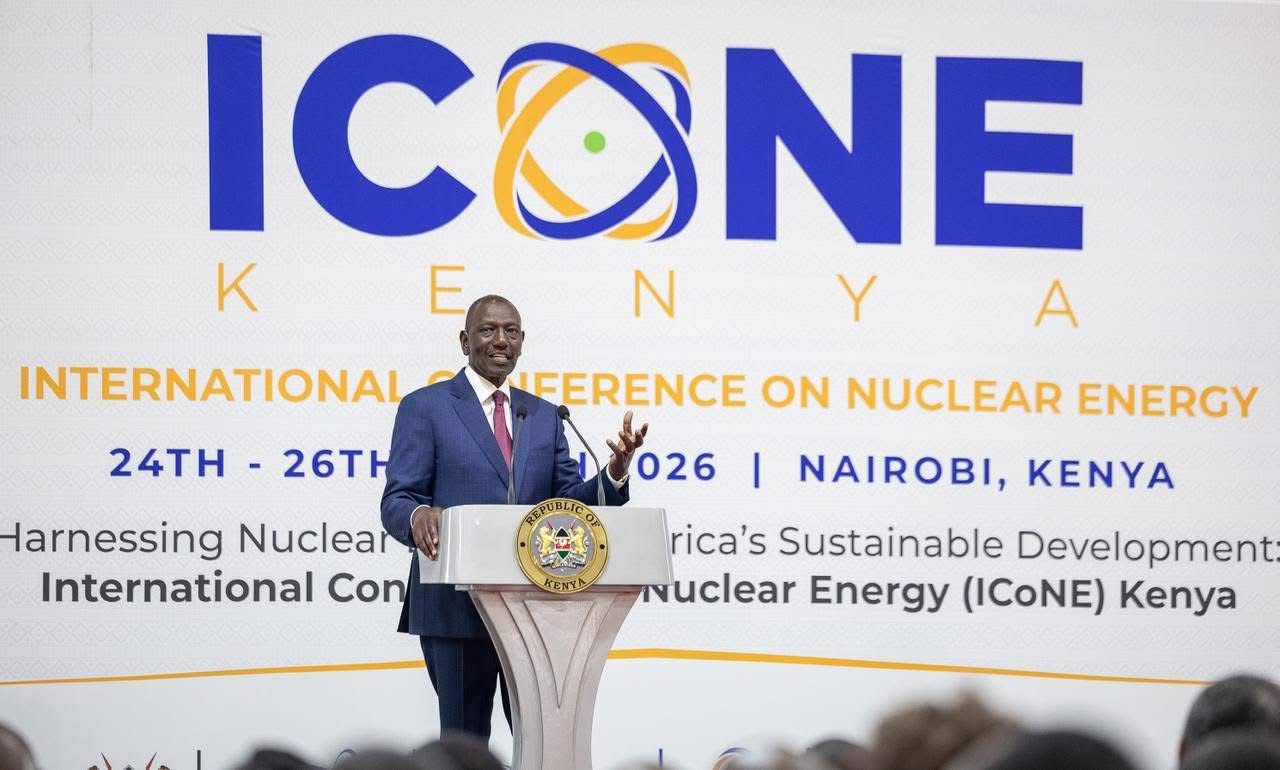
President William Ruto has announced that Kenya will begin constructing a 2,000-megawatt (MW) nuclear power plant in Siaya County in 2027, with the facility expected to be commissioned by 2034.
The President said Kenya is committed to increasing its installed electricity capacity from the current 3,300MW to at least 10,000MW over the next five to seven years, with 3,000MW of this capacity to come from nuclear energy.
Speaking on Wednesday during the International Conference on Nuclear Energy in Nairobi, President Ruto noted that the project would generate significant economic opportunities for locals.
“We have made a deliberate and strategic decision to significantly expand our energy capacity. From our current installed capacity of 3,300 megawatts, we are committed to scaling up to at least 10,000MW in the next five to seven years, 3,000MW of which will be generated from nuclear energy,” the President said.
“Consequently, Kenya plans to commence construction of a 2,000MW nuclear power plant in Siaya County next year (2027), with commissioning of the project expected in 2034.”
The President outlined the key benefits of nuclear energy, emphasising its role in providing clean and reliable power.
“The word ‘nuclear’ often evokes fear and uncertainty, and I understand why. However, this perception is not supported by evidence. Nuclear energy has been safely and reliably used for decades by the world’s most advanced economies to power development.”
“Nuclear energy produces virtually no greenhouse gas emissions, making it a powerful ally in our fight against climate change.”
According to the President, it also operates round the clock, providing a stable supply of electricity that is crucial for industrial growth and grid stability.
“During peak construction, the nuclear plant will create between 5,000 and 12,000 jobs, ranging from manual labour to highly specialised engineering roles,” he said.
“Once operational, it will provide hundreds of permanent, well-paying technical positions.”
The government plans to invest in local technical and vocational education to equip residents with the skills needed for these opportunities.
President Ruto also assured that infrastructure development in Siaya County would accompany the project.
“We will expand all-weather roads, improve water supply systems, build modern healthcare facilities and schools, and enhance telecommunications,” he said.
“The project will also stimulate the local economy by increasing demand for housing, hospitality, retail, and agricultural produce.”
Ruto added that it will have an operational lifespan of 60 to 80 years and a capital recovery period of less than 20 years.
He said nuclear power will significantly reduce electricity costs by 4 to 5.5 US cents per unit, strengthening Kenya’s energy security and supporting sustainable development for generations to come.