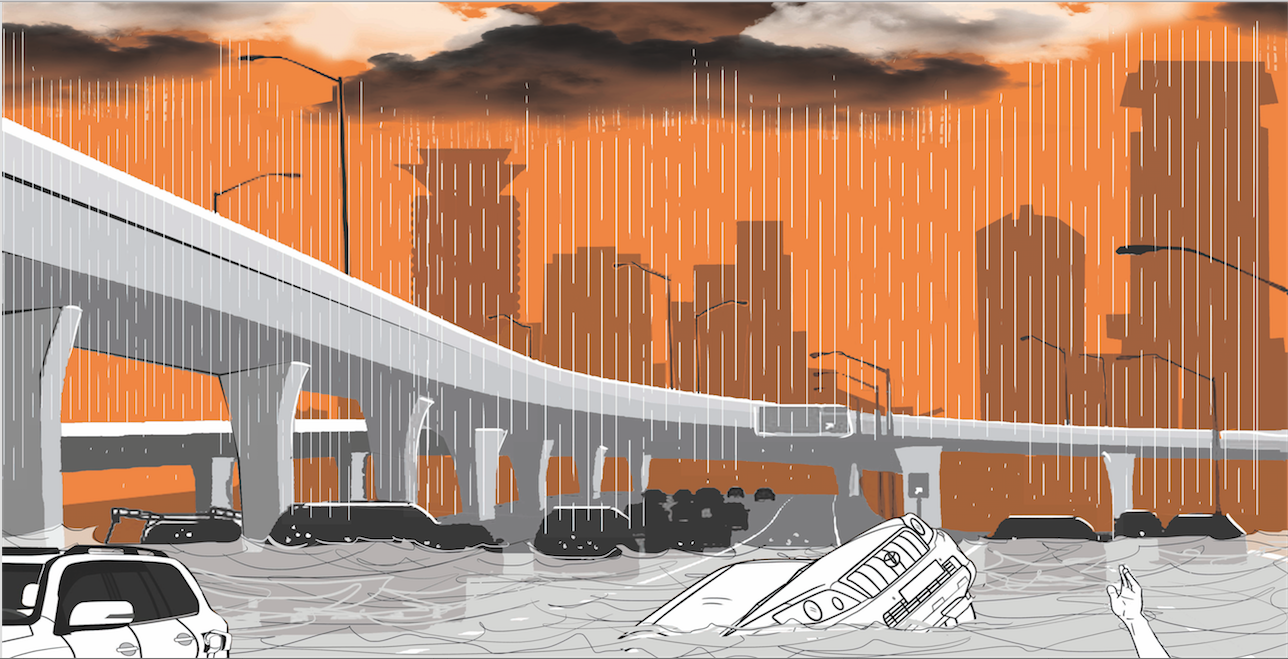
A city drowned in 160 millimetres of rain, leaving at least 60 people dead, thousands displaced, vehicles swept away like toys and entire neighbourhoods submerged. The narratives that followed were predictably meteorological: "Worst rainfall in decades," "Climate change strikes Kenya," "Nature's fury".
Was this a meteorological phenomenon or failures of soil and water management?
While extreme rainfall is becoming more frequent and intense due to climate change, the severity and human cost of floods are amplified by soil and hydrological degradation that extends far beyond the meteorological trigger.
The Water Cycle
The Water Cycle (also called the Hydrological cycle) is the continuous movement of water between the Earth’s surface, atmosphere and underground. Water evaporates from oceans, lakes and rivers due to heat from the sun, forming water vapour that rises into the atmosphere. It cools and condenses into clouds, then falls back to Earth as precipitation such as rain.
The water on the soil surface may either infiltrate or run off, if the rate of rainfall exceeds the infiltration rate. The water then collects in bodies of water, eventually flowing back to the oceans, repeating the cycle. Normal infiltration rate in healthy soils ranges from 50 to 100 millimetres of rain per hour. This means that typical rainfall events, even heavy ones, are naturally absorbed into the soil profile.
Therefore, to understand urban flooding, we must conceptualise soil and its role in the hydrological cycle. Soil is a living, dynamic system that mediates the movement of water through landscapes. The capacity of soil to absorb, store and transmit water is determined by physical properties such as texture (the proportion of sand, silt and clay), structure (the arrangement of soil particles into aggregates), porosity (the volume of pore spaces) and hydraulic conductivity (the rate at which water moves through soil body).
To contain flooding in urban areas two things must happen: intentional provision of rainwater infiltration zones, which are usually reserved as green parks and construction and maintenance of artificial waterways and drainage channels.
Diminishing rainwater infiltration zones
Poor artificial waterways and drainage channels are often cited as the main cause of flooding in our cities. However, a greater problem, which is less acknowledged, is the diminishing infiltration zones due to wanton encroachment.
Urban expansion in Nairobi and other cities has reduced some green areas because of infrastructure projects and real-estate development, even though these spaces were originally planned as public recreational parks or forests, hence, serving as the rainwater infiltration zones.
The City Park, set aside as a public park in 1925, has been encroached on by private developments, religious buildings and other structures over time. Some redevelopment projects have added more built infrastructure in Uhuru Park, reducing the natural green space.
Parts of the Karura forest host several developments, thereby reducing green space. Sections of the Oloolua forest reserve have faced encroachment and development pressure. Some portions of Uhuru Gardens are now paved and host a national monument complex.
We must stop accepting the narrative that extreme rainfall is an uncontrollable act of nature that cities must simply endure. Yes, climate change is intensifying rainfall events, but diminishing rainwater infiltration zones is the most critical, yet largely invisible soil and water management cause of urban flooding, especially in Nairobi.
Cities in the rest of the world experience comparable rainfall intensities with dramatically lower casualties and disruption. Why? Because their urban design, soil management, drainage infrastructure and building codes are engineered to accommodate water movement either by rainwater infiltration or artificial waterways and drainage channels.
For decades, we have permitted development that destroys soil infiltration capacity, neglects drainage systems and allows clogged culverts and channels to remain choked with sediment and litter. We have designed our own disasters and then blamed the weather.
Urban drainage systems are an extension of the soil hydrological function. Where natural soil infiltration capacity has been destroyed by urbanisation, drains, culverts, storm sewers and retention basins become essential.
The lives we lost in floods did not die from rain. They died from poor choices. These choices can be unmade.
The solution requires restoration of the soil function, upgrading drainage infrastructure with explicit reference to soil properties and regulating urban development to protect infiltration and water movement through landscapes.
The writer holds a PhD in Soil Science, specialising in Soil Physics from Egerton University and is the Vice Chancellor and CEO of KCA University