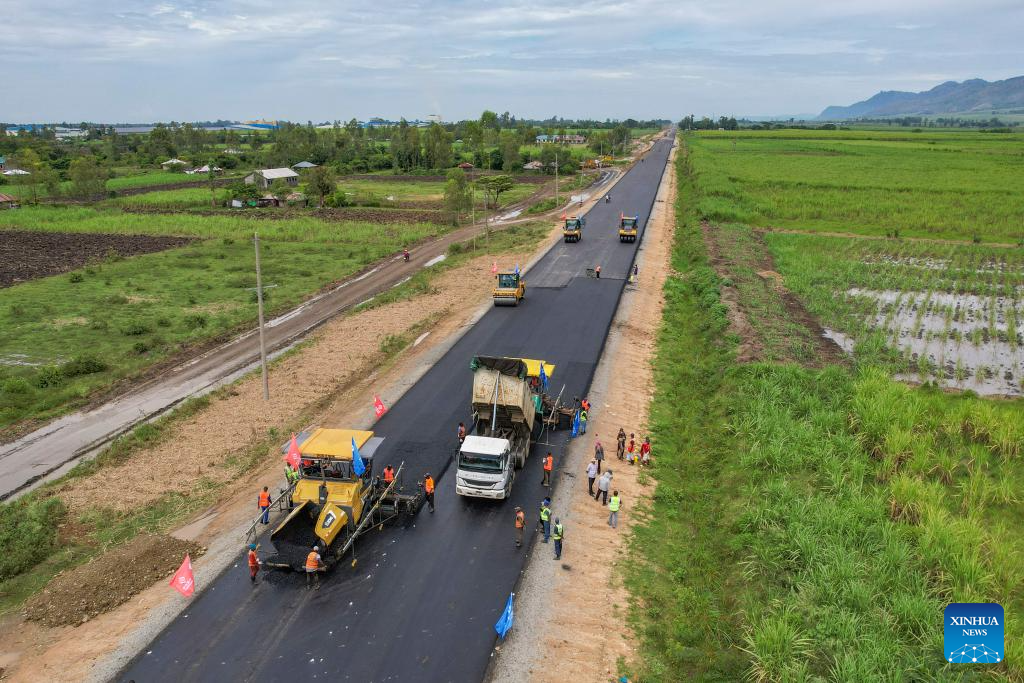
 An aerial drone photo taken on Feb. 27, 2026 shows construction vehicles and workers of Power Construction Corporation of China operating at the construction site of the second section of the Kisumu-Muhoroni highway project in a major sugarcane-producing area of Kisumu County, Kenya. Located in Kisumu County, a key economic and transport hub in western Kenya, the area is well known for sugarcane cultivation and sugar production. A road project undertaken by Power Construction Corporation of China (PowerChina) is now bringing visible change to the region. (Xinhua/Xie Jianfei)
The global business landscape is undergoing a quiet yet profound transformation, and one of the most significant drivers of this change is the deepening economic relationship between China, Kenya, and the wider African continent.
What began years ago as largely infrastructure-focused engagement has steadily evolved into a multifaceted, strategic partnership that is redefining Africa’s place in global commerce. This shift is not accidental—it reflects a growing alignment of economic interests, development priorities, and long-term vision among the partners involved.
At its core, this relationship is built on a principle that has often been missing in traditional development models: mutual growth through practical collaboration. For many years, African economies were encouraged to prioritize macroeconomic stability without equivalent emphasis on building productive capacity. The result was a cycle of dependency on raw material exports and limited industrial progress. The China-Africa partnership has introduced a more pragmatic approach—one that prioritizes infrastructure, industrialization, and trade as the engines of sustainable development.
Kenya stands out as a clear example of how this model can deliver tangible results. As East Africa’s economic hub, the country has leveraged Chinese investment and expertise to strengthen its infrastructure backbone, thereby enhancing its competitiveness. Flagship projects such as the Standard Gauge Railway have significantly improved connectivity between the port of Mombasa and inland regions, reducing transport costs and facilitating the movement of goods. This is not merely about convenience; it is about enabling businesses to operate more efficiently and opening up new economic corridors that stimulate growth across multiple sectors.
Beyond infrastructure, the partnership is increasingly defined by a shift toward industrial development and value addition. Chinese enterprises are actively investing in manufacturing, special economic zones, and technology-driven industries across Africa. In Kenya, these investments are contributing to the expansion of sectors such as textiles, construction materials, and electronics assembly. This transition is critical because it moves the continent away from exporting raw materials toward producing finished goods, thereby capturing more value within local economies.
Africa’s demographic dynamics further underscore the importance of this transformation. With a rapidly growing and youthful population, the continent faces both a challenge and an opportunity: the need to create millions of jobs in the coming decades. Industrialization offers one of the most viable pathways to achieving this goal. China’s own development journey—marked by large-scale manufacturing growth and poverty reduction—provides valuable lessons that can be adapted to African contexts. Through knowledge transfer, skills development, and investment, this partnership is helping to lay the groundwork for a more self-sustaining economic future.
Another critical dimension of this relationship lies in the evolving structure of global supply chains. As businesses worldwide seek to diversify production bases, Africa is emerging as a competitive destination. With its abundant labor force and expanding consumer markets, the continent is well-positioned to attract manufacturing activities. China’s role in supporting the relocation and establishment of industries in Africa accelerates this process, creating new opportunities for integration into global value chains. For Kenya, this means strengthening its position as a gateway for trade and investment in the region.
Equally important is the growing sense of economic agency across Africa. Countries are increasingly shaping partnerships that align with their national development strategies rather than passively accepting external prescriptions. Kenya exemplifies this approach by strategically positioning itself as a regional hub for finance, logistics, and innovation while maintaining strong economic ties with China. This proactive stance ensures that partnerships translate into real, measurable benefits for local economies.
The business logic underpinning China-Kenya-Africa cooperation is both straightforward and compelling. Infrastructure development reduces the cost of doing business. Lower costs encourage trade and investment. Increased investment drives industrial growth. Industrial growth, in turn, generates employment and boosts incomes. This virtuous cycle is essential for building resilient economies that can withstand global uncertainties while maintaining steady growth trajectories.
Looking to the future, innovation is set to become a defining feature of this partnership. The convergence of digital technology, green energy, and smart infrastructure presents immense possibilities. China’s advancements in areas such as e-commerce, fintech, and renewable energy technologies align closely with Africa’s development needs. Kenya, already recognized as a leader in mobile financial services, is uniquely positioned to bridge these innovations with local markets, creating scalable solutions that can be replicated across the continent.
In conclusion, the economic relationship between China, Kenya, and Africa represents a forward-looking model of global business engagement. It is grounded in shared interests, practical outcomes, and long-term vision. By focusing on infrastructure, industrialization, and innovation, this partnership is helping to reposition Africa as an active and competitive participant in the global economy. As it continues to evolve, it holds the promise of not only driving economic growth but also reshaping narratives about Africa’s role in the world—from one of potential to one of realized opportunity.
The writer is a Journalist and Communication consultant