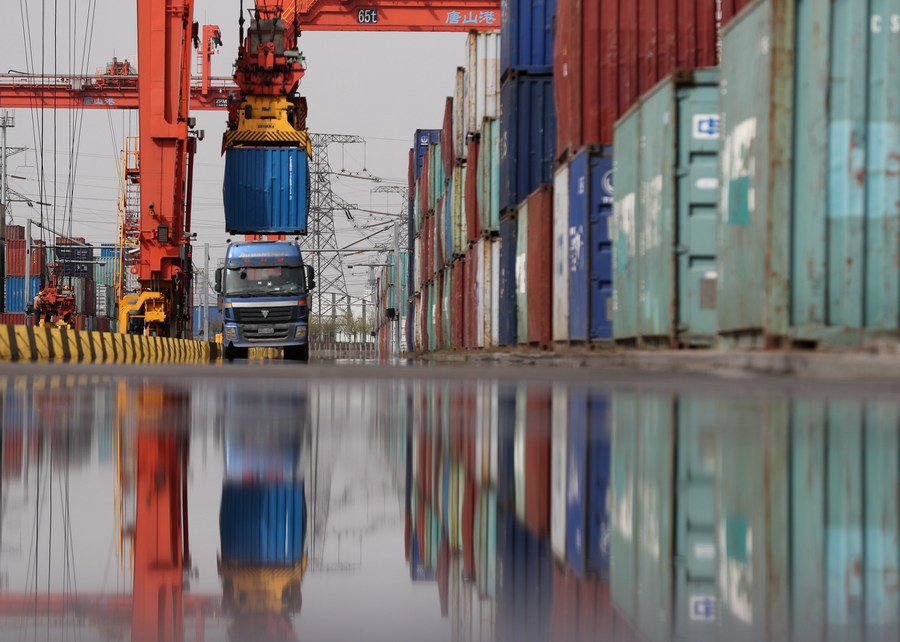
 A truck loads containers at Tangshan Port, North China's Hebei province, April 16, 2021. [Photo/Xinhua]
Title: Africa needs a harmonised strategy to enjoy China’s zero-tariff treatment, expert reveals
China plans to roll out zero tariffs for 53 African states with diplomatic ties with Beijing from May 1, 2026. This decision was announced by Chinese President Xi Jinping in February this year.
However, experts argue that without a more organised structure, the continent might find itself not fully utilising the opportunity to boost its markets.
According to Dr James Shikwati, Founder and Director, The Inter-Region Economic Network [IREN Kenya], China has a well-structured market that Africa must align with for better results.
“Our leaders must understand that we are dealing with a well-organised global player with standards, hence we must proactively seek to meet Chinese standards, and the only way is to organise our huge market, strengthen regional integration, improve policy rationality and encourage value addition to raw materials, including minerals and agricultural commodities,” says Dr Shikwati.
He was speaking during a media symposium organised by the China Media Group in Nairobi.
Dr Shikwati pointed out that the Asian economic giant is a global manufacturing hub that offers massive trading opportunities for African countries that are major producers of agricultural products and key rare earth minerals crucial to the global green energy transition.
Unlike the African Growth and Opportunity Act (AGOA), which had an imbalance in terms of trade that primarily benefited the United States, China's new move has the potential to undermine the United States and its allies' trade dominance on the continent.
AGOA was launched in 2000, granting duty-free treatment to certain African agricultural goods; however, the agreement hampered the growth of Africa's industries.
William Zhou, Chairman of the Kenya Chinese Chamber of Commerce, also stated that the West's conditionality pacts have choked African states for years.
"Chinese zero-tariff will help in the establishment of companies across Africa, delivering quality goods to the massive Chinese market while also creating jobs locally," says Mr Zhou.
He revealed that Chinese investors intend to invest $25 million in a processing plant in Baringo County by the middle of this year.ar.
"We want to export finished products made in Kenya, so we're partnering with over 100 Chinese investors who want to invest in Baringo's agricultural sector and create jobs for locals."
Recent data show that trade between China and Africa will reach US$348 billion in 2025, up 17.7% from 2024. Chinese exports to Africa totalled US$225 billion, representing a 25.8% increase, compared to US $123 billion in imports from Africa, which increased by only 5.4%.
Dr Lemmy Mulaku, a lecturer at the University of Nairobi, believes that the African Continental Free Trade Area's objectives should be revised in order to coordinate the creation of regional value hubs that can serve the interests of both the continent's least developed and middle-income countries.
Despite the continent’s potential for growth, the majority of local enterprises are faced with financial constraints due to unfair trading terms.
According to Dr Shikwati, "One of the biggest obstacles facing local businesses is a lack of steady funding to support their expansion."It's time for African financial institutions to work with organisations like the China-Africa Development Fund (CADFund) and the African Development Bank (AfDB) to acknowledge a Chinese export contract as collateral.
The only African nation left out of this agreement is Eswatini, formerly known as Swaziland. This is because it maintains diplomatic ties with Taiwan instead of the People's Republic of China.