Women are the backbone of families, communities and economies yet too often their health and wellbeing is taken for granted.
Globally, millions of women carry the physical and emotional burden of pregnancy and childbirth with limited support.
The UN Women (UNW) emphasises that when women thrive, societies prosper but when their health is neglected, entire generations are put at risk.
“Motherhood should be a journey of dignity and care, not fear and uncertainty. Despite global progress in healthcare, pregnancy remains dangerously unequal depending on where a woman lives,” UNW observes.
A report by the World Health Organization titled, ‘Trends in maternal mortality: 2000 to 2023,’ indicates that most maternal deaths happen in low and lower-middle-income regions, where women often lack access to trained healthcare professionals, adequately equipped medical facilities and timely emergency care.
In Africa, key low-income countries (LICs) are predominantly in Eastern, Western and Central Africa, while lower-middle-income countries (LMICs) include larger economies like Nigeria, Egypt and Ghana.
In these countries, what should be a moment of joy for women, often becomes a battle for survival as across the continent, maternal mortality continues to reflect deeper social and economic injustices.
The African Union has repeatedly called for stronger investments in women’s health, education and rights but this has never been actualised.
However, in Kenya the story is different.
In the 2024/25 financial year (FY), President William Ruto’s administration allocated Ksh.2 billion for free maternal care to cater for any expenses that may hinder a low-income mother from accessing maternal services.
Additionally, in the FY2025/26, there has been a significant increment in the budget allocated for the sector. A total of Kshs.16.8 billion was allocated to cater for reproductive, maternal, newborns, child and adolescent health.
This consistent funding has greatly reduced maternal deaths by covering both medical infrastructural development and recurrent expenses hence reducing the cases from 355 maternal deaths in 2020 to 70 in 2025 according to the Ministry of Health.
However, the government acknowledges that still for many Kenyan mothers, especially in remote and marginalised communities, access to lifesaving services remains a challenge.
While urban areas benefit from better-equipped hospitals, many rural regions struggle with understaffed facilities, inadequate infrastructure and long distances to referral centres.
The Ministry of Health also admits that shortage of midwives, limited emergency transport and low uptake of antenatal services place thousands of expectant mothers at daily risk with poverty, teenage pregnancies and limited health education further compounding the problem.
According to the 2022Kenya Demographic and Health Survey (KDHS)conducted by the Kenya National Bureau of Statistics (KNBS), 88 percent of women who attend regular clinics and deliver in health facilities are far more likely to survive childbirth.
President William Ruto has been on the forefront in advocating for continued commitment in reducing maternal mortality issues not only in Kenya but continent-wide.
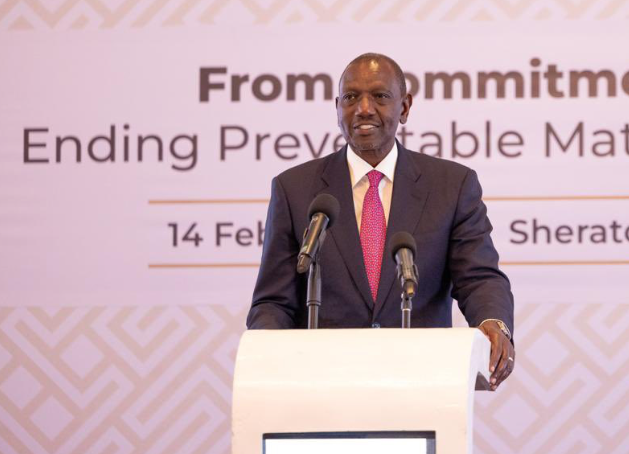
While addressing the 39th Ordinary African Union Summit in Addis Ababa, that focused on the theme, “from commitment to impact-accelerating maternal mortality reduction in Africa,” President Ruto emphasised on the need for Kenya to implement comprehensive health reforms, including restructuring health financing and expanding pre-paid maternal care through the Social Health Authority (SHA).
“So far, we have facilitated direct coverage for 50,000 vulnerable adolescent mothers, guaranteeing ante-natal, safe delivery and post-natal serviceswith an additional 38,000 mothers set to benefit, ensuring that cost does not prevent safe childbirth.” said President Ruto on the sidelines of the Summit.
To address the issue of long distances in search of medical care, the Ministry of health is advancing health facilities in counties and constituencies for easier access to such services and by providing ambulances that can rush expectant mothers to the facilities, the President added.
He gave the example of Vihiga County which he said was set for a major boost with the construction of an Integrated Maternal, Newborn, Child and Health Complex fully sponsored and equipped by Safaricom through the Mpesa Foundation.
The Kshs.60 million investments, assessed by a delegation led by Health Cabinet Secretary Aden Duale, will house a theatre, newborn unit, kangaroo room, labor ward, delivery room and postnatal ward.
Once completed, it will provide improved maternal healthcare services for more than 700, 000 residents in Vihiga and neighbouring counties.
The National Equipment Services Project (NESP) has ensured that hospitals across Kenya are equipped with cutting-edge diagnostic and treatment technologies that will be accessible to all Kenyans.
One hundred laboratory systems have been established to strengthen maternal healthcare by improving diagnosis, monitoring and emergency response.
The laboratories provide essential blood testing and cross-matching services and detection of pregnancy related complications such as anaemia, infections like HIV and gestational diabetes, which are crucial in managing postpartum haemorrhage - one of the leading causes of maternal deaths.
Through routine antenatal tests, they help monitor high-risk pregnancies and ensure complications are identified and addressed in good time.
The Ministry of Health in collaboration with the county governments is transforming major hospitals from Level 5 to fully operational Level 6 referral and teaching facilities, constructing and elevating Level 4 hospitals, including new mother-child hospitals and expanding maternity services to Level 2 and 3 facilities to bring skilled childbirth care closer to communities.
To address the issue of shortage of skilled personnel, the Social Health Authority (SHA) has contracted over 11,000 social healthcare providers covering hospitals, clinics and health centers nationwide.
Through SHA, mothers no longer need to carry cash when going to deliver in registered facilities. Once enrolled, SHA ensures guaranteed access to ante-natal, delivery and post-natal services in empaneled hospitals across the country.
By shifting from out-of-pocket payments to structured health coverage, the government is reducing delays in seeking care, one of the leading contributors to maternal deaths.
The Mama Rachel Ruto Initiative, which was officially opened in June 2024, is helping improve care for mothers and newborns by providing better equipment to health facilities, increasing the number of newborn units, supporting maternity shelters and raising community awareness about safe motherhood.
These efforts work alongside other improvements, such as upgrading maternity wards, increasing the number of skilled health workers attending births, and improving referral systems so that women can quickly access emergency care when needed.
In the long run, the goal is to make childbirth in Kenya safe, respectful, and affordable for every woman — reducing maternal deaths, improving newborn survival, and ensuring that no mother has to fear high medical costs when giving birth.