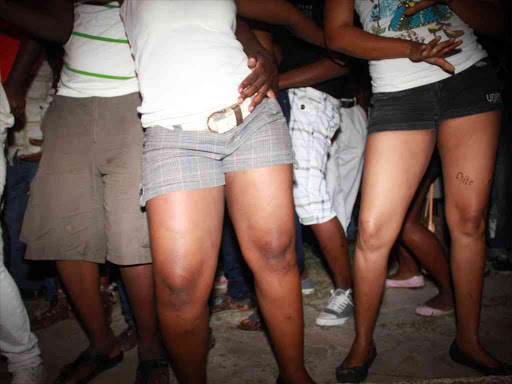
 Women engaged in sex work on a street in Nairobi. Those interviewed were all above 18 years, biological mothers to at least one child aged less than five years, and engaged in full-time sex work in the past three years.
“He was sick for three days vomiting and stooling; he did not go to the hospital and died in the brothel,” she said.
She has many colleagues, all female sex workers, who have also lost babies in different ways.
This is the disturbing pattern now being observed in Nairobi and other Kenyan cities. Babies born to female sex workers are dying more often than those of other women.
In fact, a new study indicates that one in every five sex workers in Nairobi, Mombasa and Kisumu has ever lost a child.
So what is killing the babies of sex workers in Kenya?
Investigators, who have published their findings in the Frontiers in Public Health journal, explained that there were already reports of too many deaths among children of female sex workers.
So they interviewed 302 female sex workers in Nairobi, Mombasa and Kisumu about how their children died.
The women were all above 18 years, biological mothers to at least one child aged less than five years, and engaged in full-time sex work in the past three years.
The survey actually took place in three countries and included 302 Kenyan female sex workers (FSW), 301 Nigerians, and 250 Congolese.
Of the 188 children reported to have died, most (82) were from Nigeria, followed by DR Congo (74) and Kenya, with 32 deaths.
“Our analysis found that nearly one in five mothers who are sex workers had experienced the loss of a young child—a stark statistic highlighting the need for research to understand and address preventable causes of mortality in children of female sex workers,” the researchers said.
Children of mothers not engaged in sex work fare way better. While there is no widely reported national statistic of Kenyan mothers who lose a baby at some point in their lives, the national neonatal death rate is 21 deaths per 1,000 live births (one death in every 48 newborns).
The researchers found the enemy of sex workers is closer than you may think.
The probe was conducted by Wendy Macias-Konstantopoulos, Revathi Ravi and Brian Willis, all from different institutions affiliated with Harvard University.
They discovered that children of female sex workers exhibit worse mental health functioning, report less parental monitoring, and respond differently to parenting than other children.
This is because of the environment in which they are born and brought up.
“Kidnapping, emotional, physical, and verbal abuse, neglect, sexual aggression, early separation, early sexual debut, introduction to sex work, drug use, low school enrollment, and the psychosocial impact of witnessing mothers’ interactions with clients and witnessing significant trauma such as murder were all experienced,” the researchers said.
These children also suffer intergenerational trauma carried over from their mothers.
“Indirectly, trauma is transmitted intergenerationally from mothers to their children, primarily through poor mental health outcomes and limited parenting and coping skills,” they found.
All this makes the home of a sex worker mother one of the most dangerous places for a baby to be born and live.
The researchers concluded that what is killing children of sex workers in Kenya is not mysterious.
It is the same complications that affect many Kenyan infants. These include premature birth, difficulty breathing at birth (birth asphyxia), and infections.
The difference is that children of sex workers face both poorer access to healthcare at birth and the harsher living conditions mentioned earlier.
“Children reared by mothers who are female sex workers grow up in the same high-risk, marginalised environments in which their mothers live and work,” the authors said.
Among the deaths recorded in Kenya, nearly half (46 per cent) occurred within the first 28 days of life, largely linked to neonatal conditions such as labour complications and early infections that are often treatable in a hospital setting.
"I was afraid they would take my baby away if they knew what I did for a work," was a common sentiment among sex worker mothers. This stigma means many sex workers give birth in informal settings without a skilled health worker, turning treatable birth complications into fatal ones.
Children who survived those first days found more dangers on the way of life.
Diseases like pneumonia and diarrhoea, which are common causes of child deaths in Kenya, appear much more deadly in this group. Crowded housing, poor sanitation and delayed treatment make it harder for children to recover.
The Kenya Demographic and Health Survey (KDHS) 2022 indicates a much more favourable life for children in the general population.
Only about 21 newborns in the general population die for every 1,000 live births, mostly due to prematurity, birth complications and infections.
In the general population, thanks to massive public health campaigns, deaths from diseases like measles have become rare.
However, this study found that measles is still a significant killer of children of sex workers.
It suggested a breakdown in the last mile of healthcare. While the government may have the vaccines, the children of mothers living in brothels, transit corridors, or temporary urban settlements are often invisible to the healthcare workers carrying out door-to-door immunisation drives.
“Compared to the general child population, children of female sex workers may have lower vaccination rates due to limited access to health care and higher levels of pathogen exposures and transmission due to more hazardous, crowded living conditions,” the authors said.
Their study is titled, “Causes of death among young children of female sex workers in three sub-Saharan African countries: a cross-sectional exploratory investigation.”
The researchers recommended large-scale mortality surveillance efforts within the hard-to-reach sex worker populations to identify and track unique trends in cause of death.
“Such real-time data can assist government ministries, intergovernmental bodies, non-governmental organisations, and funders in the timely development of policies and allocation of resources for evidence-based programmes that reduce preventable deaths, improve health and wellbeing, and extend the lifespan of these at-risk children,” they said.




![Africa CDC Director General Dr Jean Kaseya at a past event. [Photo: Arthur Mbuguah, WHM]](https://cdn.radioafrica.digital/image/2026/10/8ced213c-affb-4dff-97ca-1b6bac1f958e.webp)