 Cleanup of
the Nairobi
River near
the Dandora
dumpsite
yesterday
/ENOS TECHE
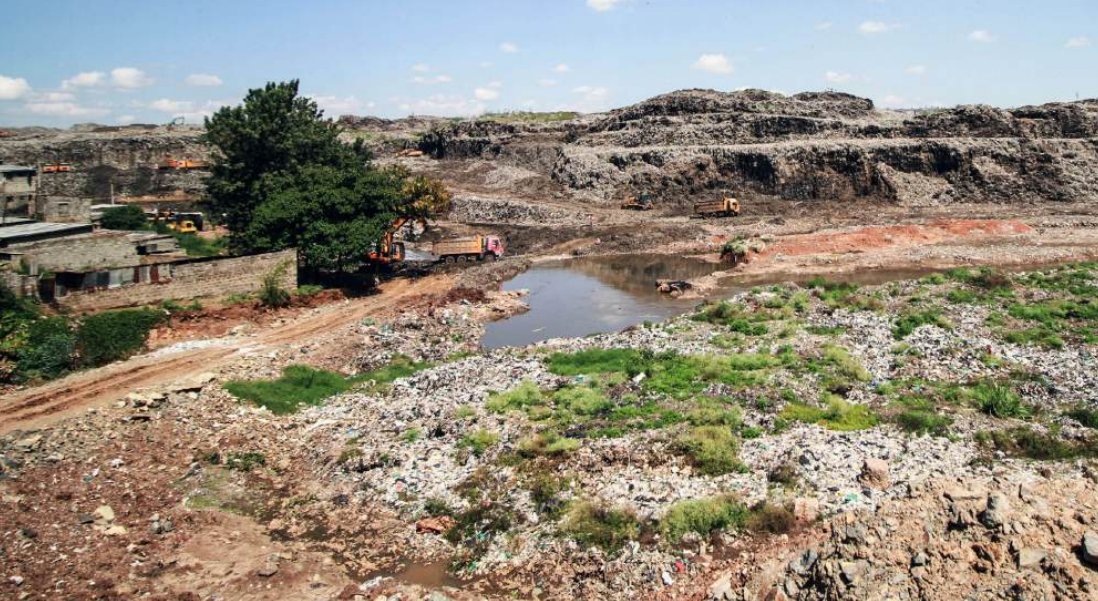
Cleanup of
the Nairobi
River near
the Dandora
dumpsite
yesterday
/ENOS TECHE
Imagine a leisurely Saturday morning stroll or a bicycle ride along the Nairobi River.
The water sparkles as it flows gently over a pristine riverbed, bathed in the morning sun.
Water beetles dart across the surface in a lively chase, while colourful butterflies and buzzing bees dance above the river — or perhaps they are simply quenching their thirst?
A cool, refreshing breeze rises from the riverbank, caressing your face. The laughter of children playing in the open green spaces along the river warms your heart.
City residents engrossed in books and newspapers, bask in the sun, or engage in excited chatter beneath the lush canopy of trees.
This is not a dream. It is the vision for Nairobi River — currently a foul and unsightly trench, groaning under the weight of toxic waste. Starting next year, that vision will become a reality.
All the slums along the river are being cleared, and two large sewer lines will run along either side to prevent waste from polluting the water.
The beautification of the entire stretch and the construction of social amenities will restore the capital to its former reputation as the Green City in the Sun.
President William Ruto launched the Sh50 billion Nairobi River Regeneration Project on March 10, 2025.
“I want to assure Kenyans that within the next 24 months, we will see a difference in Nairobi River,” he said. One year on, work is progressing at full pace.
Spanning over 70km within the city, the Nairobi River basin drains nearly 5,000 acres and passes through key subcounties such as Westlands, Starehe, Kamukunji, Kasarani, Embakasi and parts of Dagoretti and Lang’ata.
Decades of rapid urbanisation, weak enforcement of environmental laws and unplanned development have severely degraded the river system.
Industrial effluent, untreated domestic sewage from slums, indiscriminate dumping of solid waste and encroachment into riparian reserves have left the Nairobi River heavily polluted.
These pressures have compromised water quality, destroyed aquatic ecosystems, increased flood risks and exposed riverside communities to serious health hazards.
However, all this is now set to change. “Our approach involves three main interventions. First, dealing with liquid waste — the sewers,” explained Colonel Kahigu Njoroge, project manager of the regeneration works led by the Kenya Defence Forces.
“Second intervention is managing solid waste, since our city produces a lot of plastics, old clothes, bottles and other refuse. Third, addressing flooding,” he said.
The two large sewer lines, each measuring 1.8 metres wide and running on either side of the river, will collect all sewage from the banks.
One begins at Naivasha Road in Kawangware and runs down to Lucky Summer in Dandora, while the other extends up to Dagoretti slaughterhouse.
Nairobi generates between 2,000 and 2,500 tonnes of waste daily — 50 to 80 per cent of which is organic, with the remainder comprising plastics.
Currently, this waste is deposited at the Dandora dumpsite, which was opened in 1975 and declared full over 25 years ago.
“Part of the Dandora dumpsite is within the river’s course,” Njoroge said.
“We are removing that waste and installing a reinforced concrete wall to fence off the area, ensuring that waste and leachate do not return to the river,” he said.
“Additionally, we are installing several garbage interceptors along the river to block all debris.”
These interceptors will capture and remove rubbish at various points.
“To keep the river clean, we are also installing ecological weirs — structures like small dams that slow water flow and help regenerate the river,” he added.
The third intervention aims to control flooding, which caused at least 32 deaths during a single night of heavy rain on March 6.
Engineers have developed a hydraulic model to expand and deepen the river, enabling it to carry more water during periods of heavy rainfall.
Njoroge said the overarching goal of the project is “to turn the back of the city to the front.” Currently, the Nairobi River is seen as the city’s rear.
“We are undertaking extensive landscaping, beautification and greening along the riparian zones to transform the back into the front.”
The river will feature 20 motorised and 24 pedestrian bridges, ensuring safe crossings and unobstructed water flow.
“Additionally, we will have footpaths along both banks up to Dandora, following the river’s course,” he said.
Where space permits, the government is constructing social amenities for local communities.
Kamukunji Park, which is currently under development, will boast a standard football pitch, a multi-purpose sports field and a community centre housing a library, a computer lab, an arts centre and a studio.
Njoroge reported that 30 per cent of the work has been completed. The project, fully funded by the national government, has faced delays mainly due to challenges in relocating communities along the river.
“Once we mark out the structures, we issue notices requesting residents to move their fences or other belongings so we can create space,” he said.
“But before that, we have held over a hundred meetings with the communities, to ensure they understand what we are doing and why,” he said.
“We began this work around May last year, and we aim to complete it by January 15, 2027.”
Josephat Karobi is the chairman of the community-based organisation Kamukunji Environment Conservation Champions, which has been working to upgrade the famous Kamukunji Grounds prior to the government’s intervention.
He said local youths, supported by the NGO Public Space Network, have been involved in greening efforts since 2020 and in developing the grounds, which are a hub for daily social and leisure activities.
“The master plan for upgrading the park was developed by our community. We held consultations and came up with ideas. The park will embody our values of struggle, change and voice,” Karobi said.
“The features we had planned with Public Space Network have been incorporated into this project. The government has taken our ideas seriously, which is why the community is so involved.”
Karobi highlighted Kamukunji’s rich history of creative talent and said the community centre would foster arts and sports among the youth. The project has also generated thousands of jobs.
“All the workers here — from the security guard to the artisans — are from the local community. The contractors brought in only specialists,” he added.
Grace, a mother of one, sells food at the site. “I was doing nothing at home while my husband looked for work,” she said.
“When the project started, some friends advised me to set up here and sell food to the workers. I make around Sh3,500 or Sh2,500 on a bad day. Now, I am supplementing my husband’s income. This project has truly uplifted me,” she said.
Elijah Muvuti, a resident of Athi River in Machakos, supplies sand to the Kamukunji Park project from Mashuru in Kajiado.
“This project has helped me repay my loan for the lorry and sustain myself,” he said.
Benson Mumina, a professional painter, began working on the site with a team of nine. “This government project has improved my life, and I am grateful,” he said.
The father of four added that his second daughter is studying at Machakos University. “With the money I earn here, I can pay her fees and support my family.”