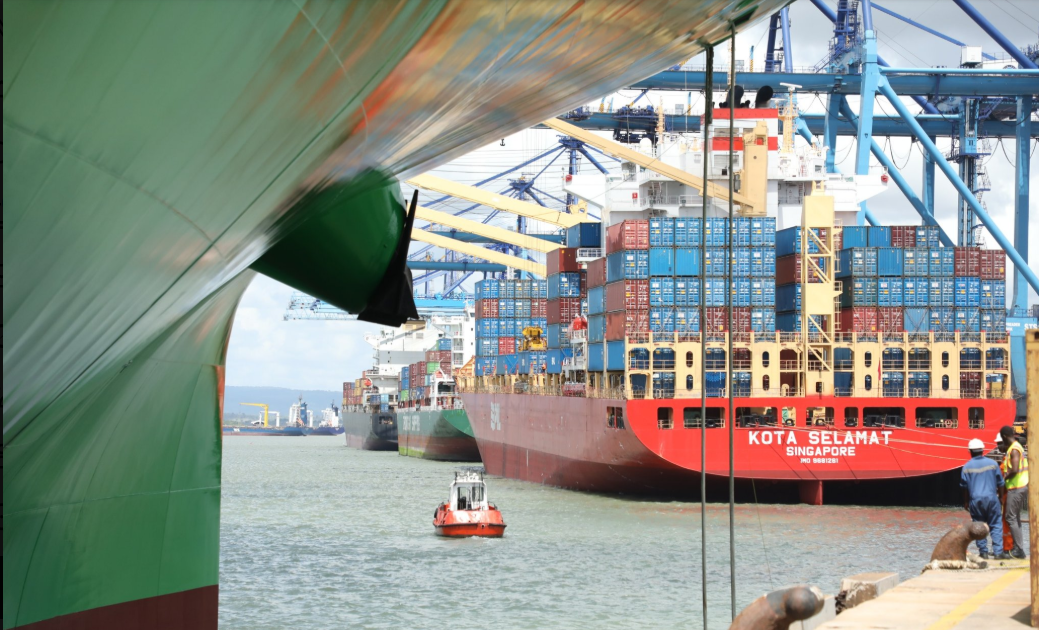
Disruption in global maritime transport occasioned by the US-Israel-Iran conflict is piling pressure on African ports, including Kenya’s Port of Mombasa.
The escalating conflicts, including disruptions in the Strait of Hormuz and Red Sea as of March 2026, have forced ships to reroute around the Cape of Good Hope (South Africa), diverting traffic toward African ports.
Major carriers have suspended transit through the Bab el-Mandeb, resulting in increased demand for bunkering and repair services in South Africa.
The Bab-el-Mandeb or Strait of Mandeb is a strait between Yemen on the Arabian Peninsula and Djibouti and Eritrea in the Horn of Africa, connecting the Red Sea to the Gulf of Aden and by extension the Indian Ocean.
Key transhipment hubs like Jebel Ali and are experiencing severe disruptions and declining vessel calls, forcing carriers to re-route around the Cape of Good Hope.
The Port of Salalah in Oman, a premier global transshipment hub, has also been affected by the war with drone strikes on fuel storage tanks reported on March 11-12, 2026, forcing it to temporarily suspend all terminal and container operations.
Kenya Ports Authority vessel schedule shows Mombasa is expecting a record 59 vessels in the next two weeks, compared to a usual average of 40 to 50 vessels.
These includes 23 container vessels, 24 conventional vessels mainly shipping iron and steel, vehicles, wheat and fertiliser, four feeder vessels, four tankers (petroleum products and palm oil), and another four transshipment cargo vessels and back loading.
The number of waiters totals 33 including nine for Bulkstream Limited which handles dry and liquid bulk commodities.
"Waiters" refers to container vessels waiting at anchor, outside a port, for a designated space (berth) to become available for unloading or loading cargo.
According to Kenya Ports Authority managing director William Ruto, the Port of Mombasa recorded 1,955 vessel calls in 2025, which was an increase from 1,873 in 2024.
“This growth in traffic, representing a 10.9 per cent rise in cargo handling, was driven by rising demand and regional trade. The port frequently managed, or was scheduled to handle, high volumes, often 40-55 vessels within 14-day periods.”
The high number of calls, which came with growth in throughput and transhipment volumes, was also linked to the Red Sea crisis that saw vessels re-route through the Cape of Good Hope.
Some vessels avoided other ports and opted to drop cargoes at Mombasa for onwards delivery.
“One shipping line for instance increased vessels call to 20 from eight due to challenges in some ports which experienced congestion and longer vessel waiting time. This put pressure on Mombasa,” Shippers Council of Eastern Africa CEO Agayo Ogambi said.
Kenya Ship Agents Association CEO Elijah Mbaru noted that the supply chain disruptions has seen shipping lines introduced emergency surcharges due to increased risk, leading to potential shortages of goods and costlier imports.
“The logistical challenges in the Red Sea and Gulf are forcing higher insurance costs on cargo, which will likely be passed on to consumers,” Mbaru told the Star.
Cargo volumes handled through the Port of Mombasa rose to a record 45.45 million metric tonnes in 2025, marking a 10.9 per cent increase compared to 2024.
Lamu Port has also received increased activities with a 9, 000 capacity Pure Car Carrier MV. Grande Auckland berthing last week where it discharged transshipment cargo.
This was 469 new vehicles that were destined for the Middle East and were initially scheduled for discharge at the Port of Jebel Ali.
General Manager Port of Lamu Captain Aziz Mzee described the decision to call the Port of Lamu on the voyage from Europe to Mumbai as “fulfilling and a show of confidence in the Port’s efficiency,” as Lamu positions itself as a transshipment hub.
He said 43 cargo vessels including container carriers and fishing vessels have docked at the Port of Lamu from January, with the port has registered between 130-143 vessels since operationalisation.
Industry players have warned that shipping disruptions in early 2026 are severe, with multiple vessels grounded or halted in critical maritime bottlenecks due to conflict in the Middle East and surrounding regional instability.
The conflict between Israel-US and Iran has caused a dramatic reduction in traffic in the Strait of Hormuz and the Red Sea, forcing major shipping lines to reroute around the Cape of Good Hope, adding 10-14 days to journeys and over $1 million (Sh129.6 million) in costs per trip.