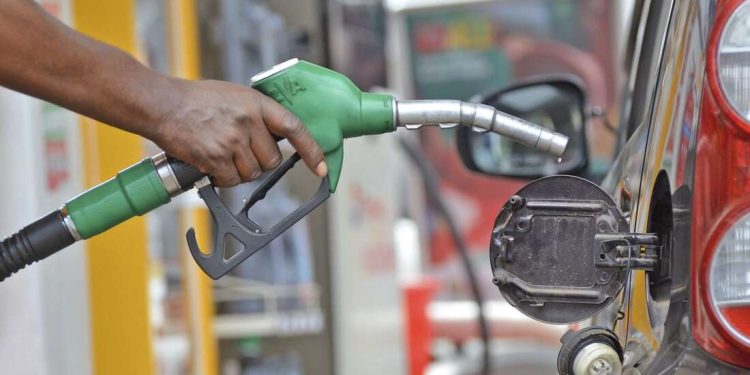
 Pump attendant fueling a car at a fuel station in Nairobi. (Photo: File)
Kenya is bracing for tighter fuel supplies as the war in Iran disrupts shipments through the Strait of Hormuz, threatening the nation’s already thin buffer of imported oil.
With the country consuming about 100,000 barrels of fuel daily and relying entirely on imports, the East African economy faces the risk of shortages if even a single shipment fails to arrive.
Oil prices have soared since the US and Israel started bombarding Iran late last month and are currently hovering at around $100 a barrel.
According to Bloomberg, about 600,000 barrels a day of refined oil products that usually flow to Africa from the Middle East are now at risk, forcing governments to seek alternative suppliers.
“The biggest fuel suppliers to Kenya are rationing product,” said Martin Chomba, chairman of the Petroleum Outlets Association of Kenya in an interview with Bloomberg.
He added that a few distributors are already “experiencing stock outs in the villages.”
Kenya imports fuel through the port of Mombasa, where a local refinery remains dormant after being shut due to unprofitability.
But the countdown on that buffer has begun, with officials yet to confirm details on cargo arrivals or when supplies might run out.
“We’re looking everywhere” for supply options, Jacob Mbele, director-general at South Africa’s Department of Mineral Resources, told Bloomberg, emphasizing that “the situation is fluid, it changes every day.”
In its March Oil Market Update, the International Energy Agency (IEA) said global oil supply is set to fall by about 8 million barrels per day (mb/d) in March to 98.8 mb/d, marking the lowest levels since early 2022.
“Global oil supply is projected to plunge by 8 mb/d in March, with curtailments in the Middle East partly offset by higher output from non-OPEC+ producers, Kazakhstan and Russia following disruptions at the start of the year,” reads the report.
However, despite the near-term shock, the IEA expects a recovery in supply over the year, forecasting an average increase of 1.1 mb/d in 2026, driven entirely by non-OPEC+ producers.
The crisis is part of a broader African challenge, with refinery closures and underinvestment leaving many nations dependent on a single trade route now at the center of a widening conflict.
East and southern Africa are particularly vulnerable, receiving about 75% of fuel imports from the Middle East, according to Elitsa Georgieva, executive director at energy consultancy CITAC.
Other African nations are feeling the pinch as well. Ethiopia has asked citizens to conserve fuel as the government prioritises energy for “basic and essential needs,” while South Africa faces a sharp decline in refining capacity, increasing its reliance on imports from Saudi Arabia, Oman, Bahrain, and the UAE.
In contrast, Nigeria’s Dangote refinery, producing 650,000 barrels a day outside Lagos, has provided a rare bright spot, ramping up to full capacity and offering a potential buffer for exports to neighboring nations.
Beyond the African continent, Sri Lanka declared every Wednesday a holiday for public institutions to conserve fuel as the island nation grapples with possible shortages in the wake of the US and Israel's war with Iran.
"We must prepare for the worst, but hope for the best," President Anura Kumara Dissanayake said at an emergency meeting with senior officials on Monday.
This was the latest in a series of belt-tightening measures undertaken by Asian countries since the war choked off the Strait of Hormuz, which used to carry millions of barrels of oil from the Gulf into the region.
Nearly 90% of all the oil and gas flowing through the strait last year was bound for Asia, which is the world's largest oil-importing region.
In Thailand, for example, the government is urging people to swap suits for short-sleeved tees to reduce reliance on air conditioning, while in Myanmar, private vehicles are allowed only to operate on alternates days depending on their licence plate numbers.
Bangladesh has brought forward Ramadan holidays in universities and introduced planned blackouts across the nation to conserve energy.
In the Philippines, some government offices have mandated that staff work from home at least one day a week, while President Ferdinand Marcos Jr has banned nonessential travel in the public sector.