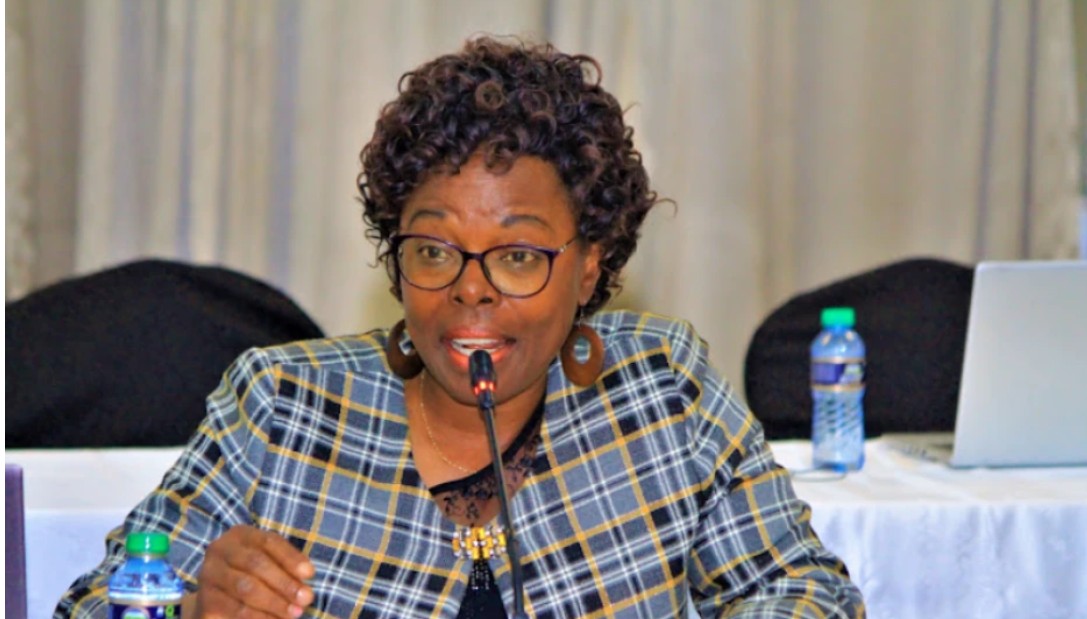
 Controller of Budget Margaret Nyakang’o/FILE
Billions of shillings in taxpayers’ money remain tied up in government projects that have dragged on for years, some dating back to 2013.
A new report by Controller of Budget Margaret Nyakang’o reveals a pattern in which slow-moving projects continue to receive allocations in successive budgets despite minimal progress.
The review covering July–December 2025 cites stalled projects across sectors, including diplomatic missions, trade infrastructure, agriculture, maritime systems and aviation facilities.
Several state lodge refurbishments are among the projects that have dragged on for years despite heavy spending.
Refurbishment of Eldoret State Lodge, launched in 2016, is only five per cent complete. Sagana State Lodge stands at 27 per cent completion, Kisumu at 14 per cent and Kisii at just two per cent.
Works at Kakamega State Lodge, which began in 2015, have also reached only two per cent completion.
“The delays highlight the critical need for strategic planning and prioritisation to ensure timely project completion,” Nyakang’o said.
President William Ruto and Treasury Cabinet Secretary John Mbadi have repeatedly urged government agencies to complete ongoing projects before initiating new ones.
Parliament has raised similar concerns. The National Assembly Budget Committee said that although the 2026 Budget Policy Statement prioritises completing ongoing or stalled projects, many remain delayed.
In the 2023-24 financial year alone, 24 ministries, departments and agencies had stalled or delayed projects worth Sh38.24 billion, with Sh7.9 billion already spent.
“It was noted that funds already spent on non-functional projects are effectively sunk costs providing no services or value for money,” MPs said in their report on the Budget Policy Statement.
Some of the most glaring cases involve renovation projects at Kenya’s diplomatic missions abroad.
Renovation of government-owned properties in Dar es Salaam and fencing of land allocated in Dodoma began in November 2016 but had reached only 21 per cent completion by December last year. The project has already consumed about Sh122 million.
Similarly, renovation of government properties in Addis Ababa, launched in July 2019 at an estimated cost of Sh500 million, had reached only 13 per cent completion. By December last year, Sh65.9 million had already been spent.
Other diplomatic projects with minimal progress include renovations of government properties in Lusaka and Kinshasa, both standing at five per cent completion.
The purchase and renovation of the ambassador’s residence in New York has reached only six per cent completion despite about Sh4 billion already being spent on the works and related purchases.
The report further notes that some projects remained active in development budgets but recorded no expenditure during the six-month review period.
Economists have previously warned that stalled projects create heavy fiscal burdens.
Jairus Kedogo and Oscar Ochieng of the Institute of Economic Affairs said, “When projects stall due to mismanagement, litigation or contractor disputes, funds already spent effectively become sunk costs.”
“The loans or bonds that financed them still require repayment. In effect, Kenya is paying interest on hospitals without patients, stadiums without spectators, bridges without roads and dams without water,” they said in an IEA analysis on stalled projects.
Slow progress is also evident in the trade sector.
The Modernisation of the Standards Laboratory (Legal Metrology Project), launched in July 2020, has achieved only one per cent completion despite a June 2026 completion target. The project is expected to cost Sh610 million.
The Warehouse Receipt System, launched in January 2020 to strengthen commodity storage and trading, stands at 22 per cent completion, with Sh222 million already spent.
Meanwhile, the Commodities Exchange Platform, launched in 2023 to support structured commodity trading, has reached only 15 per cent completion. The project is expected to cost Sh3.7 billion.
The Warehouse Refurbishment Project under the Kenya National Trading Corporation stands at 21 per cent completion, even though its expected completion date of March this year has already passed.
Agricultural projects aimed at boosting food production and farmer incomes are also progressing slowly.
The National Edible Oil Crops Promotion Project, expected to run between 2023 and 2030, has achieved only four per cent completion so far. The initiative is valued at Sh8.7 billion and is funded jointly by the government and development partners.
The Kenya Cereals Enhancement Programme – Climate Resilient Agricultural Livelihoods Window stands at 26 per cent completion despite receiving both government and donor support.
Meanwhile, the Pyrethrum Industry Recovery Project, launched in 2014, has reached only 30 per cent completion after more than a decade. The programme is valued at about Sh3.3 billion.
In the blue economy sector, several maritime projects are also significantly behind schedule.
The Kenya Lake Victoria Maritime Communication and Transport Project, valued at Sh3.6 billion, has reached only 15 per cent completion since its launch in 2023, with Sh555 million already spent.
The Kenya Maritime Data Bank project stands at 14 per cent completion despite its expected completion date of June 2025.
Another initiative, the Maritime Survival Training and Certification Centre, has reached 28 per cent completion after absorbing Sh702 million.
Overall, maritime projects valued at more than Sh5.9 billion have recorded an average physical progress rate of about 19 per cent.
Infrastructure projects in the aviation sector are also facing costly delays.
Construction and rehabilitation works at Kakamega, Kabunde and Migori airstrips have exceeded their original timelines despite continued funding allocations. The three projects have absorbed more than Sh1.2 billion in public funds.
“The projects utilised 100 per cent of their mid-year funding despite remaining past their initial expected durations or lacking updated completion percentages,” Nyakang’o said.
In another case, the purchase of aircraft accident investigation equipment, which began in July 2020, recorded zero expenditure during the six-month review period despite having a budget allocation.
Even projects under the Executive Office of the President have experienced slow implementation.
Modernisation of the Government Press and refurbishment of buildings, launched in 2013, has reached only eight per cent completion more than a decade later. The project is estimated to cost Sh1.5 billion.
Refurbishment of Harambee House, which began in 2015, stands at 35 per cent completion and is expected to be finalised this year. Integrity House renovations have also been cited, being at 36 per cent well past its completion timeline.
Another project involving the Directorate of Resource Survey and Remote Sensing, launched in 2019, has reached only 22 per cent completion.
The justice sector is also grappling with delays. “Mandera Law Courts, whose completion timeline has already lapsed, remained at 13 per cent, indicating significant delays.”
The Uadilifu Case Management project under the Office of the Director of Public Prosecutions, launched in 2022, has achieved only 16 per cent completion despite being in its final year.
Nyakang’o warned that persistent delays in capital project implementation could undermine the effectiveness of public spending and expose the government to additional costs from litigation and delayed payments.
Instant analysis
As the government continues to prioritise development spending, the findings raise fresh questions about whether ministries and implementing agencies have the capacity to deliver projects within the timelines originally planned.