 New rice varieties, Kalpaa, Kalfine, Kal Imara and Kal Gold each designed with
specific characteristics./AGATHA NGOTHO.
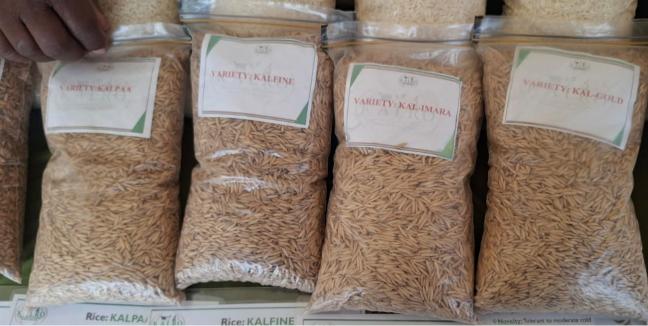
New rice varieties, Kalpaa, Kalfine, Kal Imara and Kal Gold each designed with
specific characteristics./AGATHA NGOTHO. 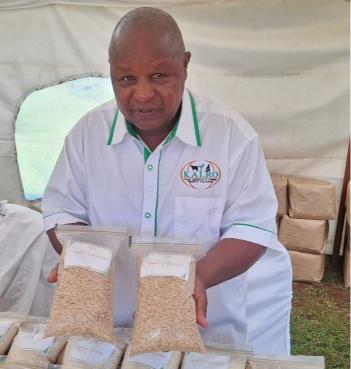 Sammy
Kagito, a senior research scientist and agronomist at the Kenya Agricultural and
Livestock Research Organization Mwea Centre, talks about the new varieties are currently
undergoing seed multiplication before being released to farmers./AGATHA NGOTHO.
Sammy
Kagito, a senior research scientist and agronomist at the Kenya Agricultural and
Livestock Research Organization Mwea Centre, talks about the new varieties are currently
undergoing seed multiplication before being released to farmers./AGATHA NGOTHO.Researchers from Kalro have developed four new rice varieties aimed at improving productivity, climate resilience and meeting consumer preferences in Kenya.
Kenya Agricultural and Livestock Research Organisation (Kalro) Mwea Centre senior research scientist and agronomist Sammy Kagito said the new varieties are currently undergoing seed multiplication before being released to farmers.
“For a long time, farmers have known Komboka as the premium rice variety. But researchers have now developed new varieties to address emerging challenges such as climate change, soil conditions and consumer preference,” Kagito said.
The four varieties include Kalpaa, Kalfine, Kal Imara and Kal Gold, each designed with specific characteristics.
Kalpaa is a high-yielding and early-maturing variety. Kagito said the name “paa” refers to its fast growth, making it suitable for farmers who want quicker harvests.
Kalfine is also early-maturing and has been developed with climate resilience in mind to help farmers cope with erratic weather patterns.
Kal Gold, on the other hand, is semi-aromatic and tolerant to cold conditions, including frost, which can affect rice production in some irrigated areas.
Kagito said the variety also responds to the growing consumer preference for aromatic rice.
“We are trying to meet customer taste by developing varieties that suit their preferences,” he said.
Kal Imara is designed for saline soils, making it suitable for coastal counties such as Kwale and Tana River where high soil salinity limits crop production.
“This variety can grow well in saline soils where many other crops fail, giving farmers in those areas a reliable option,” Kagito said.
The rice varieties were being shown at the Kilimo Biashara Expo 2026 at the Kalro Seeds head office in Thika.
The 5th Kilimo Biashara organised by Kalro was held under the theme, Advancing Agribusiness Through Improved Technologies, Partnerships and Market Linkages.
Kagito added that the varieties have also been designed to help farmers manage persistent challenges such as attacks by quelea birds, which often feed on ripening rice grains.
“These birds attack rice when it matures,” Kagito said. “However, early-maturing varieties allow farmers to harvest before the birds cause major damage.”
The new varieties have been tested in irrigation schemes including Mwea, Bura in Tana River, Busia, Bunyala, West Kano in Kisumu, Taita Taveta and parts of Kwale.
Before release, Kagito said all crop varieties undergo national performance trials across different ecological zones to confirm their adaptability and performance.
Rice farmer Peter Mwangi from Mwea welcomed the development, saying improved varieties could help farmers cope with climate challenges and rising production costs.
“Rice farming has many challenges, especially unpredictable weather and pests. If these varieties mature early and give good yields, they will help farmers earn more and reduce losses,” he said.
According to the Kenya National Bureau of Statistics, rice consumption in Kenya has been rising steadily as diets change and urbanisation increases.
The country consumes about one million tonnes of rice annually, but local production supplies only about 180,000 to 230,000 tonnes, forcing Kenya to import more than 70 per cent of its rice needs.
Data from the Ministry of Agriculture shows that the country produced about 191,000 tonnes of milled rice in 2023, mainly from irrigation schemes such as Mwea, Ahero, Bunyala and West Kano.
Researchers at Kalro say improved seed varieties will play a key role in bridging this gap.
According to Kalro data, Kenya currently produces about 304,000 tonnes of rice against a national demand of about 1.3 million tonnes, meaning local farmers supply only a small share of the country’s consumption.
Rice is now considered the third most important cereal crop in Kenya after maize and wheat and its consumption continues to grow rapidly, particularly among urban consumers and young people.
Kagito said the new varieties are expected to help close the production gap and strengthen food security.
Seed for the new varieties will be available through Kalro’s Mkulima shops at a subsidised price under a sustainable production project.
Farmers are expected to start accessing the new varieties from next year.