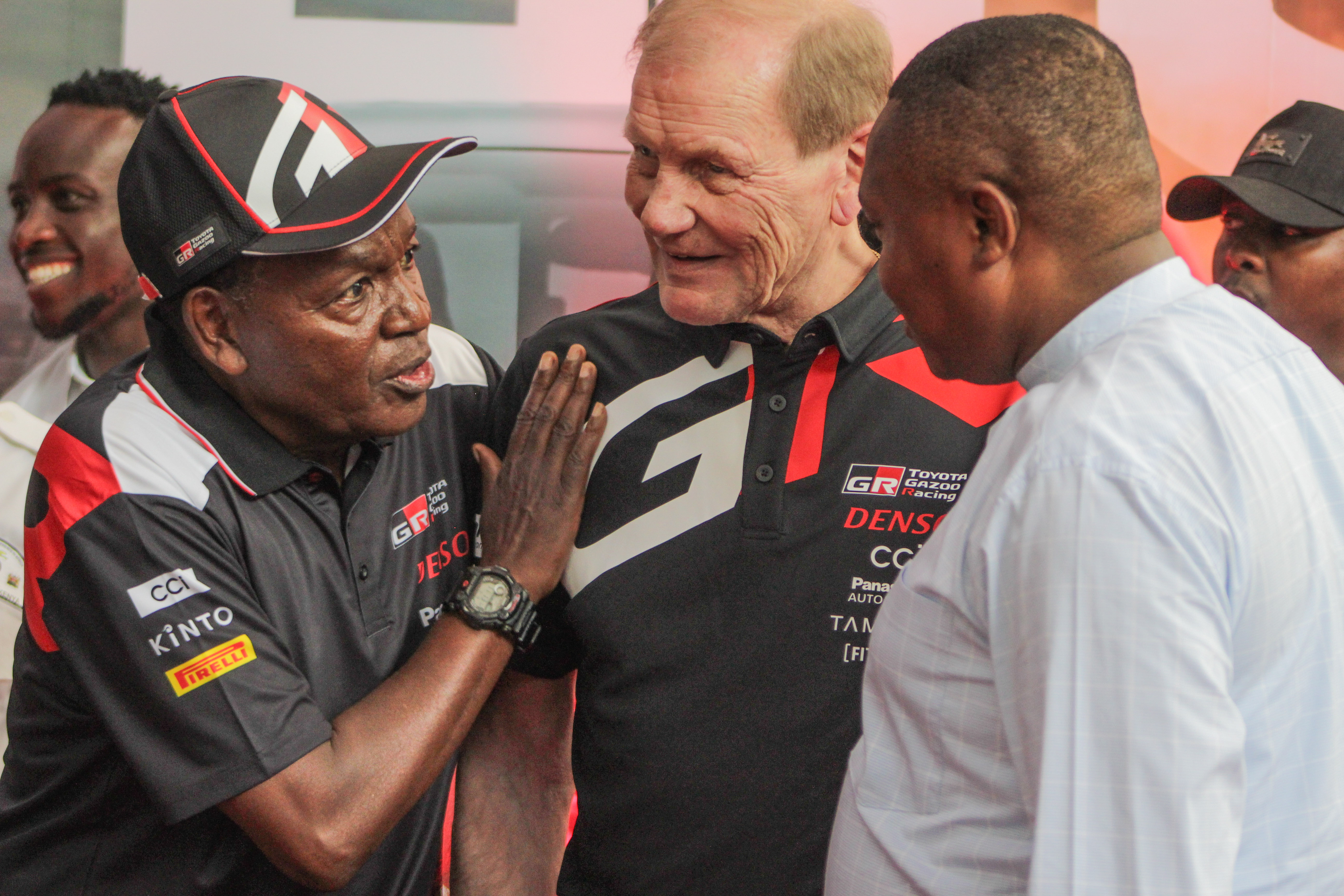
 Rally legends Patrick Njiru and Juha Kankkunen of Finland with Sports PS Elijah Mwangi/ TEDDY MULEI
Retired Safari Rally legend Patrick Njiru has reflected on how the Safari Rally Kenya and the wider World Rally Championship have evolved over the years, describing the rallies of his era as far more gruelling than today’s competitions.
Speaking on Sunday night during a live interview on Citizen TV, Njiru compared the endurance required in earlier editions of the rally with the modern format, saying drivers in the past covered thousands of kilometres in just a few days.
“Doing 5,000 kilometres in five days, these guys are now doing 300 kilometres in three days. We were doing 5,000 kilometres in five days and driving almost 18 hours nonstop,” Njiru said.
The rally driver described the old Safari Rally as one of the toughest motorsport events in the world, testing both mental strength and physical endurance.
“I think it’s mental fitness, because doing 5,000 kilometres in five days was not easy,” he said.
According to Njiru, drivers would often spend long hours behind the wheel across different terrains, battling fatigue and extreme conditions.
“You start and go to the Chyulu Hills. Once you finish the Chyulus, that’s about 55 kilometres, then you go to the Taita Hills, about 72 kilometres, then you go down to the coast,” he said.
“By the time you get there, you are really exhausted.”
Njiru said the physical toll was immense, recalling how drivers would lose significant body weight from sweating during the race.
“When we finished those races, our T-shirts would be one kilogram heavier from sweating,” he said.
The former rally star also highlighted how the terrain used in earlier rallies made the competition more unpredictable and challenging.
He explained that drivers had to adapt quickly as the road surfaces constantly changed across different parts of the country.
“The countryside areas were so beautiful because each place had different soil. You go to Taita Hills, and the soil is clay. You come to the Chyulus, and it was rocky and sandy. When you go to Aberdares, it was red soil,” Njiru said.
He said the variation in terrain made the rally a true test of skill and machine performance.
“That’s why it used to be called man and machine,” Njiru said.
Today’s Safari Rally, which is largely centred around Naivasha, is held on a more concentrated route compared to the sprawling cross-country events of the past.
“Now you are going to the same rocky black cotton soil. The difference is enormous,” he said.
Njiru also spoke about the evolution of rally cars, saying modern vehicles are far safer than those used in earlier decades.
He said improvements in roll cage technology have dramatically reduced fatalities in the sport.
“I think the cars of today, the roll cage is the one that has been built so well. During our time, we lost a few drivers because the roll cage was not strong enough,” Njiru said.
According to him, modern rally cars are designed to protect drivers even in severe accidents, adding that even if one rolls six or seven times, the car may be destroyed, but the cage where you are sitting remains strong.
“The engineering behind that has become so credible.”
Njiru said the advancements in safety engineering have made rallying less deadly compared to earlier years, when several drivers lost their lives in crashes.
“In the last five years, there hasn’t been any accident where the driver or co-driver has died in WRC championships,” he said.
The driver also shed light on how the Safari Rally was financed during his era, revealing that the government did not fund the event.
“During my time, the government contributed zero to the Safari Rally, only the police. Everything came in from Marlboro. They were the biggest sponsors for a long time,” Njiru said.
He added that other companies later joined to support the competition, including the 555 and BAT.
Njiru recalled that the rally lost momentum after it was dropped from the WRC calendar in 2002 due to financial and organisational challenges.
“Once we lost the Safari in 2002, we never got a sponsor,” he said.
The situation changed years later when retired President Uhuru Kenyatta initiated efforts to return the rally to the global championship calendar.
“Uhuru came and said he wanted the Safari back, and he put me in charge of the team with Mutea Iringo,” Njiru said.
He said negotiations were initiated to secure a sustainable financing model for the event.
However, Njiru noted that the rally continued to face financial difficulties until the current administration stepped in.
“Nothing ever came out until President William Ruto came out and said this cannot continue because last year’s event they spent a billion shillings of taxpayers’ money,” he said.
Njiru expressed optimism that new partnerships involving private sponsors could help reduce the financial burden on the government.
The Safari Rally returned to the World Rally Championship calendar in 2021 after nearly two decades of absence.
The rally, now held mainly in Naivasha and surrounding areas in Nakuru County, has since become one of Kenya’s biggest international sporting events, attracting global attention and thousands of fans each year.
The event plays a key role in promoting tourism and showcasing Kenya’s landscapes to millions of viewers worldwide.
Njiru said the legacy of the Safari Rally remains strong despite the changes over the years, noting that the event continues to inspire a new generation of drivers.
For him, the evolution of the rally reflects how motorsport has adapted to modern technology and safety standards while preserving the competitive spirit that once defined one of the toughest rallies in the world.