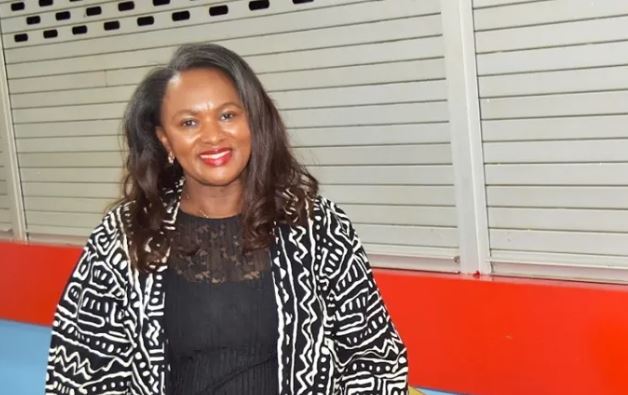
 Emertha Uwanyingira's journey took her via Tanzania, Rwanda, Uganda, Belgium and, finally, Wales./SCREENGRAB
"I remember growing up in two worlds. A country that raised you, and a country that claims you, a country that lives in your blood, but you never really stepped on it."
When Emertha Uwanyingira was a child in Karagwe, north-west Tanzania, she thought she was just like other children, speaking the local language, happily attending the local school.
Friends and family were in and out of the house, and she was surrounded by community.
But in 1990, civil war broke out in neighbouring Rwanda and everything changed.
It was the beginning of a story that was to see Emertha undertake a dangerous and desperate journey to a foreign land all alone, one which she has only told decades later, living thousands of miles away in Wales.
For her family were not Tanzanian but exiles from Rwanda. Her parents and grandparents, ethnic Tutsis, had fled decades earlier after revolution saw the Hutu majority come to power, with resulting violence against Tutsis.
Overnight, her father Sekanyambo Faustin disappeared. Her beloved grandparents were now dead. Her mother Nikuze Maria, a housewife, was left to support the family.
In school, previously a place of happiness and support, everything changed.
A phrase spoken harshly by a teacher changed 11-year-old Emertha's idea about her life forever: "You are the daughter of a rebel."
She learned Sekanyambo had gone to join the Rwanda Patriotic Front (RPF), an army led by fellow Tutsi exile Paul Kagame who invaded in an attempt to overthrow the oppressive regime.
The war was to last four years and end in the genocidal killing of between 500,000 and one million Tutsis and moderate Hutus in a 100-day killing spree.
For Emertha, it meant becoming an outsider in the place she had considered home.
"In earlier years I was just a child, like any other child, enjoying simple joy, play, laugh.
"I didn't have to think whether I belonged to another country. I had a life like every normal childhood."
Now, with her father gone, she was treated differently.
The day he was labelled a rebel she remembers: "All the children in my classroom were looking at me, laughing at me, so I started feeling that I didn't belong. This led me to actually hating school."
She started hiding in a banana plantation instead of going to school, until her mother found out and insisted she went.
The eldest of five, she also helped Nikuze make items to sell at the market in the mornings before school and spent long Saturdays there selling handmade soap and paraffin to support her family.
When she was 13 and taking the exam to move up to secondary school, she received another blow to her identity.
"The head teacher told me I should not have written that I was Tanzanian. Tanzania is all I knew as a child. You could not tell me to write another nationality.
"He shouted at me, told me I was lying [about] my nationality, asked me to write Rwanda on the form. It felt so strange and heavy. That day I felt like, you know what? Enough is enough."
As time went on and the situation in her community became intolerable, Emertha knew she had to do something and wanted to find her father.
"I believed my father was strong, was everything and I knew it was all happening because my father was not there, so I felt vulnerable."
She went to stay with her uncle in Uganda, where she heard the news the RPF had won the war in Rwanda.
"I overheard some people saying they were about to go to Rwanda and I kept on monitoring them to know when they would be leaving. There were four families."
The group were leaving by truck a week after she had arrived and Emertha took her chance.
She jumped onboard and, in the confusion, the families each assumed she belonged to one of the others.
She arrived in Tabagwe, northern Rwanda, with no ID, little money and no idea where her father was after four years.
"In the way of thinking of a child, I thought my father would be there waiting for me.
"When I asked the first soldier that I saw if he knew my father and he shook his head, that was really a great disappointment."
After requesting somewhere to sleep, she stayed at their barracks for a week before walking to another about four hours away to continue her search.
Emertha lived with female soldiers there for a month until she met a soldier from Byumba, about 90km (55 miles) away who thought he recognised the name.
She travelled with the man on the back of a motorbike to his base but it turned out to be false hope before being told her father was at a barracks in the province of Kibungo, far in the south-east of the country.
When she arrived, a soldier at reception confirmed a man with her father's name was there. Believing her search was at an end Emertha watched as a soldier approached her. It wasn't him.
But her psychological yearning overrode everything: "I wanted a father, a real or imaginary. The man looked at me [and said] 'You're my child?'. "I looked at him and said 'yes, I am your child. You are my father'. I knew he wasn't but I couldn't take any other disappointment."
The man kindly said he knew her father but he was not there and she must return to Tanzania to wait for him.
"I don't know if he really knew my father or if he wanted me to just feel OK at that moment. I think it worked because I listened to him."
Getting out of Rwanda was not as easy as coming in had been four months earlier, with checkpoints now in place - Emertha was detained and asked for a passport, a word she did not understand.
A scary few hours followed while border guards established whether her story was true and she was allowed to cross and travel home. In the wake of the genocide, people were suspicious of anyone coming from Rwanda and Emertha was accused of being a spy and had to report to authorities regularly.
She knew she had to get away.
After her family heard that her mother's parents had been able to move from Uganda to their old home in Rwanda, Emertha persuaded her mother to sell up and follow them.
But her father was still absent, so she sent a message to Radio Rwanda saying where they were and asking him to come and find them.
Then, as she played in the street one day, she saw a soldier walking towards her.
"He was my father. So I climbed on him. I hugged him and couldn't let him go."
Her long wait was over: "I felt that warmth that I had missed for a long time."
With her family back together, Emertha's father enrolled her in secondary school at age 16, and she threw herself into her studies.
But the reunion was sadly destined to be short - two years after his return, Sekanyambo died after an illness.
"I'm so grateful for the time we spent together before he died. I think he kind of filled that gap that I had. It was very painful."When Emertha was preparing for university, her mother also died, leaving her needing to work alongside studying to support four siblings until they could be independent.
Then it was time for a change.
"I needed now a space for myself. I went to Belgium to study."
She married and started a family before a chance visit to Wales by her husband George Libon prompted a move in 2017 after he described "how beautiful it is here".
Studying and working in Cardiff made her finally feel accepted.
"Wales gave me the space to sit and look back and reflect on the painful journey I had gone through."
Her reflections led to her book, The Brave Girl Within Me, which she hopes will "empower and uplift" people facing rejection or issues of identity.
She says neither Rwandan, Tanzanian nor Welsh fully describes who she feels she is.
"Honestly, I think I'm just a child of the world.
"I belong to none, but I belong to all of them. Being a human is enough of an identity for me."