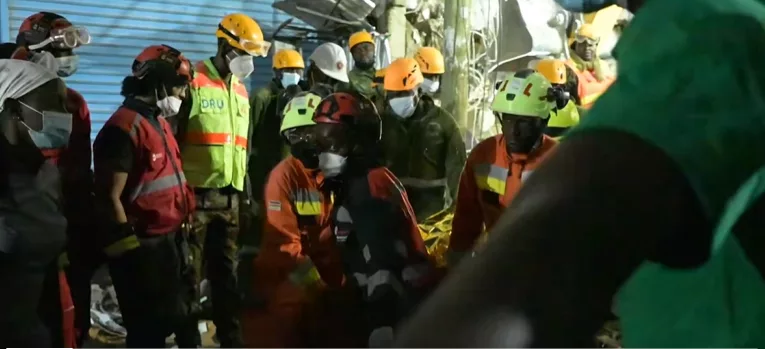
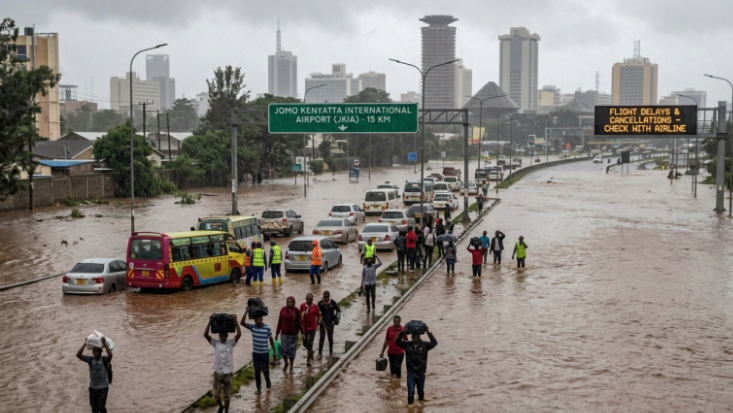
 The aftermath of
heavy rains that pounded Nairobi City County on March 6, 2026/FILE
The aftermath of
heavy rains that pounded Nairobi City County on March 6, 2026/FILEKenya has been experiencing heavy rains since early March, triggering widespread flooding in several parts of the country, displacing thousands of families and disrupting transport, water supply and other essential services.
Rivers have burst their banks in some areas while drainage systems in major towns, particularly Nairobi, have been overwhelmed by the downpours, leaving homes submerged and roads impassable.
The death toll from the devastating floods has now risen to 66, with Nairobi recording the highest number of fatalities, even as authorities intensify rescue operations and warn residents to remain vigilant amid continued rainfall.
According to the National Police Service (NPS), the victims include 50 men, eight women and eight children who have died in incidents linked to the floods across the country.
Nairobi accounts for 33 of the deaths, followed by the Eastern region with 18 fatalities and the Rift Valley region with eight.
Other regions reporting fatalities include Nyanza with four deaths, the Coast region with two, and Central Kenya with one, highlighting the widespread impact of the ongoing disaster.
Police said more than 2,000 families have been displaced as rising waters continue to destroy homes, infrastructure and livelihoods in several counties.
“As the rains persist in various parts of the country, we urge members of the public to exercise extreme caution and adhere to updates and safety advisories issued by the Kenya Meteorological Department and other relevant government agencies,” the police said in a statement on Sunday.
Nairobi identifies 37 flood-prone areas
As heavy rains continue, a mapping exercise conducted under the Nairobi Rivers Regeneration Programme has identified 37 neighbourhoods in Nairobi that are highly vulnerable to flooding.
The assessment revealed that many of the affected areas lie along major river corridors, particularly the Nairobi River, Ngong River, and Mathare River, where settlements and infrastructure are located close to riverbanks.
In Nairobi East, areas flagged as flood-prone include Kiambiu, Dandora, Kariobangi, Kayole, Komarock, Njiru, Ruai, Mwiki, Donholm, Savannah, Tassia and Fedha.
In the Nairobi West corridor, authorities identified Madaraka, Nairobi West, Lang’ata, Kawangware, Kangemi, Lavington, Westlands, Parklands, Kitisuru, Spring Valley, Kileleshwa and Chiromo.
Neighbourhoods along the Mathare River in Nairobi North, including Mathare, Korogocho and Lucky Summer, were also listed as high-risk due to dense settlements built close to riverbanks.
Within the Nairobi Central area, locations such as the Central Business District (CBD), Globe, Gikomba, Eastleigh and the Industrial Area have also been identified as vulnerable.
In Nairobi South, the mapping highlights Kilimani, Kibera, South C, South B, Mukuru Kwa Reuben and Kwa Njenga, many of which lie along the Ngong River corridor.
Authorities have urged residents living in low-lying and riparian areas to remain cautious as rains persist.
Rescue operations continue
Emergency response teams remain on high alert following severe flooding that struck Nairobi over the weekend, leaving several roads impassable and triggering rescue operations.
Heavy rainfall on Saturday night caused widespread flooding across the capital, affecting areas including Parklands, Ngong Road near Ngando, Lower Kabete, Kibera, Kilimani, South B, Kawangware, Lang’ata, Lavington, Eastleigh and Riruta.
Major traffic disruptions were reported along key routes such as the Nairobi Expressway near the Museum Hill exit, Limuru Road, Bunyala Road, Lusaka Road and parts of the CBD, as floodwaters submerged sections of the roads.
The Kenya Red Cross Society said its Aqua Rescue teams saved 11 people who were stranded in a marooned matatu along Bunyala Road. In a separate incident in Kilimani, rescuers saved two children trapped inside a house after rising floodwaters entered the building.
Authorities confirmed that both the Nairobi River and Ngong River had burst their banks, triggering riverine flooding in nearby settlements.
Water supply disruptions
The floods have also disrupted essential services, including water supply in several parts of Nairobi.
The Nairobi Water and Sewerage Company said repairs are ongoing on a damaged transmission pipeline along Outering Road, but operations have been slowed by persistent rains.
“Due to safety concerns for our staff and equipment, we had to halt works temporarily. We hope to resume and complete repairs later today, weather permitting,” the company said.
Residents affected by the disruption include those living in Buruburu Phases 1 and 2, Kariobangi North and South, Dandora Phase 1, Mathare, Eastleigh Section 3, Kiambiu, Jerusalem, Uhuru, Jericho, Ofafa and Harambee estates.
Other affected areas include Korogocho, Lower Kabete Lane and Brookeside Drive.
The company has advised residents to order water through its bowser services by dialling *260# and selecting Option 5.
Nairobi already faces chronic water shortages, with daily demand exceeding 900 million litres against a supply of about 525 million litres, a gap worsened by damaged infrastructure and leaks.
Authorities say the floods have destroyed homes, submerged farms and disrupted transport networks across the country.
The Ministry of Interior and National Administration earlier reported that 12,338 homes had been destroyed or submerged, leaving thousands of residents without shelter.
Several roads and bridges remain impassable in affected counties, slowing rescue and relief operations.
Schools in some regions have also been forced to close after floodwaters entered classrooms or cut off access roads.
At the University of Nairobi, students were forced to wade through flooded hostel corridors after heavy rains overwhelmed drainage systems on Saturday night. Videos shared online showed water entering rooms and soaking students’ belongings.
Government response
President William Ruto has assured Kenyans that the government has mobilised all relevant agencies to respond to the crisis.
“The ongoing heavy rains affecting several parts of our country continue to put lives and livelihoods at risk. My thoughts are with the families and communities that have already been affected during this difficult period,” the president said.
He said the government had activated a multi-agency emergency response bringing together security agencies, humanitarian organisations and technical departments to coordinate rescue and relief efforts.
“Relevant agencies are currently conducting rescue and evacuation operations while also clearing blocked drainage systems and restoring access routes in affected areas,” he said.
Emergency food supplies and medical assistance are also being delivered to affected communities.
Counties also affected
Beyond Nairobi, several counties are grappling with severe flooding.
In Kisumu and Homa Bay, hundreds of families have been displaced after River Miriu burst its banks, flooding villages and destroying crops.
In Nyakach, Kisumu County, more than 700 residents have fled their homes, while in Karachuonyo constituency in Homa Bay, about 500 families have been displaced.
Local authorities have established evacuation centres in schools and churches to shelter affected families.
Weather warning
The Kenya Meteorological Department has warned that the risk of flooding and landslides remains high even if rainfall intensity decreases.
Acting Director of Meteorological Services Edward Muriuki said the ground in many areas is already saturated after days of heavy rainfall.
“Rainfall may persist into early next week, maintaining elevated risks of flooding, landslides and water contamination,” Muriuki said.
He noted that some weather stations recorded extremely high rainfall, including about 160 millimetres within 24 hours at Wilson Airport in Nairobi.
Kenya Met say climate change, poor drainage systems and unregulated development along waterways have worsened the flooding problem in urban areas.
Calls for long-term solutions
Civil society organisations have called for urgent reforms in urban planning, drainage infrastructure and disaster preparedness.
Groups including Resilience Action Network Africa (RANA) and People’s Health Movement Kenya say the disaster exposes long-standing weaknesses in urban planning and flood management.
“The loss of life and property is not just due to heavy rains. It exposes long-standing flaws in urban planning, drainage and emergency preparedness,” said People’s Health Movement Kenya national coordinator Dan Owala.
They are calling for improved early-warning systems, stronger enforcement of planning regulations and investment in climate-resilient infrastructure to reduce the impact of future disasters.
Meanwhile, authorities have urged residents living in flood-prone areas to move to safer ground and avoid crossing flooded roads and rivers as rescue operations continue across the country.