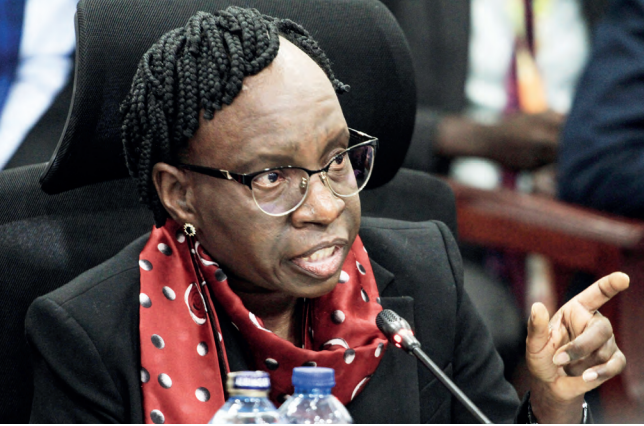
Auditor General Nancy Gathungu has questioned Sh92.8 billion in education capitation funds, citing unverified data being used in the disbursements.
She said the expenditure is in doubt because the State Department for Basic Education has not provided evidence that the student enrolment figures used to allocate the funds were verified.
Gathungu issued a qualified opinion on the department’s financial statements in her audit report for the financial year ending June 30, 2025.
She has cited weak financial controls, irregular fund reallocations, procurement breaches and staffing challenges.
At the centre of the audit concerns is the Sh92.8 billion disbursed under the Free Primary Education (FPE), Junior Secondary Education (JSE) and Free Day Secondary Education (FDSE) programmes.
The funds were released based on enrolment data captured in the National Education Management Information System (Nemis), which is used to determine capitation allocations to schools.
However, the auditor said the state department did not provide evidence that the enrolment data had been verified by subcounty directors of education before the funds were transferred.
“Management did not provide for audit review evidence of the students’ enrolment data in Nemis having been verified by the respective subcounty directors of education before the funds are transferred to the individual schools,” the report states.
As a result, the auditor said the accuracy, completeness and regularity of the funds could not be confirmed.
“In the circumstances, the accuracy, completeness and regularity of transfers of Free Primary Education (FPE), Junior Secondary Education (JSE) and Free Day Secondary Education (FDSE) totalling Sh92,806,469,242 could not be confirmed,” Gathungu said.
According to the report, the funds included Sh7.6 billion for Free Primary Education, Sh30.4 billion for Junior Secondary Education, and Sh54.7 billion for Free Day Secondary Education.
The findings raise fresh concerns over the reliability of enrolment figures used to determine school funding.
The report has been published hot on the heels of a recent audit by the Education ministry, which unearthed more than 900,000 ghost learners.
More than 885,000 pupils were unaccounted for, and 87,000 for the case of secondary schools, highlighting the huge discrepancies in Nemis.
The audit discovered 33 schools that received funding yet did not exist. About Sh4 billion may have been lost in the inexistent schools alone.
Twenty head teachers face disciplinary action following the enrolment audit findings.
Head of Public Service Felix Koskei chaired a meeting Friday following the concerns, in which it was resolved that heads of schools will be appearing before committees of the National Assembly to respond to the audit queries.
The audit also questioned Sh1.39 billion in infrastructure grants disbursed to 295 primary and secondary schools.
The money, which had been approved in the 2024-25 budget, was released in July 2025, outside the reporting period for the financial year under review.
“Disbursements were made in the month of July 2025, outside the reporting period for the financial year 2024-25, resulting in violation of cut-off procedures,” the auditor said.
The move resulted in the financial statements overstating transfers to other government entities.
“In the circumstances, the transfers to other government entities amount are overstated by Sh1,395,500,000,” the report notes.
Further scrutiny of the infrastructure grants revealed irregular reallocations of funds meant for school projects.
Out of the Sh1.39 billion disbursed, Sh672.5 million went to 106 schools that were not included in the approved budget list, while schools that had been approved for funding received much less.
A total of 209 schools allocated Sh756.5 million received only Sh84 million, while 11 schools were overfunded with Sh381 million against an approved allocation of Sh97 million.
The auditor said the reallocations violated provisions of the Public Finance Management Act that restrict movement of funds appropriated for transfers to other entities.
“In the circumstances, management was in breach of the law,” the report states.
The audit also flagged procurement irregularities involving Sh7.37 million spent on live media coverage of a National Conversation Forum on curriculum-based education held in Nairobi on April 24, 2025.
The services were procured from four media firms, but auditors found that key procurement procedures were not followed.
Among the anomalies cited were the failure to establish an evaluation committee, absence of a written contract and failure to notify the Public Procurement Regulatory Authority about the direct procurement.
“The use of direct procurement without proper justification limits competition and may result in the loss of value for money,” the auditor said.
The report also highlights discrepancies in the department’s financial records.
Receipts amounting to Sh293.4 million could not be fully confirmed, including Sh39.9 million owed by a foreign attaché.
In addition, revenue amounting to Sh285.1 million collected through the e-Citizen platform was not in the department’s financial statements.
Some Sh1.48 million owed to the Postal Corporation of Kenya was not reported, raising questions about the accuracy of reported pending bills.
Budget management was also flagged as an area of concern.
The department received Sh133.5 billion against a budget of Sh136.7 billion, resulting in a Sh3.25 billion shortfall that may have affected planned programmes.
At the same time, auditors noted unbudgeted asset acquisition expenditure of Sh213 million.
“The underfunding affected the planned activities and may have impacted negatively on service delivery to the public,” Gathungu said.
The report also highlights staffing challenges. Out of an approved establishment of 9,587 positions, only 4,890 staff were in post, leaving a shortfall of 4,697 employees.
The audit also notes that several issues raised in previous reports, including weak oversight of Nemis and pending bills, remain unresolved.
ANALYSIS
NEMIS has been flagged for inaccuracies in previous audits, begging the question on why corrective measures are yet to be instigated. The system cost taxpayers hundreds of millions yet still remains porous, susceptible to manipulation by unscrupulous officers.