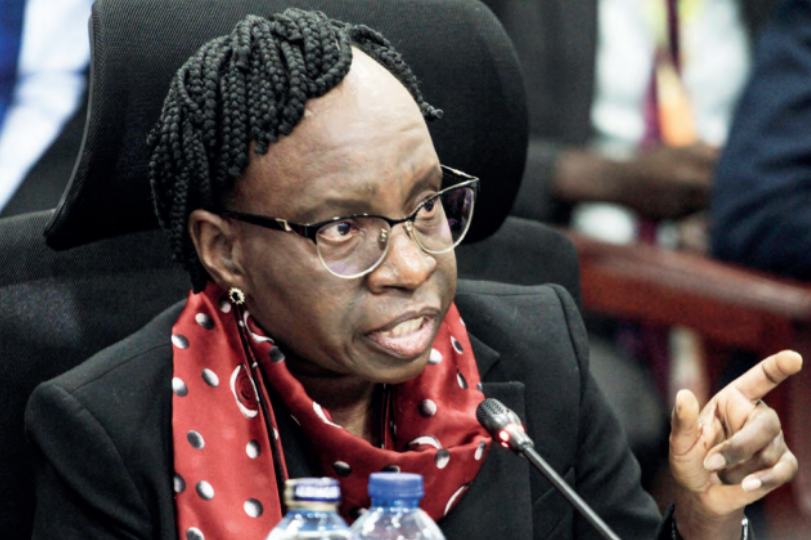
Only five out of Kenya’s 290 constituencies fully automated their bursary application and disbursement processes between the financial years 2021 and 2025, a new report by Auditor-General has revealed.
The report, tabled in the National Assembly by Auditor General Nancy Gathungu, identified the constituencies that implemented full automation as South Mugirango Constituency, Uriri Constituency, Mwala Constituency, Gatanga Constituency and Emgwen Constituency.
According to the audit findings, the majority of constituencies continue to rely on manual systems for processing bursary applications under the National Government Constituencies Development Fund (NG-CDF).
Monitoring reports cited in the audit showed that 282 constituencies processed bursary applications manually during the period under review.
“This limited access to application forms to students studying outside their home constituencies, those living far from constituency offices, and persons with disabilities who could not easily obtain or submit physical application forms,” the report stated.
The report also noted that while some constituencies attempted to digitise their systems, the initiatives faced significant setbacks.
For instance, Garissa Township Constituency, Kacheliba Constituency and Narok East Constituency introduced online application systems but struggled with implementation challenges.
Among the key issues cited were data security gaps, unstable internet connectivity and incomplete system setups, which hindered effective operation of the digital platforms.
However, the Auditor General observed that constituencies that had fully automated their systems experienced notable improvements in service delivery.
“The audit established that full automation resulted in improved efficiency and transparency in the bursary and scholarship application and disbursement processes,” the report noted.
Uriri MP Mark Nyamita noted that they have been having online bursary applications now for three years.
“We had feedback and we have modified the system to respond to those feedbacks.
We have so far trained our staff and the entire bursary committee members across the constituency,” he pointed out.
The Auditor General remarked that continued reliance on manual application processes was largely attributed to the failure by the NG-CDF Board to make adequate investments in information and communication technology infrastructure.
The report said the Board had not sufficiently supported the development and operationalisation of integrated information systems that could streamline bursary and scholarship management.
The NG-CDF Guidelines for Administration of Bursary Schemes, 2020 require constituency committees to put in place systems for identifying beneficiaries that promote community participation, transparency and inclusivity.
The NG-CDF bursary program is designed to support needy and deserving learners from low-income families or those who demonstrate financial need in order to continue their education.
During the three-year period under review, constituencies spent a total of Sh55.72 billion on bursaries and scholarships. The fund supported approximately 1.8 million learners in the 2021/2022 financial year, 1.3 million in 2022/2023 and another 1.8 million in 2023/2024.
Despite the large allocation of funds, the Auditor General warned that the continued use of manual processes had significantly limited access to bursary opportunities for many deserving students.
The audit also flagged inefficiencies in the mode of disbursement, particularly the use of cheques to release funds to beneficiaries.
The report revealed that in the 2024/2025 financial year alone, five constituencies recorded unpresented cheques totaling Sh722,636,387. According to the Auditor General, the amount could have fully sponsored approximately 18,065 students in extra-county schools on full scholarship.
Additionally, five constituencies reported cases of stale cheques amounting to Sh14,174,132. The funds, the report noted, could have supported about 351 students in extra-county schools for an entire academic year.