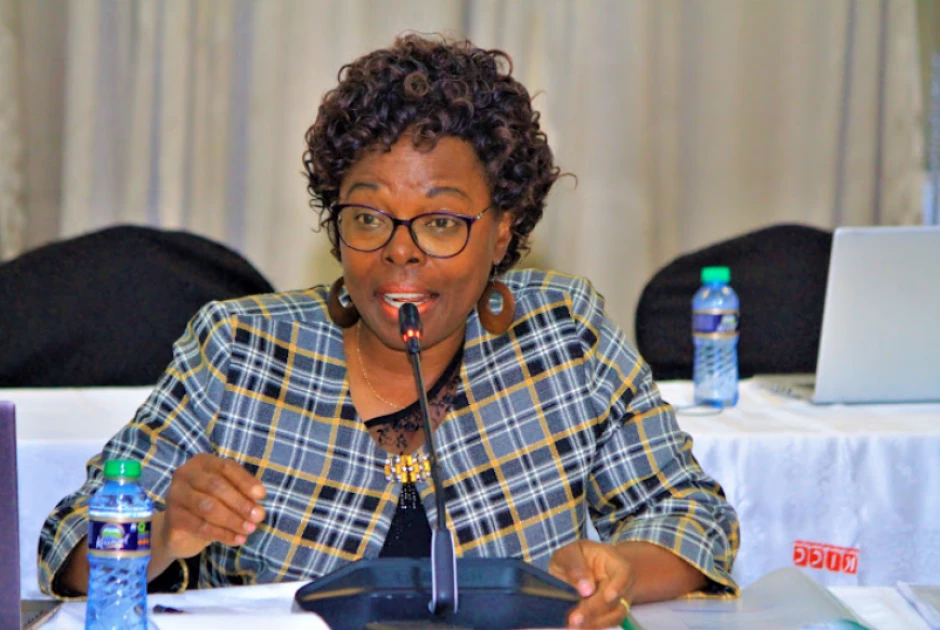
 Controller of Budget Margaret Nyakang’o/FILE
Fresh revelations about lavish government spending have cast doubt on the effectiveness of austerity measures announced by President William Ruto’s administration.
A new report shows that public officers spent more than Sh8 billion on travel and hospitality in just three months. This raises questions about the government’s commitment to cutting unnecessary expenditure.
The findings are contained in the National Government Budget Implementation Review report covering the first half of the current financial year, released on Monday.
The revelations come at a time when the country is grappling with devastating floods and prolonged drought that have left thousands of families in urgent need of humanitarian assistance.
According to the report by Controller of Budget Margaret Nyakang’o, government institutions spent Sh14.83 billion on foreign travel, domestic travel and hospitality between July and December 2025.
However, a closer analysis of the data reveals a sharp surge in spending within a short period.
In the first three months of the financial year, the government had spent Sh7.15 billion on the same items.
This means an additional Sh7.6 billion was spent between September and December alone.
The figures raise concerns about fiscal discipline, particularly after repeated promises by the government to cut spending amid a growing cash crunch and rising public debt.
Experts say the Sh8 billion spent within three months could have significantly supported climate-related disaster response.
This includes humanitarian relief, rebuilding damaged infrastructure and strengthening long-term resilience programmes.
Instead, the funds went towards travel allowances, trips and hospitality costs such as accommodation, meals, refreshments and entertainment for government officials and state guests.
The spike in expenditure comes barely two years after President Ruto announced sweeping austerity measures aimed at reducing government spending and easing pressure on the national budget.
In 2024, the President unveiled a raft of cost-cutting measures that included slashing budgets for executive offices.
He also reduced the number of advisers in government by at least 50 per cent and scrapped confidential budgets across several offices.
“The budgetary provisions for confidential budgets in various Executive offices, including my office, shall be removed, and the budget for renovations across government reduced by 50 per cent,” the President said at the time.
He also announced that budgets allocated to the offices of the First Lady, the Second Lady and the spouse of the Prime Cabinet Secretary would be scrapped as part of the austerity drive.
In addition, the government pledged to streamline operations by dissolving at least 47 state corporations with overlapping functions to reduce operational and maintenance costs.
However, the latest figures suggest that spending on travel and hospitality remains high across several government institutions.
Data from the Controller of Budget’s report shows that foreign travel expenses rose sharply from Sh872.5 million in September to Sh3.13 billion by December.
Domestic travel expenditure also increased significantly during the same period, rising from Sh4.09 billion to Sh7.74 billion.
Hospitality spending — which includes meals, office refreshments and entertainment for official guests — climbed from Sh2.19 billion to Sh3.95 billion.
Among the biggest spenders was State House, which spent Sh336.52 million on hospitality as of December 31, 2025, up from Sh199.21 million recorded in the first three months of the financial year.
The report further shows that State House had already spent 92 per cent of its annual budget by the end of December, with recurrent expenditure accounting for the largest share.
The Office of the Deputy President was also among the top spenders, using Sh262.43 million on hospitality in the first six months of the financial year.
Other government entities that recorded high hospitality expenditure include the Ministry of Interior and National Administration, which spent Sh610.63 million and the Ministry of Foreign Affairs, which used Sh118.84 million during the same period.
Additional high spenders included the National Treasury, which spent Sh112.12 million and the Department of Culture and Heritage (Sh130.88 million).
Others are the Judiciary (Sh243.76 million), the Office of the Director of Public Prosecutions (Sh135.73 million) and the National Assembly (Sh133.02 million).
Spending on travel also remained high across several departments.
The National Treasury spent Sh129.45 million on domestic travel within six months, while the Department of Lands used Sh299.44 million on similar expenses.
The Judiciary recorded one of the highest domestic travel expenditures, spending Sh411.92 million in the first half of the financial year.
Foreign travel spending was also substantial, particularly within the Ministry of Foreign Affairs.
The State Department for Foreign Affairs spent Sh1.08 billion on foreign trips within six months, a sharp increase from the Sh253.51 million spent in the first three months of the financial year.
Other notable foreign travel expenditures included the Office of the Auditor General, which spent Sh69.97 million, the Executive Office of the President, which spent Sh11.65 million and the Office of the Deputy President, which used Sh63.88 million.
Parliament also emerged as one of the biggest spenders on travel.
According to the report, spending on domestic and foreign travel by Parliament rose to Sh4.05 billion by December, up from Sh1.67 billion recorded in September.
This translates to an average expenditure of about Sh26 million per day on travel between September and December.
The National Assembly accounted for the bulk of the expenditure, spending Sh1.899 billion on domestic travel and Sh821.17 million on foreign travel in the first six months of the financial year.
This marks a sharp increase compared with the Sh936.59 million spent on domestic travel and Sh138.87 million on foreign travel during the first three months.
The Senate also recorded substantial travel expenses, spending Sh595.7 million on domestic travel and Sh483.05 million on foreign trips within six months.
In the first quarter of the financial year, the Senate had spent Sh310.42 million on domestic travel and Sh162.82 million on foreign travel.
Hospitality spending within Parliament also increased over the same period.
The National Assembly spent Sh133.02 million on hospitality in six months, up from Sh49.25 million recorded in the first three months.
The Senate spent Sh51.69 million on hospitality within six months, compared with Sh25.44 million in the first quarter.