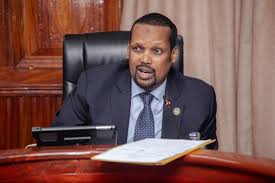
Senate Finance and Budget Committee chairman Ali Roba
Senators have warned
that the increasing public debt is unsustainable as the Treasury relies heavily
on expensive domestic borrowing.
Advertisement
Advertisement
A report by the Senate
Finance and Budget Committee shows that public and publicly guaranteed debt was
Sh12.3 trillion in December 2025, equivalent to 67.5 per cent of Kenya’s GDP.
This level of
indebtedness is well above the 55 per cent threshold set under the Public Finance
Management (PFM) framework, raising questions over long-term sustainability.
“Without sustained
fiscal consolidation and prudent debt management, Kenya risks breaching its
obligations under the PFM Act,” the report read.
Committee chairman
Senator Ali Roba of Mandera tabled the report in the House.
The report forms part
of Parliament’s review of the 2026 Medium-Term Debt Management Strategy (MTDS)
submitted by the National Treasury.
Advertisement
Advertisement
It shows government
plans to rely heavily on domestic borrowing over the next three financial
years, with 78 per cent of net borrowing expected from local sources and 22 per
cent from external sources between 2026-27 and 2028-29.
“Domestic borrowing
may be easier to access, but it comes with higher interest rates and shorter
repayment periods,” Roba said. “This could place enormous pressure on the
national budget.”
The committee also
warned that nearly 45 per cent of domestic debt will mature within three years ¾ with 21.6 per cent
maturing within one year.
“This concentration of
near-term maturities exposes Kenya to refinancing risk, particularly if
domestic liquidity tightens or interest rates rise,” the report notes.
Currently, domestic
debt stands at Sh6.84 trillion, accounting for 55.6 per cent of total debt, while
external debt totals Sh5.46 trillion.
Most domestic
borrowing comes in the form of Treasury bonds and Treasury bills issued in the
local market.
Senators expressed
concern that rising debt obligations could further tighten fiscal space and
reduce funding for development projects.
By June 2025, the
government spent Sh1.72 trillion on debt servicing, up from Sh1.56 trillion in
2024.
Domestic debt
accounted for Sh1.14 trillion, while external debt servicing stood at Sh579
billion.
Debt servicing now consumes
more than 71 per cent of government revenue, up from 69 per cent the previous
year.
Stakeholders who
submitted views to the committee also raised concerns about increased borrowing.
The Institute of
Certified Public Accountants of Kenya cautioned that sustained domestic
borrowing could crowd out the private sector’s access to credit.
“Excessive government
borrowing from the local market limits funds available for businesses, which
could slow down economic growth,” ICPAK chief executive James Mwangi said.
Similarly, the Council
of Governors warned that debt servicing reduces revenue available for counties.
“More than half of the
country’s projected ordinary revenue is going into debt servicing, leaving
counties with much less to deliver essential services,” CoG said.
The Medium-Term Debt
Management Strategy highlights plans to diversify borrowing through instruments
such as diaspora bonds, green bonds, and sustainability-linked bonds.
Senators cautioned,
however, that these instruments carry risks.
“We must evaluate all
new instruments carefully. Innovative financing should not become an additional
burden to taxpayers,” the senators said.
The committee also
raised concerns about structured financing arrangements such as securitisation
and collateralised borrowing, some of which include government guarantees.
“If expected revenues
fail, these arrangements could be converted into direct public debt,
compounding the problem,” the Senate report warns.
To enhance
transparency, the committee recommended the National Treasury submits a
detailed report to Parliament within 60 days, outlining the structure, costs,
and risks of all new debt instruments.
Senators also urged
the government to prioritise efficient use of public resources and invest in
projects with high economic returns.
Additionally, the
report recommends maintaining the fiscal deficit at 5.3 per cent of GDP in
2026-27, gradually reducing it to 3.6 per cent in 2027-28 and 3.3 per cent in
2028-29.
“Achieving sustainable
debt levels will require disciplined borrowing, stronger revenue collection,
and careful spending,” Senator Roba said.