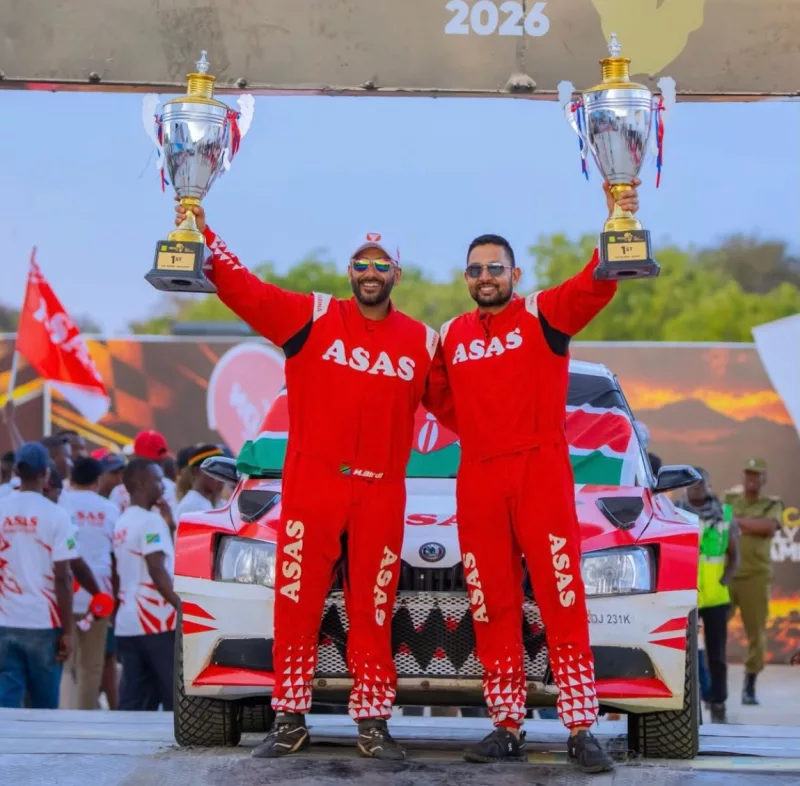
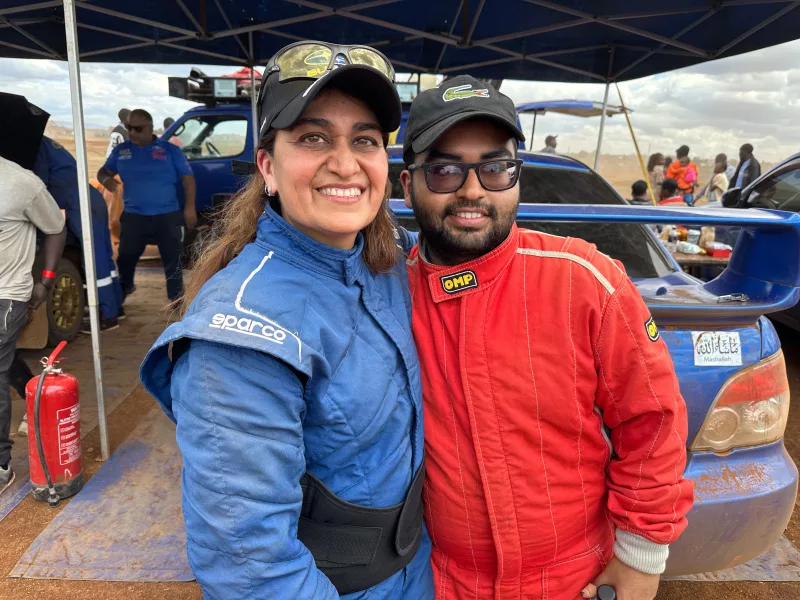
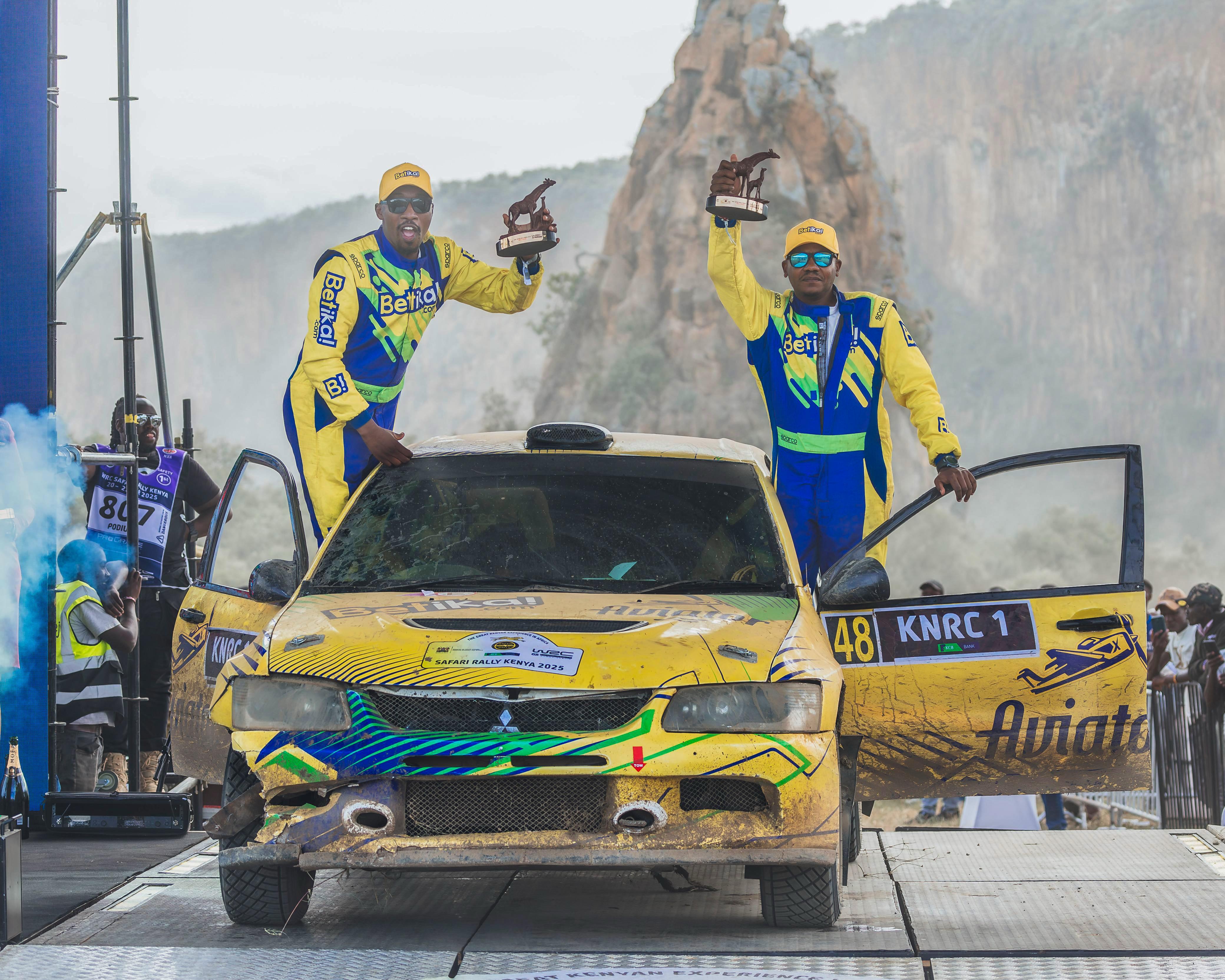
 Ishmael Azeli (L) and his navigator John Ngugi during the 2025 WRC Safari Rally/ HANDOUT
Few sporting spectacles stir the soul of a nation quite like the Safari Rally Kenya.
For generations, the rally has been more than just another round of the World Rally Championship.
It is a cultural event, a mechanical theatre played out across the unforgiving landscapes of Kenya, where roaring engines, flying gravel and fearless drivers collide with the raw brutality of nature.
Every year, it pulls crowds to dusty roadside vantage points, where fans wait patiently under the sun just to witness a fleeting moment of brilliance as rally machines blast through the stages in clouds of thick, choking dust.
First staged in 1953 to celebrate the coronation of Queen Elizabeth II, the Safari Rally quickly carved out a reputation as one of the toughest motorsport events on the planet.
For decades, it served up some of the most dramatic and electrifying performances in global rallying.
When the event returned to the WRC calendar in 2021 after nearly two decades away, it was greeted with immense excitement.
The global motorsport community once again had the chance to experience the unpredictable magic of a rally famed for its brutal terrain, unpredictable weather, roaming wildlife and sheer endurance.
But beyond the dust, speed and mechanical brilliance, Safari Rally week carries something deeper.
It is a time when fathers introduce their sons to the world of rallying. A time when families gather to witness engineering masterpieces scream through the wilderness. A time when strangers become friends along the stages, united by a shared love for the sport.
For rally driver Ishmael Azeli, those childhood memories would one day evolve into a dream and eventually, into reality.
Set to compete in only his third WRC Safari Rally alongside navigator John Ngugi, Azeli vividly recalls how his fascination with the sport was ignited at a tender age.
Born on August 6, 1989, at Nairobi’s Pumwani Hospital, Azeli’s earliest encounters with the Safari Rally came long before he sat behind the wheel.
They came from the best seat a young boy could have, his father’s shoulders.
“I have grown up loving cars, and I had a keen interest in how machines work. My dad used to carry me on his shoulders to go watch the Safari Rally flag off at Kasarani, then we’d go back home and follow the rest of the rally on the TV,” Azeli recalls.
“Sometimes, when possible, we would go and stand along the Nairobi-Nakuru highway just to get a glimpse of the cars speeding away.”
Those childhood glimpses of roaring engines and flying gravel planted a seed that would stay alive through his formative years.
Yet, like many dreams, life would briefly steer him down another road. Despite his deep passion for cars, Azeli had to make a practical choice after high school.
“Despite my love for cars. I had, after high school, to look for a career that would put food on the table, so I ventured into filmmaking,” he says.
Today, the 36-year-old father of three stands as one of Kenya’s most accomplished filmmakers. Through the lens, Azeli has told powerful stories that have travelled across film festivals and screens around the world.
He is an accomplished director and cinematographer known for his work on films such as Poacher (2018), Neptune Frost (2021) and Ayaanle (2022).
His work has earned him numerous accolades, including Best Cinematography Short Film at the 2020 Eldoret Film Festival for Silence, Best Documentary Short at the 2023 North Hollywood Cinefest for Finding Ubuntu, Best Cinematographer at the 2023 Africa International Horror Film Festival and Best Horror Film at the 2024 Norwescon Speculative Film Fest.
Azeli has also received nominations at the Kalasha International Awards, including Best Cinematography Short Film for Poacher in 2018 and Best Cinematography for Last Supper in 2022.
Recently, he directed and shot the Nike television commercial featuring Kenyan marathon legend and two-time Olympic champion Eliud Kipchoge.
“Just the way I grew up loving cars, I also had a keen interest in technology and how cameras work. Filmmaking for me was the only right option," he says.
But like any enduring love story, Azeli’s relationship with motorsport would eventually find its way back.
While working as a cinematographer, Azeli often found himself filming the Safari Rally from helicopters, capturing breathtaking aerial footage of rally cars carving through Kenya’s rugged landscapes.
“I used to film rally cars at the Safari on the chopper and I developed even more love and interest in being in a rally car one day. I love those two worlds, cameras and cars,” he said.
Eventually, watching from the air was no longer enough.
Four years ago, Azeli decided to take a bold step and purchased a Subaru GS8 to begin his journey into competitive rallying.
“Mindo Gatimu and Erick Bengi introduced me to rallying four years ago. They showed me the ropes, taught me about the protocols and how it is important to be in a club," he reveals.
Learning the art of rally driving is rarely smooth. The sport demands courage, discipline and a deep understanding of both machine and terrain.
For Azeli, those early years were filled with lessons, some of them harsh, but they were all part of the journey.
“After that, I bought my first Rally car, a Subaru GS8, to get into competitive rallying. I rolled a couple of times while I was still learning, but I got back on track,” he said.
In 2024, that journey delivered a moment he had imagined since childhood.
Azeli lined up for his debut in the Safari Rally, the very rally he once watched perched on his father’s shoulders and later filmed from a helicopter.
But making it to the Safari Rally start line is far from simple. Azeli explains that entering a WRC event involves strict regulations and multiple layers of qualification.
“There are a couple of qualifications that have to be passed so that you can compete in the WRC Safari Rally. Firstly, you need to have experience driving and be approved by KMSF (Kenya Motorsport Federation) with a valid licence,” Azeli reveals.
Drivers must also compete in several local events sanctioned by the federation.
“You must also have done several local races and acquired an FIA (Fédération Internationale de l'Automobile) licence through KMSF,” he adds.
Beyond the driver, the rally car must meet strict international safety and performance standards.
Vehicles must be approved by the FIA to meet safety and performance requirements, typically within the Rally1, Rally2 or Rally3 categories and maintained by a qualified technical team.
“Scrutineering tests must have a certificate, and the company that gives you the certificate must be certified by FIA," observes Azeli.
Scrutineering in rallying is a mandatory, detailed safety and technical inspection conducted by officials before an event to ensure vehicles and crew equipment meet strict safety standards and competition regulations.
It verifies compliance with rules regarding roll cages, safety gear, and, if passed, grants permission to compete. Safety requirements are uncompromising.
“The car must have a fireproof tank that does not come from the car manufacturer; you have to modify that yourself and it has to be approved. Also, you need fireproof suits,” he says.
Rally suits are highly specialised, designed for long and physically demanding stages.
They prioritise flexibility and ergonomic comfort while incorporating durable materials and stretch panels suited for working on cars in rugged environments. Beyond machinery and safety gear, FIA regulations also govern tyres and fuel.
“There is a certain type of tyre we use for the Safari Rally; for the past two or three years, it has been Hankook tyres. For fuel, only one company serves the entire rally; for this year, the fuel supplier is Total Energies. They switch the fuel and tyre suppliers after some time," he says.
Then there is the enormous logistical planning required.
“There is a time frame given to acquire all requirements, like ordering sufficient fuel and tyres to be ready before the rally. For tyres, the maximum number to order is 16.”
“For fuel, the organisers send out routes in kilometres so that suppliers can calculate the size of the engine and how much fuel is needed.”
When Azeli finally stepped onto the Safari Rally stage in 2024, he was determined to make the most of the moment. Modifications on his Subaru GS8 were necessary.
“We modified the engine to give the car more power because we were now in a big stage," he reveals.
The gamble almost paid off.
“We were leading the national category for two days, but on the final day of the championship, the engine blew up, and we were retired early,” he recalls. “It was a really big blow for us but from that experience, I learnt to push my adrenaline but also be composed while driving."
Rather than discouraging him, the setback only sharpened his resolve. The following year, Azeli returned to the Safari Rally with a Mitsubishi Evolution 9.
“We had a new, upgraded car and it really gave us a good run. It was amazing. I really enjoyed it. We were able to finish the rally and get on the podium (in the national category), which was a big achievement,” he says.
Azeli and Ngugi clocked a cumulative time of 4:05:06.5, finishing 14th on the national classification.
Now, with another Safari Rally on the horizon, the duo are eager to push further.
“We have gathered mistakes and lessons from the past two years and believe we have learnt from them. We shall do our very best to be competitive," he says.
“This year we signed up for the WRC, KNRC and the ARC.”
A new car, Subaru WRX GVB, has boosted their confidence.
“This year, we will be in a Subaru WRX GVB. It is one of the best Subaru factory cars. I believe we will have a good run because the car has a better engine, better mapping and better suspension,” he says.
Interestingly, that was not the original plan.
“We had ordered a Skoda Fabia and we were hoping it would be delivered early enough, but because of logistical issues, we realised it would not arrive in Kenya on time.”
Still, Azeli believes the Subaru is more than capable of delivering.
“The car puts us in a better class, the WRC2 category," he adds.
The main competition classes in the WRC are Rally1 (RC1), Rally2 (WRC2/RC2), Rally3 (WRC3/RC3), Rally4 (JWRC/RC4), and Rally5 (RC5)
WRC1 (often called Rally1) is the top-tier, manufacturer-backed category featuring the fastest hybrid-powered cars, while WRC2 is the primary support championship for privateers and teams using less powerful, production-based Rally2 cars.
WRC1 focuses on elite performance, whereas WRC2 serves as a pathway for drivers to move up to the top level.
Preparations for the Safari Rally, Azeli explains, have been meticulous.
“Our itinerary was determined 3-4 weeks ago and we have already placed orders for all necessary materials. Our preparations began as early as October, when we started booking hotels, because I have a crew of around 20 people, including my co-driver, mechanics, and our families as well," he reveals.
“I have also been doing a lot of local meetings like the Motocross Championship and the RX championship, where I am the current Open Class champion."
Yet rallying remains an expensive pursuit, one that Azeli believes requires stronger grassroots support in Kenya.
“In Kenya, there is a notion that rallying is a Whiteman’s sport. We come from families where the sport is not considered part of our culture. And when one gets into rallying, people tend to think you have a lot of money. We have to start supporting and nurturing talent at a very tender age," he says.
“In addition, you can’t race without proper funding; you need to have sponsors."
For this year’s Safari Rally campaign, Azeli will be backed by KenGen, Betika, WhiteCap and Shell.
He believes Kenya’s lack of automobile manufacturing limits the country’s growth in rallying.
“The reason international rally drivers do so well is that they have access to top cars, and manufacturers have pitched camp in their nations. Unlike Kenya, where we only have dealerships. If we had manufacturing companies in Kenya, then we would have access to top-class rallying cars," he opines.
Still, the sport continues to reward him with unforgettable moments.
“The highlight moments for me since I began my journey were leading at the national event Safari Rally for two days and also making it to the podium last year," he adds.
“I also had the privilege this year of driving YouTube star IshowSpeed when he came to Kenya. It was an amazing experience for me.”
Yet perhaps the most powerful moment came not on a rally stage, but in a classroom.
“Recently, I went to my kid’s school during a parents meeting and surprisingly 70 per cent of the kids said they would like to be rally drivers in future. That is motivational. I want to encourage and inspire the next generation," he concludes.