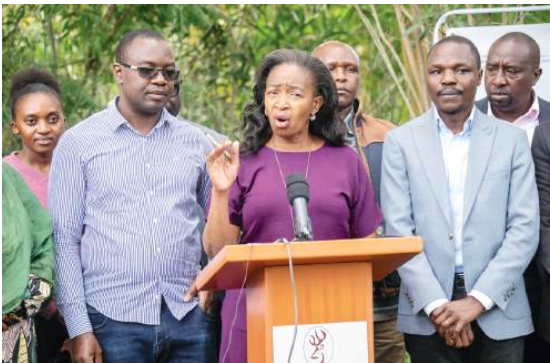
 Committee on
Implementation
of the 10-point
Agenda
members Javas
Bigambo, Agnes
Zani and Gabriel
Oguda during
a presser at
Maanzoni Lodge
in Machakos
county
/EMMANUEL
WANSON
Committee on
Implementation
of the 10-point
Agenda
members Javas
Bigambo, Agnes
Zani and Gabriel
Oguda during
a presser at
Maanzoni Lodge
in Machakos
county
/EMMANUEL
WANSON
The committee overseeing the implementation of the NADCO report and the ten-point agenda (Coin -10) has given it a 61 per cent rating ahead of the submission of its status report next week.
The special oversight team will submit its status report on Tuesday next week, before a joint ODM and UDA Parliamentary Group meeting to be co-chaired by President William Ruto and ODM leader Oburu Oginga.
The two parties will review Nadco implementation, amid stalled reforms on power-sharing, gender quotas, party hopping, and post-election compensation ahead of 2027.
The joint parliamentary group meeting is expected to focus on assessing progress on the 10-point Nadco plan, the blueprint guiding the alliance between the Orange Democratic Movement and the United Democratic Alliance.
The handover will be staged at the Kenyatta International Convention Centre (KICC).
Initially, the submission was to happen on Saturday, March 27, to coincide with the same date that former ODM leader Raila Odinga and Ruto signed the Memorandum of Understanding (MoU) between the two parties.
The team, chaired by former nominated senator Agnes Zani, is expected to first brief President Ruto on Thursday ahead of the March 7 announcement on the progress of reforms agreed upon during bipartisan talks.
The Star, in an interview with multiple sources in the Coin-10 who are familiar with the report, has established that the team has rated the implementation at 61 per cent.
“The overall verdict is 61 per cent, while several commitments have been initiated, some areas remain unresolved,” a source told the Star.
Among the major concerns flagged are delays in passing crucial legislation required to operationalise parts of the agreement and the failure to compensate victims of past human rights abuses.
“There was a feeling that so far we have achieved a lot, but pending compensation of rights victims and other unresolved areas need to be expedited,” added another source.
The sources said although some policy and administrative steps have been taken, Parliament has yet to conclude debate and approval of several bills tied to the reform package, slowing down full implementation of the agreement.
“We have highlighted those bills. Also pending is the issue of the audit of the 2022 election, which is part of our mandate. You know, in the ten-point agenda, the first agenda item is the NADCO report. The auditing of the 2022 election came from the NADCO report,” a source told the Star.
“We are also overseeing the implementation of the NADCO report and the issue of opposition leader, prime minister, all those ones, which are part of NADCO, we are also overseeing their implementation.”
Another sticking point is compensation for victims of rights violations, a pledge that formed part of the broader reconciliation framework but has yet to be fully honoured.
Attempts by Ruto’s administration to empanel a team to oversee the compensation last year suffered legal challenges, with the courts terming the team that was headed by Prof Makau Mutua unconstitutional.
During an ODM Parliamentary Group meeting on Tuesday, concerns were raised on the delays to compensate victims of rights abuses, as was captured in both the Nadco report and the ten-point agenda.
The party also raised issues on devolution and allocation disbursed to counties.
National Assembly Minority leader Junet Mohamed said the Tuesday joint meeting will be key for the two parties to know what has been achieved and what is pending.
“From there (KICC) the public will be told what progress the report has made, what has beenachieved, what has not been achieved,” Junet said after the PG at Parliament buildings.
“Parliamentary group emphasised on twomain issues that they expect to happen, that is the compensation bit of the matter of the10-point agenda and the devolution issue that they want monies increased to the devolvedunits and they also want the people who are affected through post-election violence from2017, that money must be put in the supplementary budget that is in parliament I think fromtomorrow.”
“So those are two major issues they have emphasised among other things contained inthe 10-point agenda which they are going to receive on Tuesday in a broad-basedparliamentary group meeting.”
Crucial constitutional amendments remain pending, including the creation of a prime minister with two deputies, the official opposition leader role and the audit of the 2022 presidential election results
Efforts to meet the two-thirds gender requirement in Parliament are incomplete, with a task force recommending temporary top-ups to bridge the gap.
The meeting also comes amid growing divisions within ODM over the Ruto deal, particularly on whether the pact extends beyond 2027.
ODM deputy party leader Godfrey Osotsi, while maintaining the implementation remains, faulted Ruto’s administration for giving the ten-point agenda lip service.
“It is evident that our counterparts are not keen on implementing the agreement in good faith, and the implementation deadline is this Saturday, March 7, 2026,” Osotsi said.
According to ODM secretary general Edwin Sifuna, the March 7 deadline is not negotiable and cannot be extended even by a day.
“Anybody who wants to extend the 10-point agenda must go to Bondo to get Baba's signature,” Sifuna said on Monday during a morning show on K24 television.
But Oburu's team has poured cold water on the deadline ultimatum, saying Tuesday is just an anniversary and has no bearing on the relationship between the two parties.
“Some people are misleading our supporters that on March 7, we will part ways with the government,” Oburu said in Migori on Sunday.
“On that day, we are going to receive an interim report on the 10-point agenda, and not end our relationship with the government.”
The ten-point commitments and resolutions were meant to pursue and achieve a more cohesive and prosperous nation.
They include implementing the National Dialogue Committee (NADCO) report, promoting inclusivity in governance and national development, protecting and strengthening devolution, and addressing Kenya’s debt crisis.
It also endeavours to secure the future of Kenya, promote integrity in national leadership, eliminate wastage of public resources, win the war against corruption, safeguard the right to peaceful assembly, and uphold the rule of law and constitutionalism.
INSTANT ANALYSIS
The Tuesday meeting is expected to review the progress of the agreement and chart the next steps in implementing the remaining items, as pressure mounts on the government to deliver on promises made under the bipartisan deal meant to ease political tensions in the country.