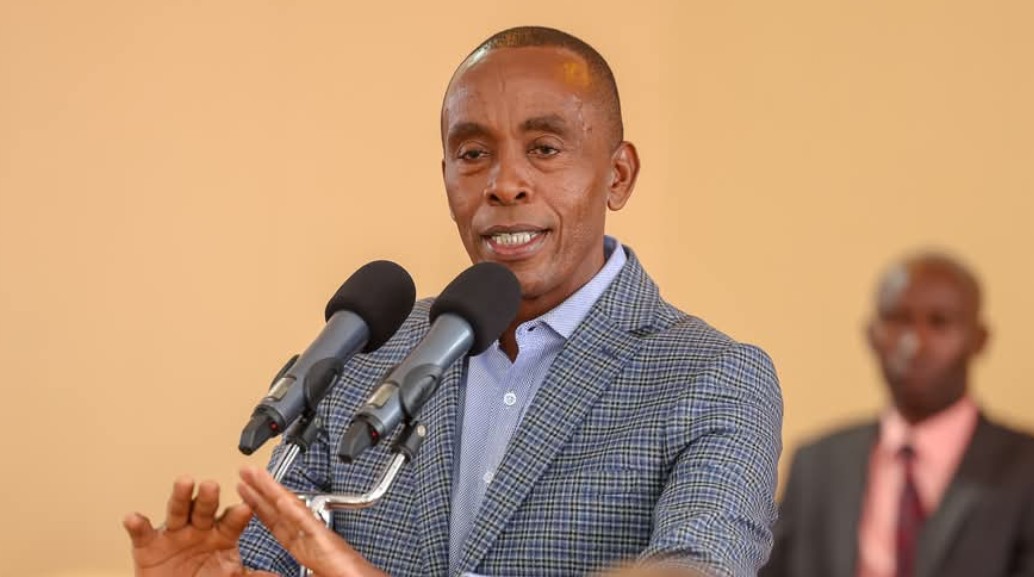
 Kiambu Governor Kimani Wamatangi/FILE
Governors have reignited their long-standing battle with MPs over control of the Roads Maintenance Levy Fund (RMLF).
The county bosses are demanding that 42 per cent of the fund be allocated directly to county governments.
Appearing before the Senate Roads, Transport and Housing Committee, Council of Governors Transport Committee chairperson Kimani Wamatangi said the current allocation is meagre and unconstitutional.
Wamatangi appeared before the panel chaired by Migori Senator Eddy Oketch to present his views on the Kenya Roads (Amendment) Bill, 2025, which allocates counties five per cent of RMLF proceeds.
“When counties manage over three-quarters of Kenya’s road network, allocating only five per cent of the levy cannot be justified,” Wamatangi told senators.
The development comes as county chiefs dispute the new classification of roads in the Bill, terming it unconstitutional.
“There is no such thing as a Constituency Roads Fund. Counties should receive what the law and the constitution assigns to them,” Wamatangi said.
Before the Bill, governors and MPs had been fighting over RMLF proceeds.
The dispute began when MPs locked counties out of the funds, prompting governors to move to court.
A High Court ruling in June 2025 declared the exclusion of counties from direct RMLF allocations unconstitutional.
The Court of Appeal subsequently gave Parliament a 12-month window to amend the law or risk disrupting road maintenance funding.
Wamatangi said the current legal framework predates the 2010 Constitution.
“The law was written when counties did not exist. Now, it must reflect the constitution,” he said.
He explained that the Kenya Roads Act and the Kenya Roads Board Act created national agencies such as the Kenya Urban Roads Authority, Kenya Rural Roads Authority and Kenya National Highways Authority to manage trunk and urban roads, leaving counties with limited authority.
Under the Bill, roads are reclassified into national trunk roads and county roads.
However, under the current provisions, counties would receive only five per cent of the RMLF, roughly Sh6 billion out of Sh119.7 billion collected in the 2024–25 financial year.
The Council of Governors proposes that counties receive 42 per cent of the levy. Wamatangi said this is both fair and necessary.
“Counties already maintain the majority of roads. The levy is a user-pay fund. Equitable share money is for general services such as health, water and agriculture. Roads need their own dedicated funding,” he said.
The governors also want reforms to ensure counties have a voice in national road governance.
They propose amending Section 7 of the Kenya Roads Board Act to replace two Principal Secretary positions with representatives nominated by the Council of Governors.
Wamatangi said Kura and KeRRA should eventually be phased out once road reclassification is complete.
The Council of Governors has also proposed that minor urban arterials, secondary rural roads linking towns and urban collector streets be classified as county roads.
Security roads would remain under national control, but with clearer definitions to avoid overlap.
Wamatangi called for road classification and reclassification to be handled jointly by the national and county governments.
Addressing concerns about capacity, Wamatangi dismissed claims that counties are ill-prepared to handle more funds.
“Most counties already have functional roads departments with qualified engineers. They have been maintaining roads with limited resources. This is about fairness and constitutional compliance,” he said.
The renewed push has once again intensified the feud with MPs.
Legislators argue that national oversight ensures uniform standards and prevents misuse. Governors counter that counties, being closer to the people, are better positioned to maintain roads efficiently.
“The people who pay the levy on every litre of fuel expect their roads to be fixed by the government closest to them,” Wamatangi said.
The conflict over the RMLF is not new. Governors have previously taken MPs to court after counties were locked out of the fund.
With the Bill now under Senate committee review, the debate over allocation, governance and devolution is set to dominate discussions in Parliament in the coming months.