Mentally ill offenders will no longer be held indefinitely in prisons but will instead be detained in psychiatric hospitals for treatment.
This will be the case if MPs enact the proposed Power of Mercy Bill, 2025, which redefines the criminal justice system's approach to mental health.
The Bill, currently before the National Assembly, abolishes the colonial-era practice of detaining offenders found "guilty but insane" at the "pleasure of the President".
The current system has seen individuals locked up for decades without a fixed sentence or adequate medical care.
The Bill, sponsored by Majority Leader Kimani Ichung’wah, introduces a specific finding of "not guilty by reason of mental incapacitation".
It also establishes a Mental Health Offenders Review Committee to oversee these cases.
If enacted, courts will be limited to ordering detention in a mental health facility for a maximum of 90 days pending review, replacing the previous system of indefinite detention.
The change recognises that individuals who commit offences during a state of mental crisis are patients in need of treatment, not criminals deserving of punishment.
The Constitution provides for the right to the highest attainable standard of health, including mental healthcare.
The reforms directly respond to years of Kenyan courts repeatedly declaring the old system unconstitutional.
Earlier, the High Court held that leaving sentence length to the President violates the fundamental rights and freedoms of the accused.
It held that the status quo is "inimical to the fundamental duty of the Judiciary".
In a 2016 case, the court found that detaining a mentally ill person for an indeterminate period constitutes cruel, inhuman and degrading treatment contrary to Articles 25 and 29 of the Constitution.
A case ruled in 2017 further established that the lengthy incarceration of such convicts erodes their human dignity.
Justice John Mativo, in the landmark judgment, said, "The imposition of a punishment in a criminal matter… is the exercise of judicial, not executive, power".
Legislation on matters touching on mental health has gained traction in the country.
In January 2025, the High Court declared criminalisation of attempted suicide as unconstitutional, recognising that it violated the right to dignity and the right to health.
The government has since moved to integrate mental health services into the national insurance benefits package under the Taifa Care Model and Social Health Authority.
Health Cabinet Secretary Aden Duale confirmed that mental health services are now part of the national insurance benefits package, "ensuring that no Kenyan has to choose between caring for their mind and feeding their family".
While mental health advocates welcome the reforms, significant implementation challenges remain.
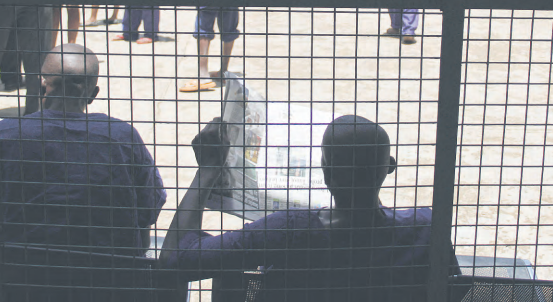
Currently, the country’s prisons hold approximately 64,000 inmates across 136 penal institutions.
A 2023 report by the Kenya National Commission on Human Rights showed that two-thirds of prisoners are battling physical and mental health challenges.
Some 63 per cent of prisoners reported their mental health had deteriorated after being locked up.
The country has only four public mental health hospitals – Mathari National Teaching and Referral Hospital in Nairobi, and facilities in Nakuru, Eldoret, and Kisumu – with limited bed capacity.
The government has pledged to decentralise mental health services through 107,000 digitally empowered Community Health Promoters.
Even so, specialised inpatient psychiatric care remains concentrated in major urban centres.
Correctional Services PS Salome Beacco acknowledged the scale of the challenge in 2024.
She noted that although prisoners are entitled to enjoy the highest attainable standard of health, many with mental health problems do not receive adequate care.
The PS promised that the government would come up with a law to address challenges related to healthcare services for those in detention.
The Power of Mercy Bill's provisions are hailed as aligning Kenya with the United Nations Convention on the Rights of Persons with Disabilities.
The convention recognises that persons with mental disabilities are entitled to equal recognition before the law and freedom from cruel, inhuman or degrading treatment.
Dr Mercy Karanja, President of the Kenya Psychiatric Association, has emphasised that "suicidal behaviour is a manifestation of mental and psychological distress, requiring health-centred interventions rather than criminal prosecution".
INSTANT ANALYSIS
The bill is expected to be debated in the National Assembly in the coming weeks. If passed, it will mark the culmination of years of advocacy by mental health professionals, human rights organisations, and the judiciary to transform the country’s treatment of mentally ill offenders from punishment to care.