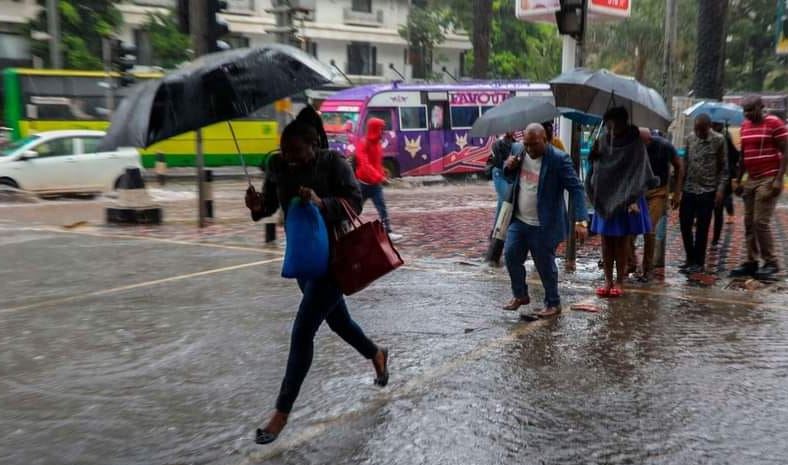
The Kenya Meteorological Department has issued a heavy rainfall advisory, warning of continued downpours across parts of the country.
According to the advisory, rainfall exceeding 20mm in 24 hours is expected to continue from March 3 to March 9, 2026.
The department described the rainfall as moderate to heavy, with a probability of occurrence estimated between 33 and 66 per cent.
“The rainfall is likely to intensify and peak between March 4 and 7, 2026, before decreasing in most areas by March 8, 2026,” Kenya Met said.
The department noted that while rainfall will reduce in most regions after March 8, heavy showers exceeding 20mm in 24 hours are expected to persist in the Lake Victoria Basin, Western Kenya, parts of the Central Highlands, the Southeastern lowlands, and the Coastal region until March 9.
Counties identified as areas of concern include Turkana, Samburu, Migori, Nyamira, Bungoma, Busia, Kakamega, Vihiga, West Pokot, Baringo, Elgeyo Marakwet, Trans Nzoia, Nandi, Uasin Gishu, Nakuru, Siaya, Kisumu, Homa Bay, Kisii, Kericho, Bomet, Kiambu, Embu, Murang’a, Kirinyaga, Nyandarua, and Nyeri.
Other counties at risk are Laikipia, Tharaka-Nithi, Meru, Nairobi, Narok, Kajiado, Makueni, Machakos, Taita-Taveta, Kitui, Kwale, Mombasa, Tana River, Kilifi, Isiolo, Marsabit, Garissa, and parts of Wajir and Mandera.
Residents in these areas have been advised to be alert for potential floods, flash floods, and poor visibility. The department cautioned that floodwaters may appear even in places where rainfall has not been heavy, particularly downstream.
“People are advised to avoid driving through or walking in moving water or open fields and not to shelter under trees and near grilled windows to minimise exposure to lightning strikes. Updates will be provided promptly if there are any changes,” the weatherman said.
Kenya Met said the long rain season has begun earlier than usual in several parts of the country, urging farmers to start planting to take advantage of the favourable conditions.
The department explained that the onset criteria for long rains—at least 20 millimetres of rainfall within three consecutive days, with no dry spell exceeding seven days—have already been met since mid-February in western, central, and highland regions, including Nairobi, the Lake Victoria Basin, and the highlands west of the Rift Valley.
The early rains have been linked to favourable atmospheric conditions, including enhanced convective activity associated with the Madden–Julian Oscillation (MJO), which has temporarily increased moisture convergence and rainfall across several regions.
However, the department warned that the MJO is likely to transition to less favourable phases from mid-March, which may reduce rainfall and increase the likelihood of dry spells in some areas.