
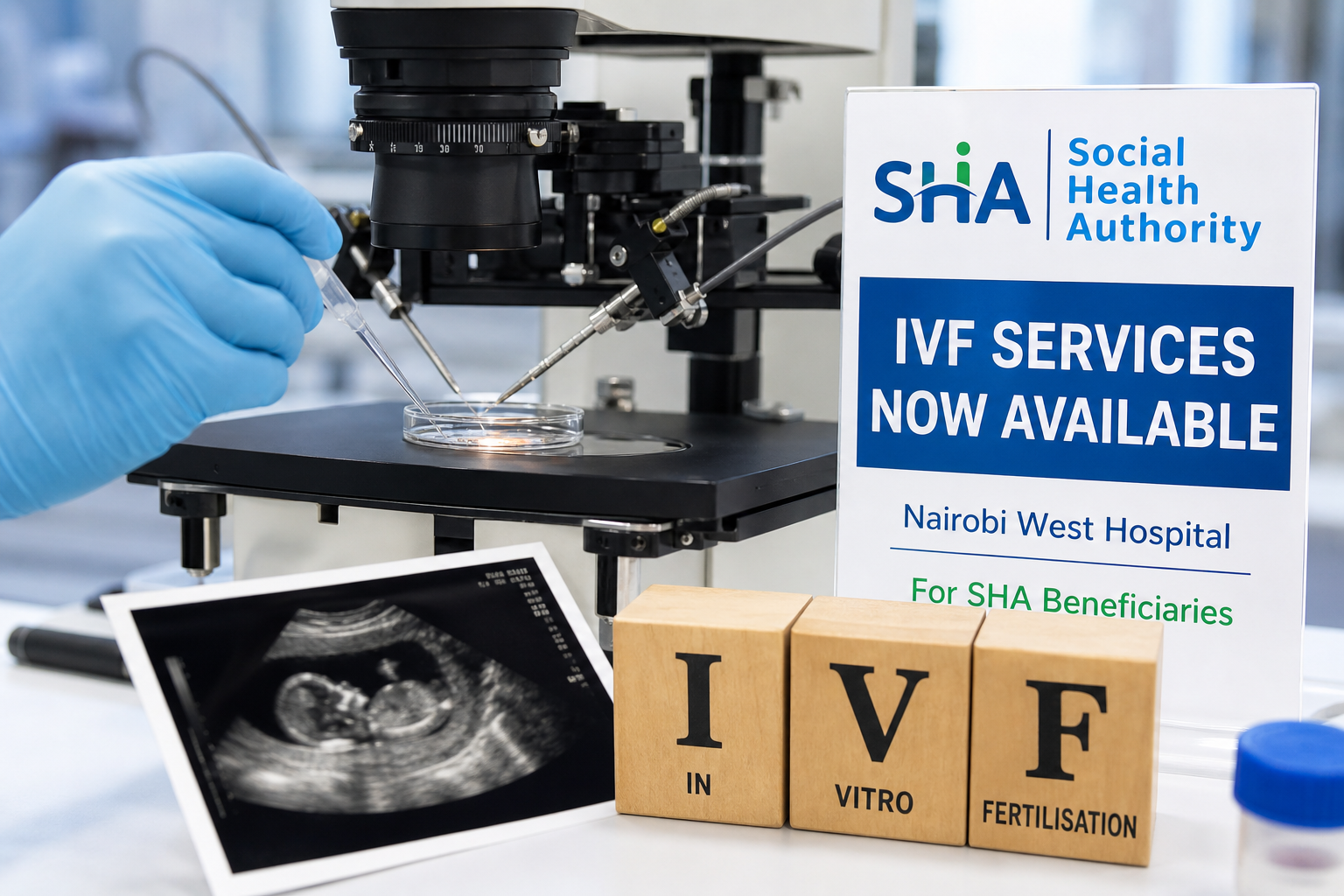
 The benefit covers frozen embryo transfer (FET) cycles, as well as cycle cancellation or unsuccessful treatment.
Teachers under Kuppet and Knut are now entitled to specialised care under the Social Health Authority (SHA) following consultations that resolved challenges experienced during the transition to the Mwalimu Comprehensive Medical Cover under the Public Officers Medical Scheme Fund (POMSF).
This includes provision of in-vitro fertilisation (IVF) services at Nairobi West Hospital, the contracted and accredited facility to support teachers facing difficulties conceiving.
Teachers will also have access to overseas treatment in select facilities, while the controversial tariff locking and co-payment components have been withdrawn, effectively eliminating out-of-pocket charges at facilities.
In an update, the Teachers Service Commission (TSC) confirmed that IVF services at Nairobi West Hospital were formally activated on April 24 and are now available to affected teachers.
The commission said SHA recognises infertility as a medically recognised condition with significant physical, emotional and social effects, and that the benefit is designed to provide safe, quality care to affected members.
IVF is an assisted reproductive technology that treats infertility by fertilising eggs with sperm outside the body in a laboratory.
It involves stimulating the ovaries to produce eggs, retrieving them, fertilising them with sperm and transferring the resulting embryo into the uterus to achieve pregnancy.
The procedure can also include genetic testing and gender selection before the embryo is transferred.
IVF is targeted at couples who are unable to conceive because of blocked fallopian tubes, low sperm count, endometriosis, or unexplained infertility.
A single cycle takes several weeks to months, and many individuals require more than one round.
While highly effective, it does not guarantee pregnancy and is considered a physically and financially demanding treatment.
TSC said eligibility for treatment is strictly limited to SHA beneficiaries under the POMSF, who must meet a series of conditions.
Eligible beneficiaries must be principal members or their lawfully declared spouses and must have a documented failure to conceive after 12 months of regular unprotected intercourse, or as clinically determined by a qualified specialist.
Beneficiaries are also entitled to a maximum of two IVF attempts per beneficiary over their lifetime.
Another precondition is that the female partner must be aged 41 years or below at the start of the treatment cycle.
The benefit is applicable to couples struggling with both primary and secondary infertility.
For secondary infertility, however, the couple must have no living child at the time of treatment.
"All cases must be supported by a documented clinical diagnosis and a written recommendation from a registered specialist," TSC said.
The commission added that the IVF benefit is provided within the existing inpatient benefit limit of the Mwalimu Comprehensive Cover.
The benefit covers frozen embryo transfer (FET) cycles, as well as cycle cancellation or unsuccessful treatment.
This means if a cycle is cancelled or fails — for example, due to poor ovarian response, failure to retrieve viable oocytes, failure of fertilisation, absence of viable embryos, or failed implantation — costs incurred up to that point will be applied against the inpatient limit.
TSC said treatment will continue until either the inpatient benefit limit is exhausted or the patient reaches the maximum two IVF attempts, whichever comes first.
"All treatment must strictly follow national clinical guidelines and SHA pre-authorisation procedures. Only services provided at SHA-contracted and accredited facilities will be eligible for reimbursement," the commission said.




Comments 0
Sign in to join the conversation
Sign In Create AccountNo comments yet. Be the first to share your thoughts!