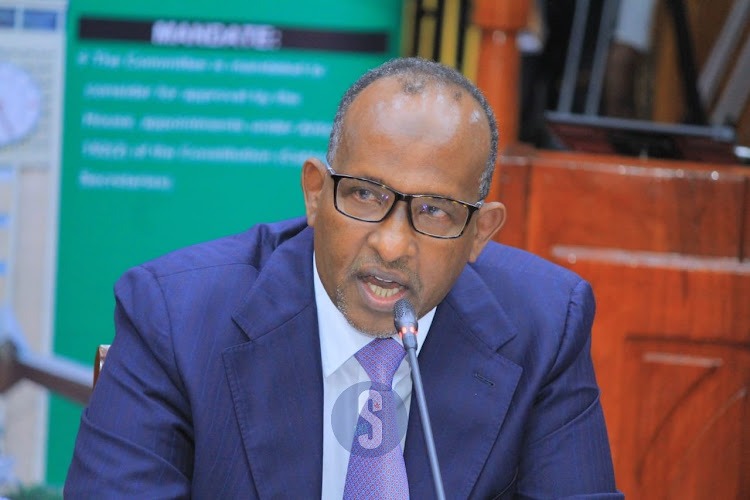
 Health CS Aden Duale/FILE
Health Cabinet Secretary Aden Duale has lifted the lid on the reforms in the health sector, some of which have stirred political controversy.
In an exclusive interview with the Star, he spoke on the Sh100 billion the Social Health Authority digital system, cancer cover caps, fraud crackdowns and the battle over foreign doctors.
He said that more than 1,180 fraud files have been forwarded for investigation, Sh12.7 billion in suspicious claims blocked by artificial intelligence systems and dozens of facilities suspended.
On questions regarding procurement, he insists the Integrated Healthcare Information Technology System contract is not a “Sh104 billion payout”.
The CS also dismissed speculation on the politically sensitive question of 2027 ambitions, insisting his focus remains fixed on universal health coverage.
Below are excerpts of the interview.
The cancer treatment cap under SHA has sparked public outcry. Why impose a ceiling?
Cancer treatment is among the most expensive areas of medicine globally. When designing the Social Health Insurance Fund benefits package, we had to balance meaningful financial protection, equity across millions of Kenyans and long-term sustainability.
The law requires periodic review every two years. After an actuarial review, the Health Benefits and Tariffs Advisory Panel has proposed increasing the Emergency, Chronic and Critical Illness Fund limit from Sh150,000 to Sh400,000.
Combined with household allocations, oncology cover could rise to Sh800,000 per beneficiary annually. Through a landmark agreement with Roche, SHA now fully covers Herceptin(targeted antibody therapy for stomach and breast cancer) at zero additional cost.
We have also signed collaboration frameworks with Aga Khan University Hospital and The Nairobi Hospital to open advanced oncology services to SHA beneficiaries.
Additionally, through the National Equipment Support Project, we have invested Sh6.18 billion in 120 county facilities to decentralise diagnostics.
Q: How does SHA handle treatment abroad?
A: The era of overseas treatment abuse being a conduit for abuse, where cartels and unscrupulous agents exploited vulnerable patients and the public purse, is over.SHA only pays if the procedure is unavailable locally, of which all beneficiaries have access.
The Health Benefits panel identified 39 interventions eligible for overseas referral. Patients must obtain prior approval. Every case undergoes peer review.
Treatment is limited to SHA-contracted overseas facilities with local linkages for continuity of care. The maximum payable amount is Sh500,000.
Q: Why were specific hospitals contracted? Why not open accreditation?
A: There is confusion between licensing, empanelment and contracting. SHA doesn’t accredit or license hospitals. Licensing is done by regulators like the Kenya Medical Practitioners and Dentists Council and Clinical Officers Council.
Empanelment is open and continuous. Contracting, however, must follow the public procurement law. Facilities are selected based on regulatory compliance, capacity, equipment, geographic equity, digital readiness and integrity history.
I must also correct the misconception that we have restricted access to only a few select hospitals. We have digitised 10,277 facilities nationwide. Coverage is widespread.
Reports of impersonation and fraud persist. How serious is this?
A: The Mbagathi hospital impersonation case exposed old system flaws, but the new digital health system is now crucial for detecting and preventing fraud. Our digital system recently flagged suspicious claims worth Sh12.7 billion. That money was not lost; it was blocked. We have phased out one-time password verification and introduced fingerprint authentication in levels 4, 5 and 6 facilities. Rollout to lower facilities is ongoing. Healthcare professionals must use a geo-fenced application for pre-authorisations. We have deployed AI-driven fraud detection systems. So far, 1,188 fraudulent files have been submitted to the Directorate of Criminal Investigations. Dozens of facilities have been suspended. Fraud is a criminal offence. Beneficiaries and providers face prosecution.
Critics say the APIERO-linked Sh100 billion contract is excessive
A: There are massive public misconceptions regarding this procurement that I must correct. This is not a Sh104 billion lumpsum payout from SHA funds.
The contract awarded to the consortium, including Safaricom, Apeiro Limited and Konvergenz Network Solutions, implements the Integrated Healthcare Information Technology System.
We desperately needed this system to build our digital health superhighway. It establishes a National Health Information Exchange, standardises hospital management systems and digitises the Kemsa supply chain to stop theft of medicines. There is zero upfront capital or operational expenditure for the government.
The consortium invests and recovers costs more than 10 years based on strict performance metrics. The backlash stems from a misunderstanding of this financing model, but the lesson drawn is the need for proactive, simplified public communication regarding complex procurements.
How is the new medical equipment framework different from the previous leasing model?
The National Equipment Support Programme (NESP) is fundamentally different from the old Managed Equipment Services. MES was a rigid lease where the government paid fixed sums regardless of whether the equipment was functional or actually being used.
NESP is fee-for-service. We pay only when the equipment is actively used to treat patients. A major shortcoming of the previous MES was the exclusion of county governments, leading to misaligned health investments.
In contrast, NESP has institutionalised collaboration. All 47 counties signed Intergovernmental Partnership Agreements.
Equipment worth Sh6.18 billion has been installed in 120 county and six national facilities. This decentralises CT scans, digital X-rays and basic cancer staging services.
Kenya reportedly loses Sh10 billion annually to India in medical travel. What are you doing about it?
We are building local specialised healthcare capacity to make overseas treatment the exception rather than the norm. For example, Kenyatta National Hospital (KNH) has established a state-of-the-art HLA Lab for organ transplant matching, ending reliance on expensive foreign labs.
Through strategic partnerships with facilities like Aga Khan University Hospital, complex procedures such as kidney transplants are now accessible locally under SHA, at zero additional cost.
Doctors pursuing specialist training spend years treating patients at KNH without pay. Would you consider stipends for them, given that they are full-time hospital staff?
I completely agree with the premise of this question. Our specialist trainees - the registrars- are the backbone of service delivery in our national referral hospitals like KNH and MTRH (Moi Teaching and Referral Hospital). They spend years treating patients, performing surgeries and working gruelling hours while pursuing their Master’s in Medicine.
They are not just students; they are full-time frontline healthcare providers building Kenya’s future specialised capacity. It is a matter of fairness and systemic efficiency that their immense contribution is recognised and supported.
The ministry is actively engaging with the National Treasury, the Council of Governors and the training universities to develop a sustainable financing mechanism.
We are aggressively looking at policy interventions that will provide stipends and structured accommodation support for these doctors to ensure they can focus on their rigorous training and patient care without financial destitution.
What about unemployed Kenyan doctors versus foreign practitioners?
We have more than 4,000 qualified Kenyan doctors unemployed or underemployed. It is economically and morally indefensible to import doctors when local talent is idle. Foreign doctors will only be licensed in rare sub-specialities where genuine gaps exist, and with mandatory skills transfer.
Uhuru-era Cuban doctors programme, was there value for money?
Yes. The programme addressed critical specialist shortages in underserved counties and enabled vital knowledge transfer for Kenyan clinicians. The country learnt various skills that have been utilised in establishing the Primary Healthcare Models currently in place.
However, the current administration has built on these gains by prioritising local specialist training to ensure sustainable national workforce self-sufficiency aligned with Taifa Care goals.
What about Beyond Zero Campaign Ambulances?
The Beyond Zero Campaign laid an important foundation for UHC by strengthening emergency referral capacity, particularly for maternal and newborn health. Many of these ambulances remain operational within county emergency systems, supporting timely referrals.
Under Taifa Care, we are accelerating this legacy through Every Woman, Every Newborn Everywhere agenda. We are targeting 26 priority counties to drastically reduce maternal mortality by strengthening emergency obstetric care because no mother should die while bringing forth life.