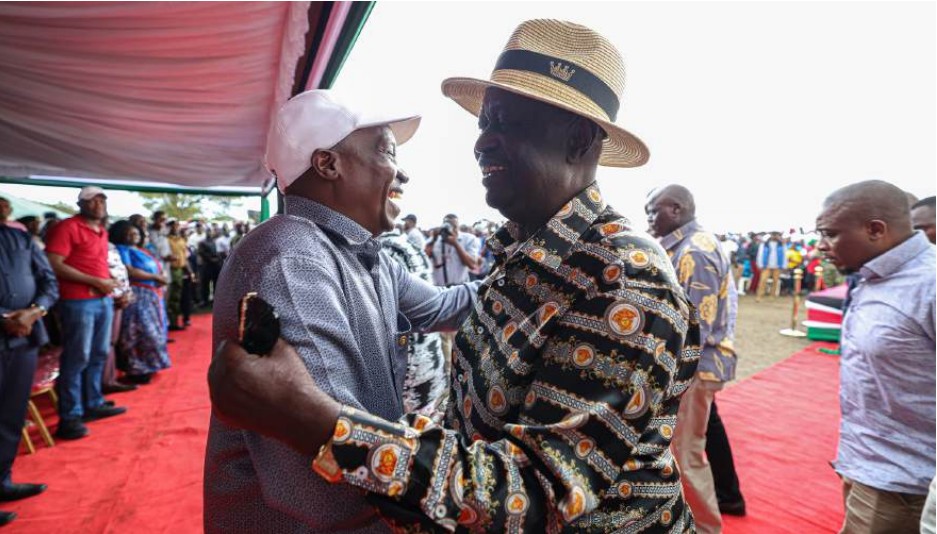
ODM party leader Oburu Oginga has dismissed claims of a looming divorce between the outfit and President William Ruto’s UDA as the two entities mark the first anniversary of working together.
On Saturday, the ruling UDA and ODM will celebrate one year of working together under a broad-based arrangement anchored on a 10-point agenda.
The Siaya senator insisted the working relationship between the two sides remains intact and is focused on reform and service delivery rather than political symbolism.
Speaking in Migori during the party’s Linda Ground rally, Oburu said the March 7 anniversary has no effect on the working relationship between the two biggest political parties.
“Some people are misleading our supporters that on March 7, we will part ways with the government,” Oburu said.
“On that day, we are going to receive an interim report on the 10-point agenda, and not end our relationship with the government.”
He urged leaders to avoid politicising the arrangement, saying the focus should remain on delivering reforms and easing the burden on Kenyans grappling with a high cost of living, unemployment and strained public services.
The remarks come amid ongoing debate in ODM, where some leaders and supporters have questioned the pace and sincerity of the implementation of the 10-point agenda signed between Ruto and former ODM leader Raila Odinga.
Oburu said the agenda is being implemented progressively and there is no cause for alarm.
He announced that the government has set aside funds to promote reconciliation and address grievances arising from the protests that rattled the administration and exposed deep frustrations among young Kenyans.
“In the current budget, we have set aside Sh2 billion to compensate the families who lost their loved ones and those who were injured. Soon, the money will be given out; we are just complying with the court order,” Oburu said.
The compensation plan, he said, demonstrates that the broad-based arrangement is not merely political but is yielding tangible outcomes aimed at healing the nation.
Speaking at the same function, ODM chairperson Gladys Wanga also dismissed talk of a looming split.
“Those saying the March 7 anniversary will lead to divorce are misleading our people; that is a white lie. All we will do is to review the 10-point agenda, which we have all agreed must be implemented,” she said.
The Homa Bay Governor also alleged there had been attempts by former President Uhuru Kenyatta to influence the party’s direction and push it out of government, remarks likely to further inflame tensions in opposition ranks.
“It is very sad that during the handshake, we didn’t get anything. Every time we asked for a position, we were told that we should wait for the presidency, which ended the way it ended,” Wanga said.
This was in reference to the 2018 truce between Raila and Uhuru that reconfigured the political landscape but left sections of ODM dissatisfied.
However, the most pointed internal criticism has come from James Orengo, who has publicly questioned the wisdom of the arrangement with Ruto.
Orengo has maintained that his discomfort with the partnership is rooted in principle, arguing that ODM risks losing its identity and reformist credentials by aligning too closely with the very administration it once fiercely opposed.
He has warned that the party must guard against being absorbed into government without clear gains for its supporters.
In recent remarks, Orengo suggested that ODM should not forget the political battles it fought against what he described as authoritarian tendencies, cautioning that history could judge the party harshly if it appears to abandon its core ideals.
He framed his opposition as a matter of safeguarding the legacy of Raila and the sacrifices made by supporters over decades of struggle.
Oburu, however, downplayed the claims and strongly rejected assertions attributed to Orengo that the same forces that allegedly “killed” Raila politically were now targeting ODM.
The senator termed the talk around Raila’s death as reckless and insensitive, saying he would want to be told who killed his younger brother if such claims were true.
“I am saddened by some people who are now claiming that the side we are in is responsible for the killing of my brother. If they know who killed my brother, I would be very interested to know that person, too,” Oburu said, dismissing the narrative as inflammatory.
He maintained that disagreements in ODM should not be interpreted as a collapse of the working arrangement, describing them instead as healthy internal democracy in a broad party.
Political observers say the March 7 event will be a crucial test of cohesion in ODM as it seeks to balance participation in government with retaining its independent identity ahead of future electoral contests.
A final comprehensive report detailing the status of the MoU's implementation will be released to the public on March 7, marking the one-year anniversary of its signing.
The document is expected to outline progress made on electoral reforms, economic stabilisation measures, youth empowerment initiatives and accountability mechanisms agreed upon under the 10-point framework.
For ODM, the report will serve as evidence to justify continued cooperation with UDA, especially to sceptical supporters. For Ruto’s camp, it offers an opportunity to demonstrate inclusivity and broaden political support beyond traditional bases.