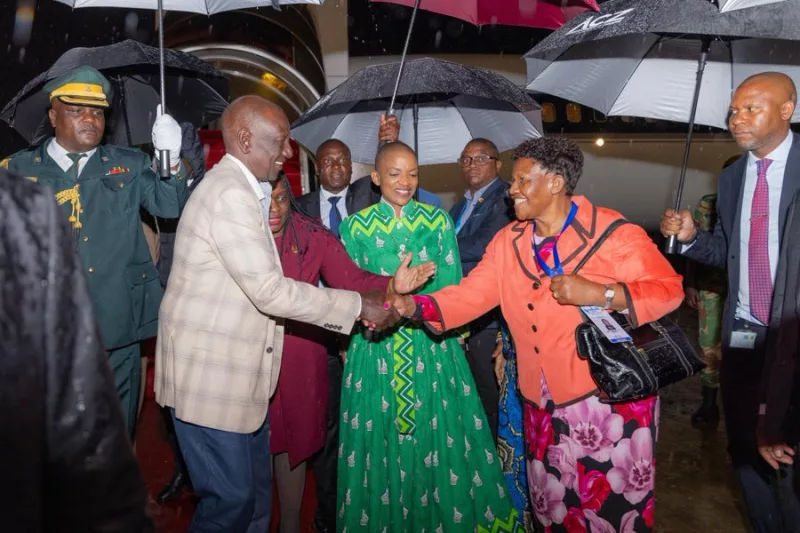
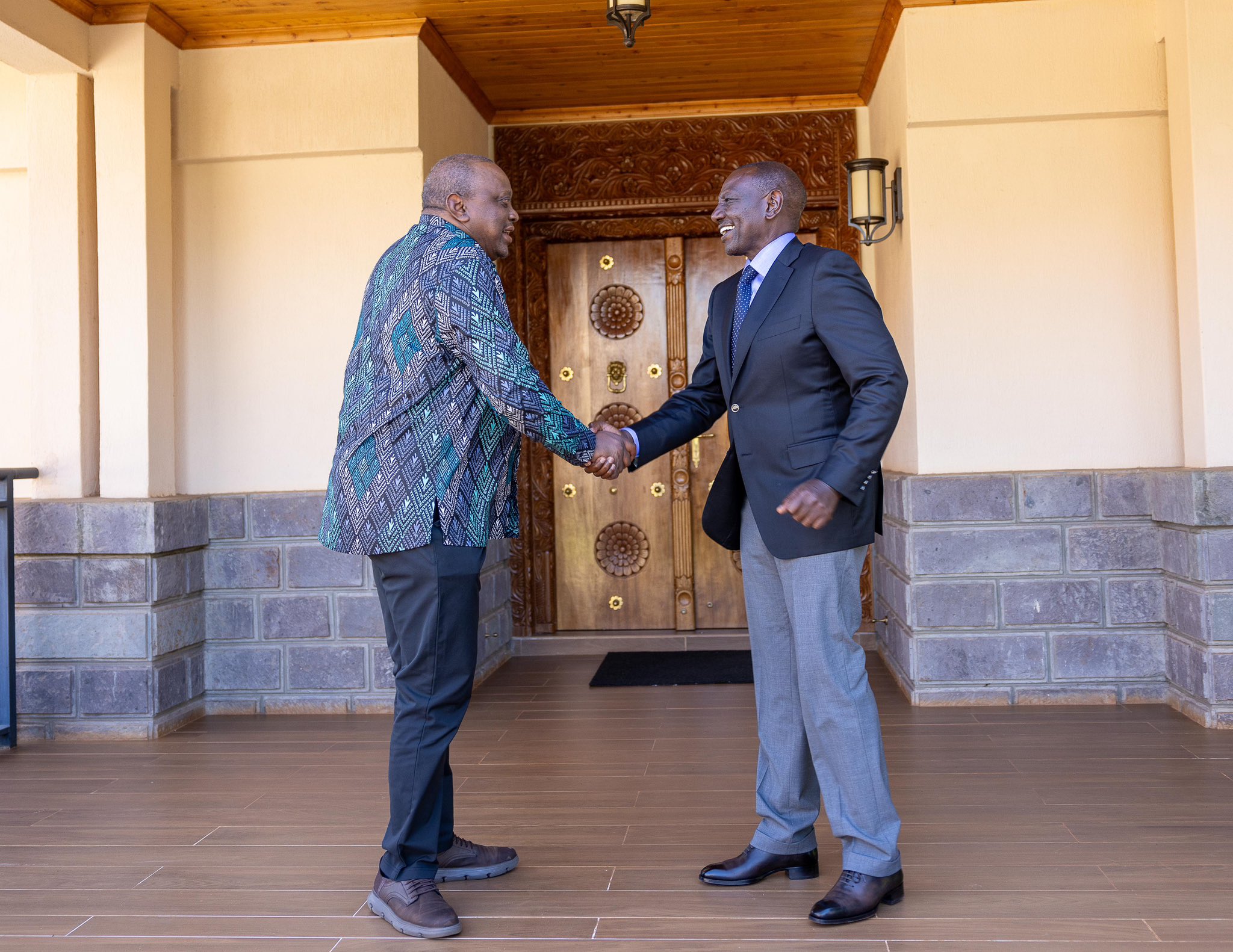
 Former President Uhuru Kenyatta and President William Ruto at a past meeting /FILE
Kenya’s political history has always been shaped by a tension between promise and power. Every new administration arrives wrapped in hope, only to be tested by the old demons of exclusion, ethnicity and elite capture.
The comparison between the Uhuru Kenyatta administration and that of President William Ruto is therefore not merely a political rivalry; it is a referendum on the soul of leadership in Kenya.
It is a debate about who belongs, who rises, who is protected and who is heard. This is not an exercise in blind praise or reckless condemnation; it is an honest interrogation of two governing philosophies, one rooted in dynasty and continuity, the other in disruption and claimed inclusivity.
Dynasty state vs the hustler state
The Uhuru government, for all its infrastructure achievements and international polish, operated largely as a diverse state. Power, access and privilege revolved around familiar elite circles.
Marginalised communities and minorities often felt like spectators in their own country, present, taxed, governed, but rarely trusted or elevated.
Ruto’s government, whatever its flaws, represents a deliberate attempt to break from that tradition. His administration projects an image, sometimes aggressively so, of inclusion. Whether in rhetoric, appointments, or public engagement, the message is consistent. Kenya does not belong to a few surnames. This contrast is not cosmetic. It is structural.
Breaking of an old ceiling
Few institutions reveal the true heart of a state like its security apparatus. Historically, Kenya’s military and intelligence leadership mirrored post-independence ethnic hierarchies.
Under both the Kibaki and Uhuru governments, certain communities, particularly the Kikuyus, dominated the upper echelons of the military, CID and internal security. This was not accidental; it was an inherited policy.
The Luhya and Luo communities, in particular, suffered systematic stagnation. Despite their numbers, patriotism and sacrifice, they rarely rose beyond the rank of major for decades. This mirrored Jomo Kenyatta’s era and continued quietly but firmly.
For the first time in Kenya’s history, a Luo rose to the position of Chief of Defence Forces. The Kenya Air Force is today commanded by Maj Gen Wycliffe Waliula, a Luhya, and the deputy CDF is Lt Gen John Omenda, also a Luhya.
These are not symbolic appointments; they are powerful signals that loyalty to the nation, not ethnicity, is the new currency of advancement. No amount of political spin can erase the significance of this shift.
Civil service and the end of ethnic preservation
The civil service under Kibaki and Uhuru became an ethnic preserve. Strategic institutions like the Central Bank, CID, Treasury, Immigration, and Internal Security were dominated by a narrow demographic. Merit was often secondary to surname and origin.
President Ruto has taken a different approach. His appointments reflect Kenya’s diversity more than any administration before him. Critics may question individual competence, and that is fair, but the ethnic gatekeeping that defined previous governments has undeniably weakened. For the first time, many Kenyans see themselves reflected in the state.
Extrajudicial Killings and Abductions
One of the darkest chapters of the Uhuru administration was the normalisation of extrajudicial killings. Rivers like Yala, Tana and waterways across central Kenya were found carrying bodies, often of young men, often poor, often voiceless. Human rights groups cried out. Families mourned quietly. I was one of the victims. Yet national outrage was muted. There were no sustained demonstrations. No loud media outrage. No elite panic. Why? Because the victims were largely from the margins.
Under President Ruto, this culture of casual death has visibly reduced. This does not mean abuses have vanished but the scale, brazenness and impunity of that era have receded. A state that kills its citizens quietly is not strong; it is afraid. Ending that fear is leadership.
KRA: From weapon to institution.
The Kenya Revenue Authority under Uhuru became infamous not just for tax enforcement but for selective harassment.
Businesses owned by non-Kikuyu entrepreneurs allegedly complained of extortion, intimidation and punitive audits. Tax law became a weapon, not a tool. Ruto has taken a harder stance on taxation; no one disputes that.
Taxes are higher, compliance stricter, and enforcement broader. But the method has changed. KRA today approaches businesses with a procedural, professional and less ethicised posture. The pain is shared and not targeted. Fair taxation is painful. Ethnic taxation is poisonous.
Accessibility and the human face of power
Uhuru governed from a distance. His presidency was formal, insulated and often aloof. Public access was minimal. Direct engagement was rare. Social media felt irrelevant to him and phone access was unimaginable.
President Ruto is the opposite. He is present, sometimes too present. He engages on social media, picks calls, attends local events and speaks directly to citizens. This accessibility does not automatically translate to better policy, but it restores dignity. People want to feel seen, even when they are struggling.
Leadership is not just about decisions. It is about connection.
Taxation vs development
The honest contradiction here is that honesty demands balance.
Under Uhuru, taxation pressure was relatively lower, and the visible development of roads, rail, and ports was aggressive. Ruto taxation is heavier, while large-scale development appears slower. This is a legitimate criticism of the current administration.
However, development that excludes people eventually collapses under its own weight. Roads alone do not feed families. Infrastructure without inclusion breeds resentment. Ruto’s challenge is to match his inclusivity with visible development, and history will judge him harshly if he fails.
Poverty reduction
Uhuru’s poverty reduction strategies were uneven. Youth employment programmes, such as road clearing and casual labour, were allegedly heavily concentrated in central Kenya. Other regions watched from the sidelines.
President Ruto has rolled out Nyota, Women Enterprise empowerment, and the Hustler Fund initiatives, which, while imperfect, are national in scope. A young person in Turkana, Kisii, or Kwale has the same theoretical access as one in Kiambu. Inclusivity does not mean perfection. It means fairness in opportunity.
Conclusion
Leadership is a direction, not a halo. President Kenyatta was not a villain, and President Ruto is not a saviour. But the direction of leadership matters.
One government preserved old hierarchies. The other is actively disrupting them.
One governed comfortably for the elite. The other governs uncomfortably for everyone but more inclusively.
Kenya does not need perfect leaders. It needs fair ones, accessible ones and brave ones willing to break inherited injustice.
History will not ask who built more roads. It will ask who widened the table.
And on that question, the answer is becoming clearer.
The writer is an expert on Horn of Africa on issues of geopolitcs, security and diplomatic trends