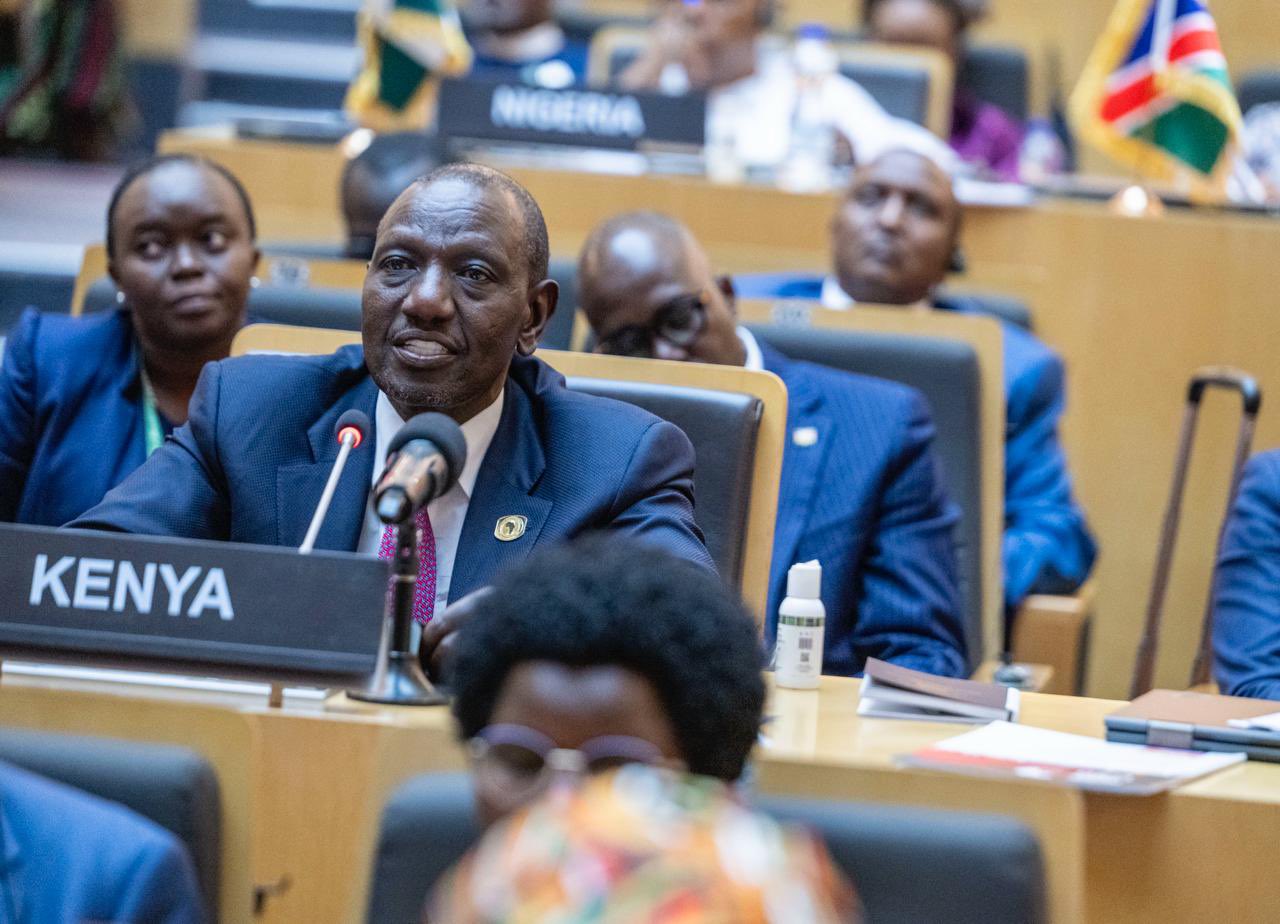
Ruto, the AU Champion on Institutional Reform, emphasised that sustainable, predictable funding is essential for the continent to advance its peace, security and development agenda.
In his report to the 39th Ordinary Session of the Assembly of Heads of State and Government in Addis Ababa, Ruto outlined comprehensive proposals to overhaul the AU’s financing framework, citing the persistent reliance on external donors as a key obstacle to Africa’s self-determination.
“The African Union must be financed in a predictable, sustainable, equitable and accountable manner, with full ownership by its Member States,” Ruto’s report reads.
The report comes amid growing concern that while AU members have largely met their obligations to fund the AU’s operational budget, financing for programmes and peace support operations remains heavily dependent on external partners.
Currently, African governments cover just 24 per cent of the AU programme budget, while funding for Peace Support Operations continues to rely on international assistance. This gap threatens the AU’s ability to respond swiftly to crises across the continent.
At the heart of Ruto’s proposals is the AU Peace Fund, a critical vehicle for African-led conflict prevention and resolution initiatives.
The Fund, established under Article 21 of the Peace and Security Council Protocol, has mobilised hundreds of millions of dollars since its inception, with more than $348 million coming from members and $219 million from partners.
Yet only $434 million has been disbursed to date, highlighting a significant shortfall between Africa’s needs and the available resources.
To fix this, Ruto proposed the expansion of the Peace Fund’s endowment from $400 million to $1 billion.
The strategy includes diversifying sources of funding, establishing a replenishment mechanism and engaging the Alliance of African Financial Institutions. It also recommends leveraging the convening power of Heads of State to mobilise contributions from African financial institutions, private sector leaders and philanthropists.
These measures aim to ensure that African solutions to African challenges are not constrained by external donor priorities or timelines.
In line with these ambitions, the AU will convene an Extraordinary Session of the Executive Council later this year, bringing together Ministers of Foreign Affairs and Finance from all member states.
The session, the report says, will explore innovative financing mechanisms for the AU’s priority programmes under Agenda 2063 and strengthen the Peace Fund. It will also ensure that Africa has the financial capacity to lead its own development and security agenda. Chief executives of African financial institutions are also expected to participate.
Ruto’s proposals are part of a broader institutional reform agenda, which seeks not only to improve the AU’s operational efficiency but also to reposition Africa as a coherent and influential actor on the global stage.
The reforms emphasise the link between financial sustainability and effectiveness, highlighting that governance, peace and development goals cannot be achieved without predictable funding under African control.
The report also notes progress in members’ compliance with previous AU financing commitments. Since 2017, African countries have met the Johannesburg target of funding 100 per cent of the operational budget, and a new sanctions regime has ensured timeliness in assessed contributions.
However, the 75 per cent target for AU programmes and the 25 per cent target for PSOs remain elusive, underscoring the urgent need for reforms to bridge funding gaps.
Ruto’s report further highlights the potential of emerging technologies, such as artificial intelligence and satellite-based early-warning systems, to improve crisis response and strategic planning.
These tools, he argues, must be backed by reliable financial support to strengthen Africa’s resilience and ensure the AU can act decisively in times of conflict, humanitarian crises or regional instability.
The AU’s focus on financial independence is also closely tied to the broader goals of Agenda 2063, which envisions a self-reliant and united Africa capable of funding its own priorities and shaping its own destiny.
By linking financial reform to peace, security and development, Ruto aims to embed sustainability and accountability at the heart of the union’s operations.