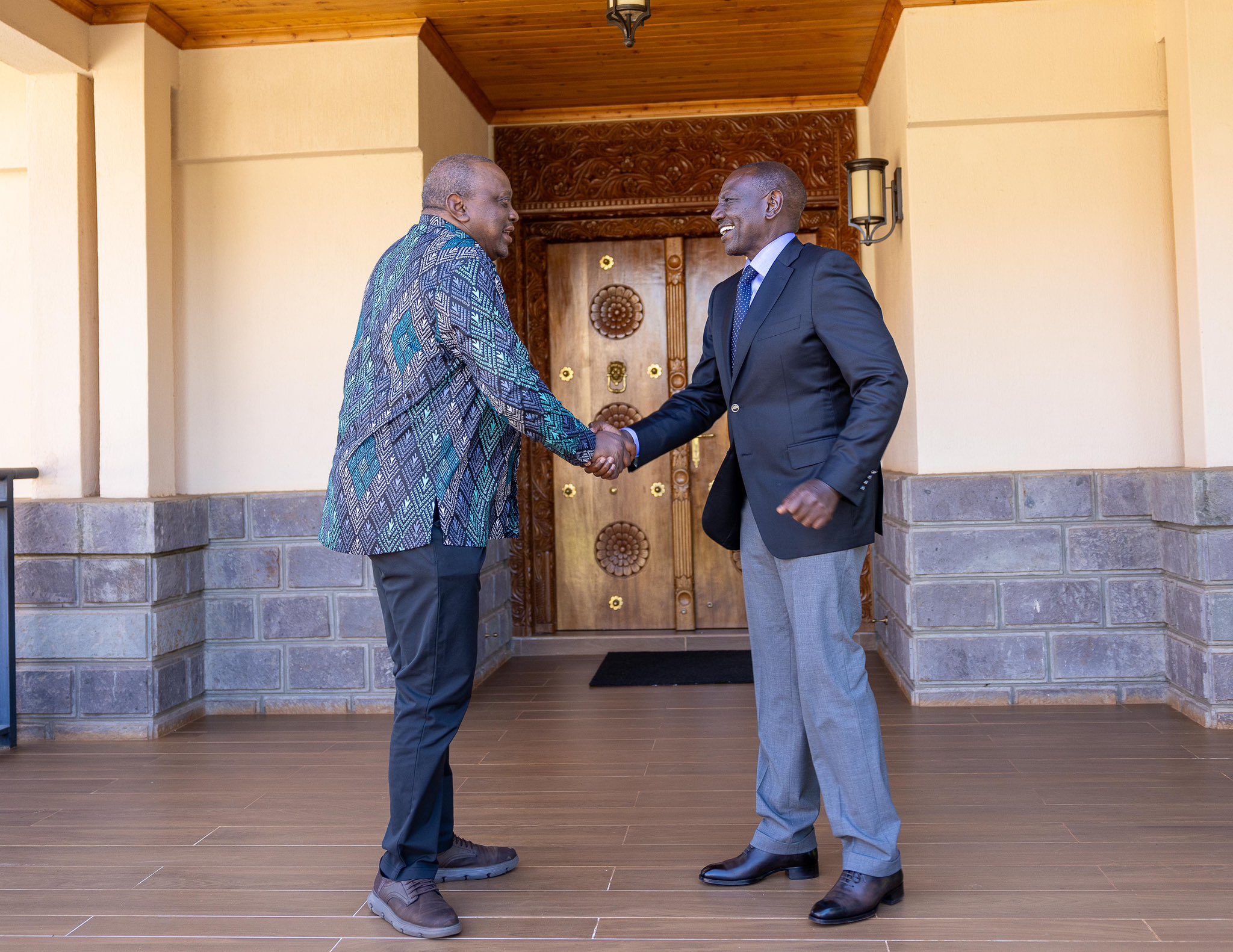
 Former President Uhuru Kenyatta and President William Ruto. Statesmanship demands that former presidents recognise a simple truth: their season of direct political leadership has passed /FILE
As Kenya navigates its current political landscape in 2026, it is worth reflecting on what history teaches us about the role of former presidents such as Uhuru Kenyatta.
Having handed over power to his successor, President William Ruto, in 2022, the former president now has a unique opportunity to exemplify restraint by stepping back from active political engagement that could undermine the current administration.
The question is not whether retired leaders have the right to remain engaged in national affairs — they certainly do. Rather, it is about the manner and extent of that engagement, and whether it serves the nation’s interests or merely perpetuates political rivalry.
Gold standard examples
Nelson Mandela perhaps set the most compelling example of presidential restraint in modern African history. After serving a single term as South Africa’s first democratically elected president, Madiba stepped back with grace and dignity.
He did not micromanage his successor, Thabo Mbeki. He did not fund opposition movements or publicly undermine government initiatives. Instead, he focused on nation-building through his foundation, HIV/Aids advocacy and continental peacekeeping efforts.
When he did speak on political matters, it was measured, rare and oriented toward national unity, rather than partisan advantage.
Closer to home, Kenya’s own Mwai Kibaki demonstrated similar restraint. After leaving office in 2013, President Kibaki largely withdrew from active politics. He did not establish a political base to challenge his successor.
He did not mobilise opposition or seek to reclaim influence through proxy. His public appearances were few, his statements non-partisan. This restraint enhanced rather than diminished his legacy, allowing Kenyans to remember his economic achievements without the taint of post-presidential political machinations.
Global precedents
Across the Atlantic, the United States has cultivated a tradition of presidential restraint that serves as an informal constitutional norm. Former President George W Bush famously said he didn’t think it was appropriate for former presidents to criticise their successors, maintaining remarkable silence even as his successor, President Barack Obama, reversed many of his policies.
Obama himself, despite deep policy disagreements, largely refrained from directly attacking Donald Trump during his presidency, understanding that democratic transitions require space. Of late, however, he has delivered indirect criticisms of policy and a racist Trump-approved video.
Jimmy Carter channelled his post-presidential energy into humanitarian work through the Carter Centre, building houses for the poor and mediating international conflicts. George HW Bush formed an unlikely friendship with Bill Clinton — the man who defeated him — demonstrating that personal grace can transcend political rivalry.
Why restraint matters
The restraint shown by retired presidents is not about weakness or irrelevance. It is about understanding that democracy requires certain unwritten rules to function properly.
When a former president, such as Uhuru, actively works to destabilise his successor, Ruto — whether through funding opposition movements, mobilising protests, or constantly criticising government initiatives — damaging consequences follow.
First, it creates governance paralysis. A sitting president, constantly looking over his shoulder, fighting battles with his predecessor, cannot focus fully on delivering services and implementing his agenda. The mandate given by voters becomes diluted by the continuing power struggle
Second, it undermines democratic legitimacy. Elections are meant to be decisive moments in which citizens choose their direction. When former leaders refuse to accept the verdict and continue fighting through other means, it sends a message that electoral outcomes don’t truly matter — that power is never really transferred, only contested indefinitely.
Third, it damages the institution of the presidency itself. When citizens see former presidents behaving like ordinary politicians — scheming, funding the opposition, engaging in tribal politics — it diminishes the dignity of the office for all who hold it, present and future.
Path forward
Statesmanship demands that former presidents recognise a simple truth: their season of direct political leadership has passed. This does not mean silence on all matters — former presidents can and should contribute to national discourse on constitutional issues, matters of principle, or national crises.
But there is a vast difference between occasional, measured interventions on matters of national importance and active political warfare against one’s successor.
The path of honour for any retired president, including Uhuru, involves channelling their experience, connections, and influence toward nation-building rather than political combat against the President.
There are foundations to establish, young leaders to mentor, peace initiatives to mediate and international goodwill to cultivate for Kenya’s benefit. These contributions can cement a positive legacy far more effectively than any political manoeuvring.
Call to action
Kenya deserves better than a political class locked in permanent combat. Our former presidents have given their service to the nation, and that service deserves honour and gratitude.
But the greatest service they can render now is to step back, allow democratic space to breathe, and trust the people’s verdict. History remembers Mandela’s grace, Kibaki’s restraint and the dignity of leaders who knew when their moment had passed.
It also remembers those who couldn’t let go, who fought their successors, who diminished their own legacies through post-presidential political warfare. The choice of legacy remains open. Statesmanship is always available to those wise enough to choose it.
Nyamweya is the former president of Football Kenya Federation