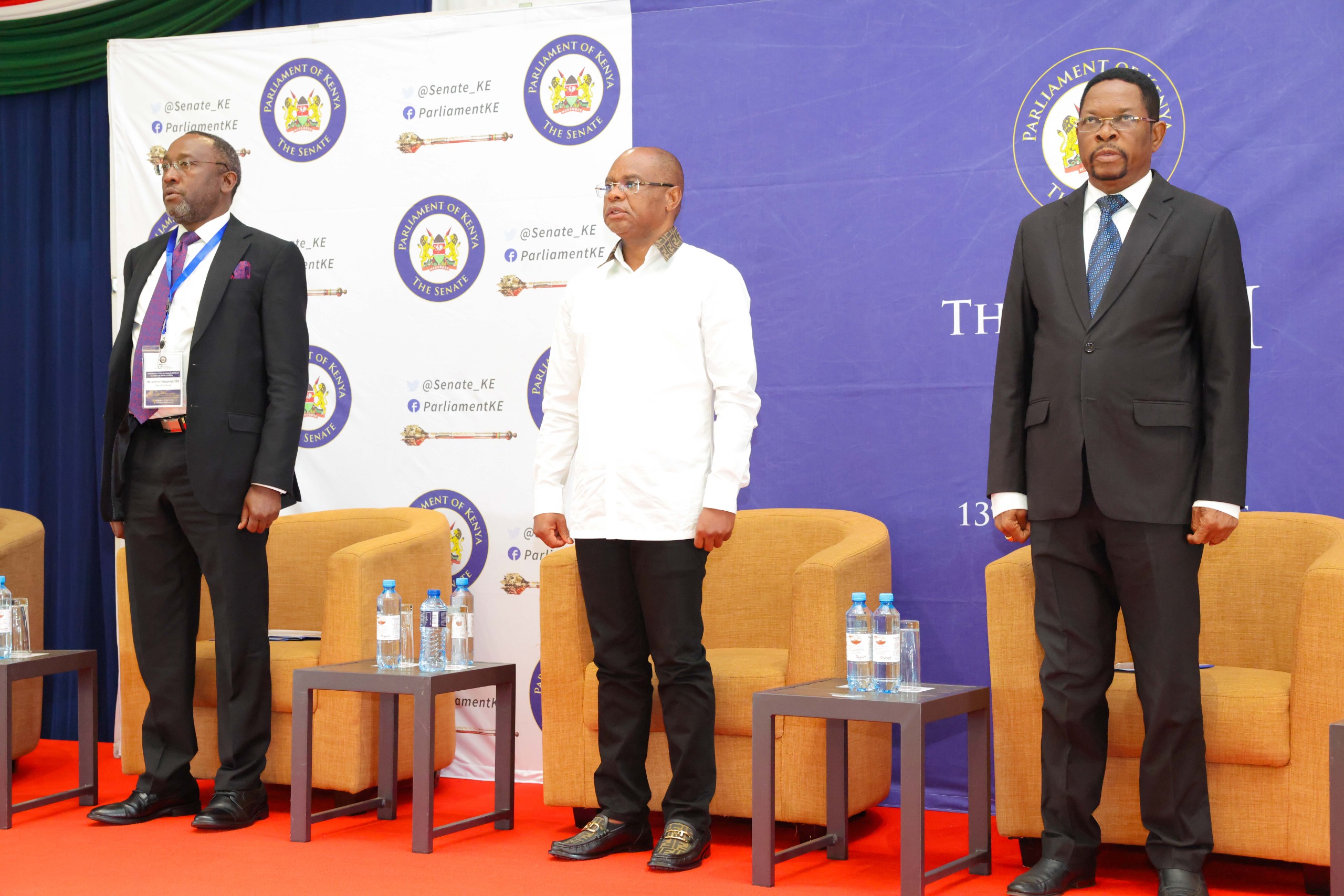
Senate Speaker Amason Kingi has issued a stern warning to lawmakers against skipping House and committee sittings, saying that rising absenteeism is undermining the Senate’s work.
Speaking at the official opening of the fifth session planning retreat at Sawela Lodge in Naivasha, Kingi said 48 committee meetings had been adjourned recently due to a lack of quorum.
He described the trend as “troubling” and a threat to the House’s constitutional mandate.
“The Senate cannot afford to become collateral damage of political campaigns. Our legislative, oversight and representative roles must not be suspended or diluted by political ambition,” Kingi said.
He urged senators to prioritise parliamentary duties despite heightened political activity in their counties ahead of next year’s general election.
Kingi said that committees remain the “laboratories of the Senate,” where laws are scrutinised, audit reports examined and county governments held accountable.
He warned that failure to attend committee meetings weakens oversight and delays the consideration of key bills, stressing that “disagreement is the lifeblood of democracy, but disorder is not.”
The Speaker also addressed tensions between the Senate and county governments, saying that some governors had sought to remove four senators from key oversight committees and threatened to boycott summons.
Kingi dismissed the move as unconstitutional, stressing that accountability is not optional.
“It is inconsistent to seek Senate support for increased revenue while resisting oversight on expenditure. Governors must honour invitations from the County Public Accounts Committee and the County Public Investments and Special Funds Committee,” he said.
As the fifth session gets underway, Kingi outlined the House’s priorities, including faster processing of bills, stronger scrutiny of county spending, follow-up on audit queries and enhanced public participation through petitions.
Senators were urged to take a keen interest in climate change oversight under the Financing Locally-Led Climate Actionprogramme, given the crucial role counties play in implementing adaptation measures.
Other priority areas highlighted include the universal health coverage, food security, education and intergovernmental relations.
Kingi commended senators for their performance in the fourth session, noting that the House held 127 plenary sittings and 864 committee meetings, including 77 county oversight visits.
During the same period, the Senate conducted three impeachment proceedings and launched an impeachment manual to guide county assemblies and ensure due process.
“In athletics, it is not the runner who starts fastest who wins, but the one who finishes strongest. This final lap demands renewed energy and discipline,” he said, urging members to finish the term strong and leave a lasting legacy of protecting devolution.
The retreat is themed ‘Advancing the Senate’s Agenda: Review, Strategy, and Sustainable Progress.’
Senate Clerk Jeremiah Nyegenye highlighted the critical role of the session in reviewing performance, identifying challenges, and aligning priorities for the year.
Nyegenye said that the current session presents an opportunity to fast-track pending legislation, strengthen oversight and cement the Senate’s legacy ahead of the final phase of the 13th Parliament.
The gathering brings together senators, parliamentary leadership, Cabinet secretaries and key stakeholders from devolution, health, agriculture, education and climate governance.
Nyegenye said devolution and intergovernmental relations would dominate discussions, as governors, county assembly representatives and national government officials engage senators on collaboration challenges and legislative gaps.
“The retreat will help identify priority interventions to strengthen devolved governance structures and improve coordination between the two levels of government,” he said.
He added that past clashes between the Senate and counties over audit compliance and accountability make the issue central to the House’s constitutional mandate.
Health sector reforms, including the 2023 Social Health Insurance framework, were discussed to assess implementation of UHC at national and county levels.
Agriculture and food security, key contributors to Kenya’s GDP and employment, also featured prominently, with discussions expected on climate shocks, supply chain bottlenecks, and value addition to boost productivity and rural livelihoods.
Climate financing under the FLLoCA programme will be examined with an emphasis on accountability, value for money, and the role of counties in climate adaptation.
Nyegenye stressed that counties are central to translating national climate commitments into practical, community-responsive actions.
Education remains another key focus area, particularly the management of Early Childhood Development Education and technology-driven training initiatives.
On the legislative front, senators will review the draft Referendum Bill and the Constitution of Kenya (Amendment) Bill, aimed at enforcing the two-thirds gender principle and enhancing representation of persons with disabilities, a rule that has remained unimplemented since 2010 despite repeated attempts.
The retreat will also address senators’ welfare, including a proposed post-service medical scheme, infrastructure upgrades and capacity-building programmes through the Centre for Parliamentary Studies and Training.
Support desks from the Social Health Authority, the National Social Security Fund and the Kenya Revenue Authority have been set up to assist members during the retreat.
Nyegenye assured senators of the secretariat’s continued support in executing their constitutional mandate.
“It is my hope that the outcomes of this retreat will inform the Senate’s strategic focus and guide the refinement of its legislative and oversight priorities,” he said.