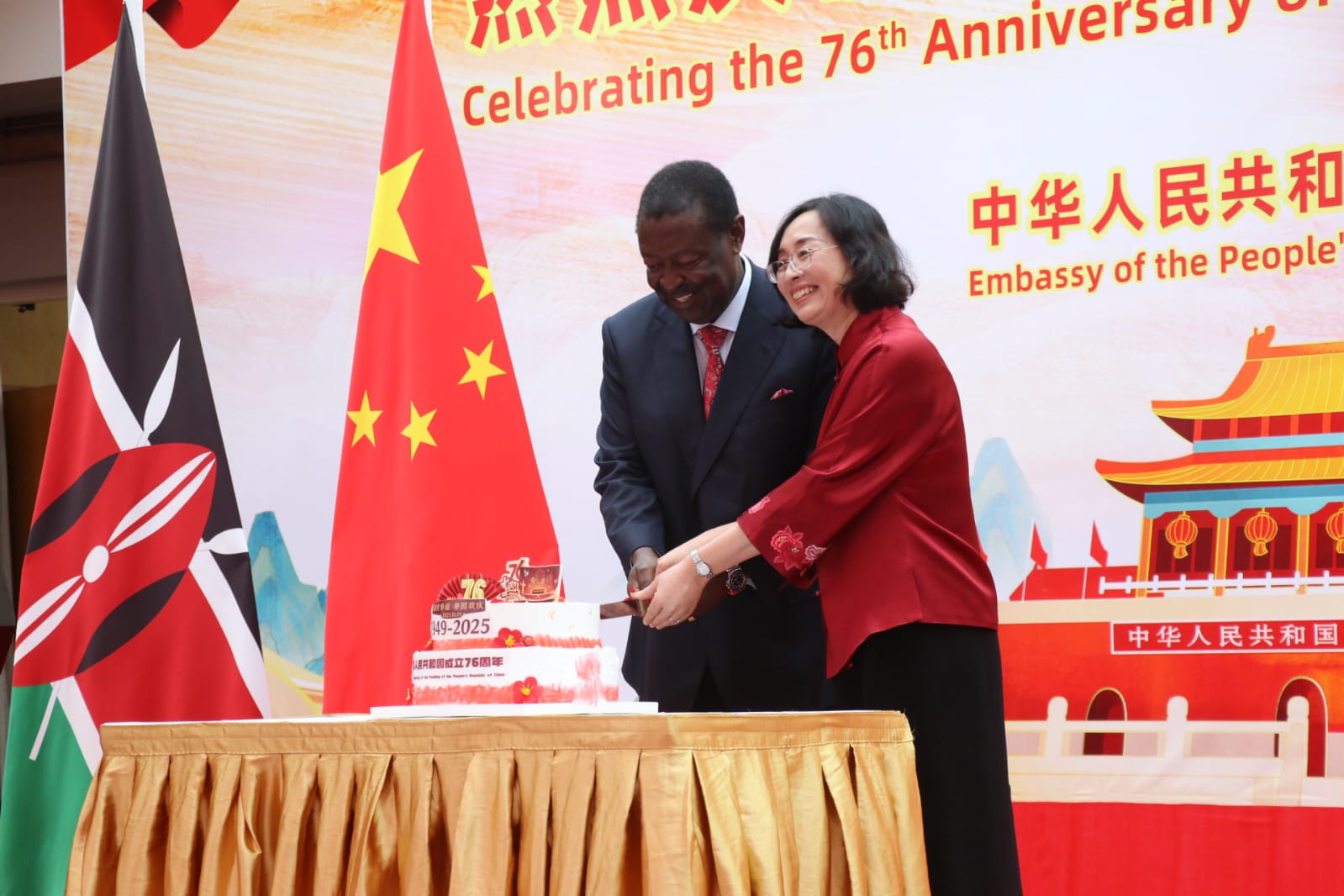
 Prime Cabinet Secretary Musalia Mudavadi and Chinese Ambassador to Kenya Guo Haiyan cut a cake during the 76th anniversary of the founding of the People's Republic of China at the Chinese embassy in Nairobi on September 29, 2025 /LEAH MUKANGAI
Last year, despite significant external and domestic pressures, China’s GDP surpassed 140 trillion yuan, expanding by five percent. In a global environment where many advanced economies struggle to achieve even half that pace, such growth is not trivial. It reflects resilience in the face of a volatile trade climate, structural adjustments in the property sector and persistent supply-demand imbalances.
What is striking is not simply the headline number, but the composition of that growth. Industrial output remained robust, with the value-added of industrial enterprises above designated size increasing by 5.9 percent year-on-year. Equipment manufacturing and high-tech manufacturing demonstrated strong momentum, underscoring a broader transformation toward advanced production and what Chinese policymakers call “new quality productive forces.”
For years, sceptics have forecast imminent decline, viewing every headwind as a precursor to a hard landing. Instead, China has repeatedly recalibrated. Timely policy adjustments, trade diversification and the shock-absorbing capacity of a 1.4 billion-consumer domestic market have enabled the economy to navigate pressure without the dislocations many anticipated.
As 2026 begins, the first year of China’s 15th Five-Year Plan, expectations remain steady. Provincial governments have set growth targets largely between 4.5 and 5.5 percent, with some regions aiming higher. Hainan, now operating under its Free Trade Port framework, is targeting around six percent growth, while the Xizang Autonomous Region aims for more than seven per cent.
These ambitions are supported by a strategy built around three reinforcing pillars: expanding domestic demand, accelerating scientific and technological innovation and strengthening the real economy.
Boosting domestic demand is central. China’s policy framework emphasises upgrading consumption and unlocking the potential of service industries. Rising spending on healthcare, elderly care, tourism and digital services reflects a maturing economy where services increasingly complement goods production. This shift reduces overreliance on external demand while deepening internal resilience.
At the same time, technological innovation is moving from rhetoric to execution. Beijing plans to fully implement its “AI Plus” initiative and establish a national AI application pilot base. Zhejiang projects strong revenue growth in its artificial intelligence sector. Across provinces, government reports consistently emphasise research and development, advanced manufacturing and emerging industries such as electric vehicles, clean energy technology and robotics.
The World Economic Forum’s President Borge Brende recently said that China is consolidating traditional strengths while expanding into new technological frontiers. He expressed confidence that continued reform and innovation will sustain growth, observing that China remains a major contributor to global economic expansion.
That contribution is significant. Even as geopolitical complexities persist, global growth forecasts for 2026 hover above three percent, with China expected to account for a substantial share. In an interconnected global economy, sustained expansion in China provides demand stability for commodities, manufactured goods and services worldwide.
Beyond domestic performance, China’s outward-facing policies amplify this stabilising effect. Zero-tariff treatment for low-income countries, the “Export to China” campaign and the development of the Hainan Free Trade Port signal continued openness. Chinese overseas investment, particularly in infrastructure and manufacturing, supports employment and industrial development in host countries.
China’s leadership in renewable energy manufacturing and electric vehicles also carries global implications. As the largest producer of wind turbines, solar equipment and electric vehicles, China plays a central role in accelerating the global energy transition. These industries reduce costs internationally and expand access to green technologies, reinforcing climate objectives across developing and developed economies alike.
None of this suggests that challenges have disappeared. Domestic consumption must continue to expand sustainably. Innovation must deepen further. Structural reforms must persist. But the foundations remain solid: a vast domestic market, disciplined long-term planning, flexible supply chains and sustained investment in research and development.
History demonstrates that economic influence evolves gradually. Today’s global landscape reflects a diffusion of economic power, with Asia playing an increasingly central role. In this context, China’s steady performance under President Xi Jinping offers more than growth statistics; it offers predictability.
In uncertain times, predictability itself becomes a form of global public good. By maintaining consistent expansion, upgrading its industrial structure and preserving openness under pressure, China’s economy is positioning itself as a stabilising anchor in a fragmented world.
As 2026 unfolds under the 15th Five-Year Plan, the world will watch not for rhetoric but for results. If current trajectories hold, China’s economic resilience will continue providing something global markets desperately need: confidence grounded in scale, execution and shared prosperity.