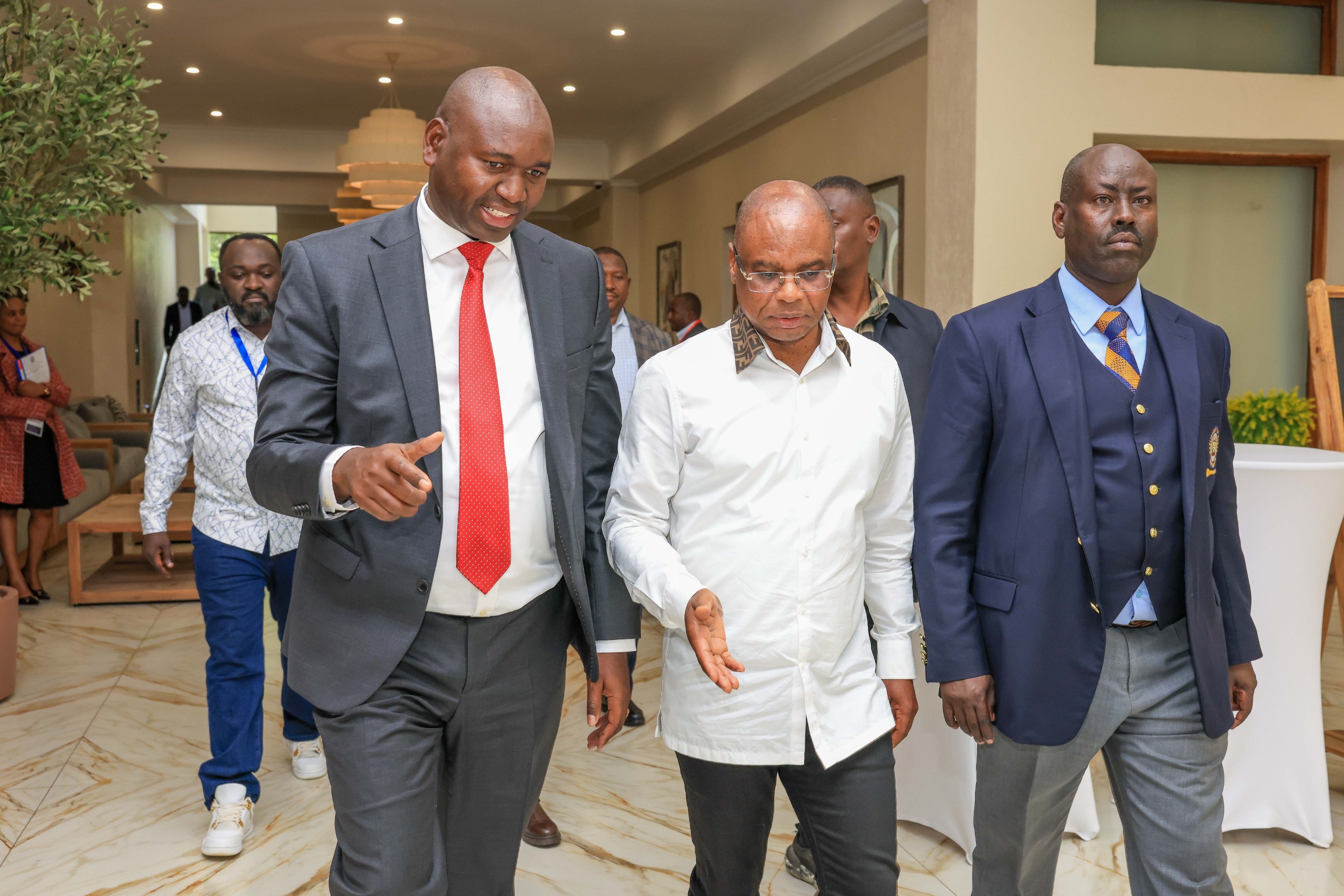
 Basic Education PS Prof Julius Bitok, Senate Speaker Amason Kindi and another official during the Fifth Session planning retreat in Naivasha/HANDOUT
The Senate has been challenged to tighten its oversight of county governments to improve the quality of pre-primary education.
The development comes amid growing concerns over poor infrastructure, underpaid teachers, and weak learning outcomes among young learners.
Basic Education PS Prof Julius Bitok told senators meeting at the Fifth Session planning retreat in Naivasha that while Kenya has made major gains in access to education, foundational learning remains fragile due to gaps at the Early Childhood Development Education (ECDE) level.
He said that although pre-primary enrolment stands at 94.2 per cent, learning outcomes paint a worrying picture.
He disclosed that three in ten Grade Six learners are unable to solve Grade Three mathematics and nearly half are struggling to comprehend a Grade Three English text.
“These statistics demand urgent intervention. We must move from focusing only on enrolment numbers to ensuring quality learning,” said Bitok.
The PS noted that the national government had made significant progress in basic education, including nearly 100 per cent transition to senior school under the Competency-Based Education system.
The government has recruited 100,000 teachers, expanded classrooms and laboratories, and ensured the timely disbursement of capitation funds.
He added that the recent verification exercise that removed ghost learners from school registers would improve planning and ensure resources are allocated based on accurate data.
However, he said the biggest weaknesses remain at the ECDE level, which is under county governments.
The PS called on the Senate to ensure counties prioritise child-friendly infrastructure in their County Integrated Development Plans.
In some regions, he said, pre-primary pupils still learn under trees or in dilapidated structures, while ECDE teachers face delayed salaries, lack of pension schemes and casualised employment.
“An unhappy teacher cannot nurture a child’s mind. We must harmonise schemes of service and move away from short-term contracts that undermine professionalism,” he said.
Prof Bitok also raised concerns over disparities in school feeding programmes, noting that some counties provide meals while others do not, creating what he termed a “lottery of birth” where a child’s nutrition depends on where they live.
He proposed a national–county framework to guarantee at least one fortified meal daily for every ECDE learner.
The PS further called for stronger coordination between the national and county governments to address policy gaps between pre-primary and primary education.
This includes the adoption of a uniform curriculum, equitable resource allocation and full rollout of the Kenya Education Management Information System to track learners from early years.
He told senators that the education budget has reached a historic high of more than Sh700 billion but still faces a Sh111 billion deficit needed to fully fund free primary education, school feeding and national assessments.
The Senate was also urged to support the proposed Basic Education (Amendment) Bill, 2025, which seeks to clarify roles between the two levels of government and strengthen coordination in the sector.
Senators were reminded that they are “ultimate guardians” of the more than four million children enrolled in ECDE centres through their oversight role over counties.
“Your oversight is the bridge between a child’s potential and their reality. By holding counties accountable, you ensure funds meant for our youngest learners reach the classroom,” he said.
The retreat, attended by senior government officials, is reviewing legislative priorities and oversight strategies ahead of the new parliamentary session.