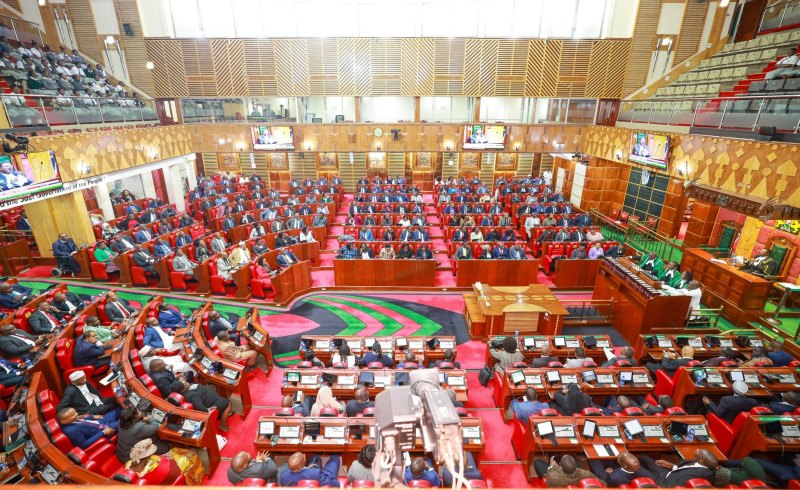
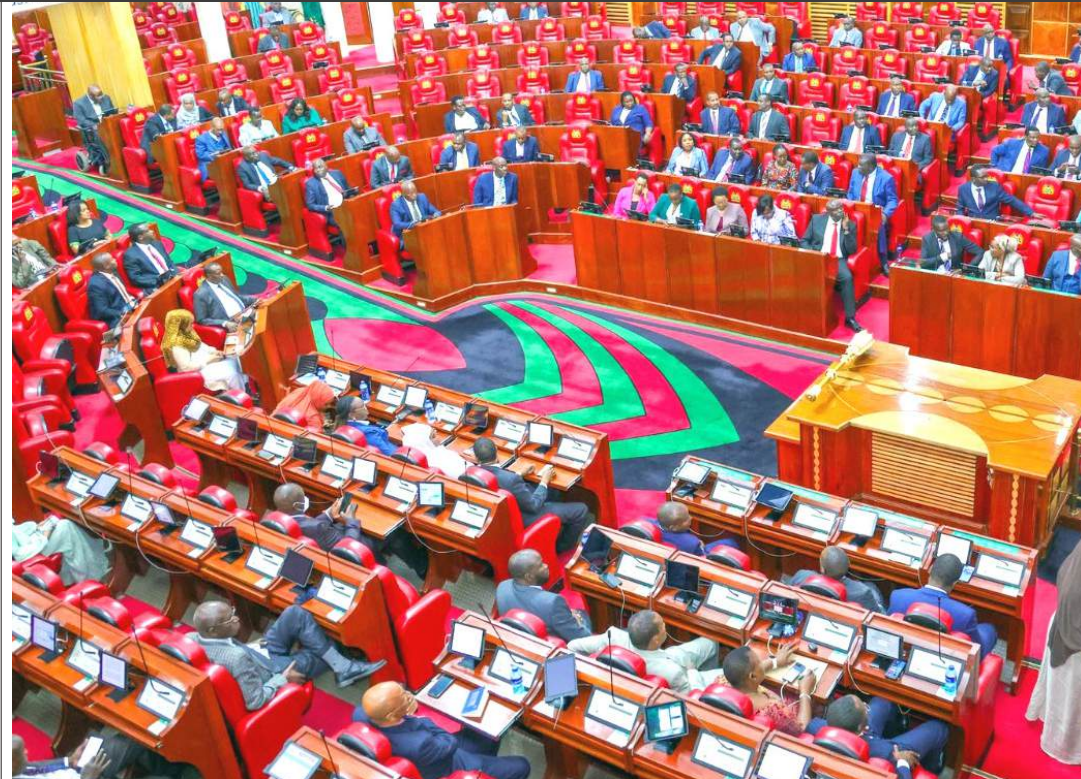
 Parliament in
session /FILE
Parliament in
session /FILE
Members of Parliament have conceded that they are powerless to stop the growing trend where civil servants are taking home next to nothing after statutory and other deductions are effected on their salaries.
In a new report, the National Assembly’s Public Accounts Committee (PAC) declared that enforcing the existing law designed to protect workers’ incomes has become “impractical”.
“The committee recommends that the PSC reviews and submits to the National Assembly amendments to this law within three months,” the Butere MP Tindi Mwale-led committee said.
The report exposes what it terms a critical failure in the application of Section 19(3) of the Employment Act, 2007, which requires that an employee must retain at least one-third of their basic salary after all deductions.
The review followed an audit of the government payroll, which found that this safeguard is being eroded by policies and contributions introduced by the state itself.
MPs say the recent implementation of key government policies has created a perfect storm for workers’ payslips.
Among them is the mandatory 1.5 per cent housing levy introduced by President William Ruto’s administration and the 2.75 per cent for the Social Health Authority.
The levies, deducted from employees’ salaries, has pushed many workers beyond the legal deduction limit and has consistently been red flagged by the auditor general.
The rollout of the NSSF Act, 2013, has also significantly raised deductions for permanent and contract staff in the public service.
In addition, the rate for the Public Service Superannuation Pension Scheme was increased from five per cent to 7.5 per cent.
While the move was meant to boost retirement savings, it has ironically left some workers with very little to live on in the present.
MPs heard that officers whose salaries were already at the one-third threshold were heavily impacted by the increased deductions, resulting in some falling below the required legal limit.
It also emerged that transfers of officers from one station to another affected hardship allowance, extraneous allowance and house allowance for a number of employees, further reducing their net pay.
Kenya Union of Civil Servants secretary general Tom Odege (Nyatike MP) said the only way out of the crisis is to reduce taxes, "as salary increase will not sort it".
"The auditor is right in her observation. There is a policy that employees retain a third of their income, but with the introduction of multiple taxation, the government broke it to enable them to get money from the same slip," the union boss and MP said.
HR practitioner Moraa Morira said a restrictive regime is in an employee's best interests.
"Scrapping the two-thirds salary rule would legitimise debt slavery in the public service, condemning employees to financial ruin, mental distress, and chronic economic instability," she told the Star.
There are also fears that empty payslips could heighten corruption in government.
In the period up to June 2024, more than 47,300 civil servants took home less than a third of their salaries, triggered largely by the new deductions.
This effectively means that thousands are working for a net pay packet that is almost entirely consumed before they even receive it.
The cases cut across ministries and departments.
At the Ministry of Health, at least 168 employees were flagged after their deductions exceeded the limits allowed in law. The Roads department had 131 cases in the 2023 review period.
The situation worsened in the 2024 reporting period.
The National Police Service was the worst hit, with 36,660 officers cited for breaching the one-third rule. More than 550 judicial staff were also affected.
There were 1,275 cases at the Immigration department, 437 at the Social Protection department, 380 at the Medical Services department, and 220 at the Technical and Vocational Education and Training (TVET) department.
In their defence, various accounting officers admitted that the breach of the law was beyond their control, arguing that most of the deductions were mandatory.
They told PAC they had no discretion to stop statutory deductions such as housing levy, NSSF contributions, pension deductions and health insurance payments.
The National Treasury informed MPs that deductions for officers with outstanding departmental liabilities, including imprests, overpayment recoveries, rent arrears and court orders, are processed without consideration of the one-third rule.
Treasury also explained that some officers, who were placed on interdiction and are therefore earning half their salary, remain affected by deductions until the completion of the disciplinary process.
The Public Service Commission, in cases involving its own staff, said the reinstatement of Pay As You Earn (PAYE) rates in 2021 after the Covid-19 tax relief period made the situation worse for some civil servants.
According to PSC, the reduced tax bands during the pandemic had given employees more purchasing power, which enabled some staff to access additional loan facilities.
When the tax relief ended and PAYE rates were restored, many officers found themselves with higher deductions due to loan repayments combined with statutory contributions.
Attempts to mitigate the situation by asking affected officers to restructure their loans and adjust their Sacco contributions have not fully resolved the problem.
After reviewing the matter, the PAC concluded that enforcing the one-third-basic salary rule is no longer feasible under the current circumstances.
“The committee noted that enforcing the one-third-basic salary rule was impractical under the current statutory deductions framework,” the report states.
Instead of compelling ministries and departments to comply with the existing law, MPs have recommended that the law itself be amended.
If the proposed changes are adopted, they will formalise a situation where civil servants can legally take home less than one-third of their basic pay.
The report comes just days after it was revealed that a number of civil servants have seen their net pay drop to near zero due to cumulative deductions.
INSTANT ANALYSIS
The proposed amendments signal a major shift in worker protection laws, prioritising the government’s ability to collect revenue and mandatory contributions over the guarantee of a minimum take-home pay. If passed, the changes will make it legal for thousands of Kenya’s civil servants to go home with empty or near-empty payslips.