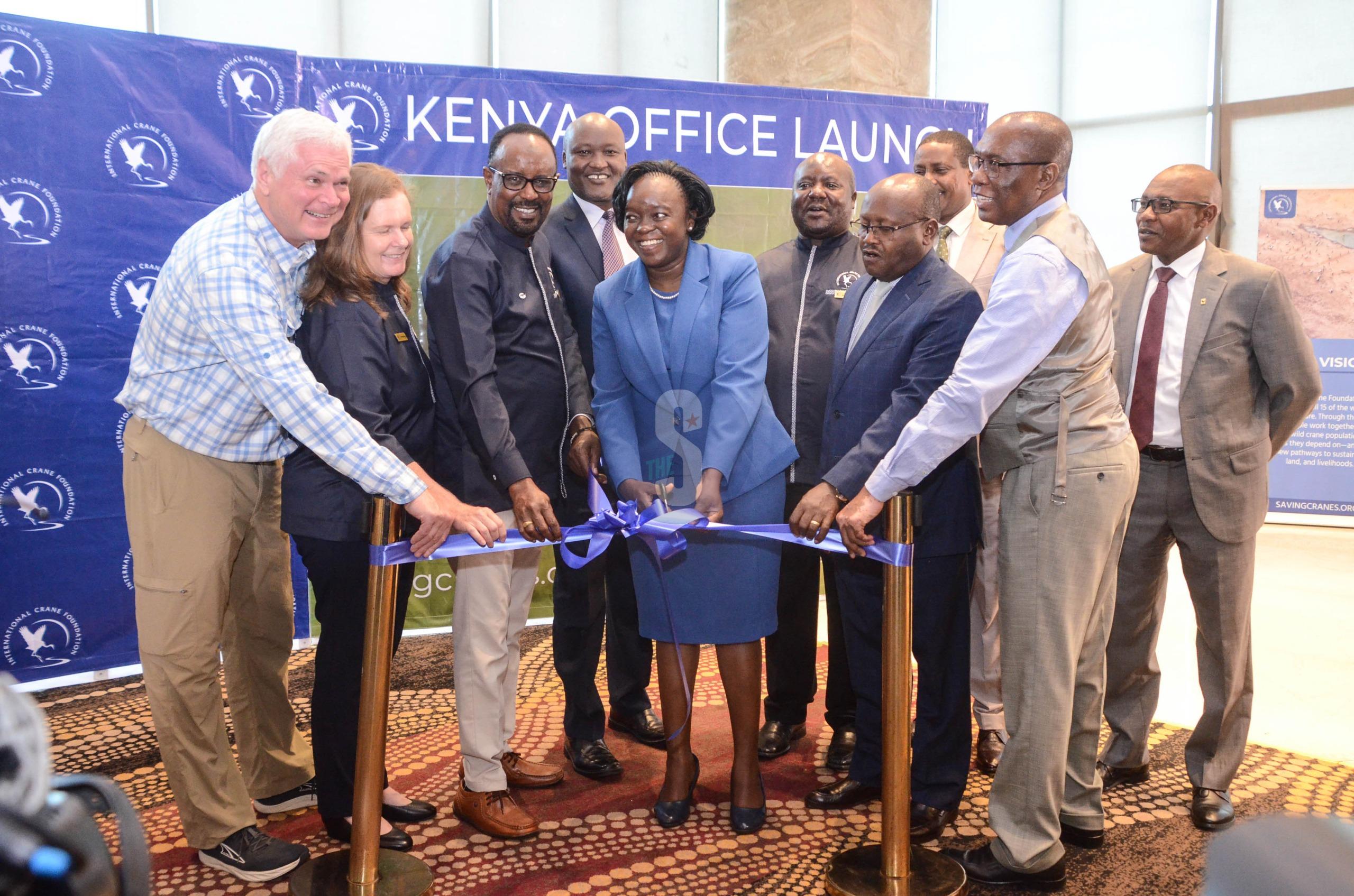
 Environment, Climate Change and Forestry CS Deborah Barasa joined by International Crane Foundation country manager Adan Kabelo, Conservation Secretary, State Department for Wildlife Conservation John Chumo, NEMA chairperson Emilio Mugo and other officials, cut the ribbon during the official launch of ICF Kenya office, at Emara Ole Sereni Hotel on February 26, 2026./DOUGLAS OKIDDY
Kenya’s iconic grey-crowned crane is vanishing—and with it, a warning about the country’s fragile wetlands.
Environment Cabinet Secretary Deborah Mlongo Barasa has revealed that the bird’s population has plummeted by more than 80 per cent in just four decades, pushing it into the endangered category and signalling deeper environmental distress.
Barasa made the remarks on Thursday during the official launch of the International Crane Foundation’s Nairobi hub, where she warned that climate change, habitat degradation, land-use changes and illegal wildlife trade are driving the sharp decline.
“It has experienced a population decline of over 80 per cent in the past four decades, leading to its classification as an endangered species. Its survival is inseparable from the health of our wetlands,” she said.
The Cabinet Secretary described cranes as a critical indicator of environmental health, cautioning that their disappearance points to wider ecological problems, including threats to water systems.
“When water disappears, cranes disappear. And when cranes disappear, our water systems are endangered,” she said.
 Environment, Climate Change and Forestry CS Deborah Barasa joined by International Crane Foundation country manager Adan Kabelo, Conservation Secretary, State Department for Wildlife Conservation John Chumo, NEMA chairperson Emilio Mugo and other officials, cut the ribbon during the official launch of ICF Kenya office, at Emara Ole Sereni Hotel on February 26, 2026./DOUGLAS OKIDDY
She added that the presence of cranes reflects a healthy and functioning ecosystem.
“The crane is a symbol of rich and healthy biodiversity. The absence of its voice means the species is endangered, and our ecosystem is also endangered,” she said.
Barasa noted that Kenya hosts some of Africa’s most important wetlands, including Yala Swamp, Tana River Delta, Lake Naivasha, and the Ewaso Nyiro wetlands, which support biodiversity, water security, and livelihoods.
However, she warned that these ecosystems are under increasing pressure.
“Kenya is privileged to host some of the most vital wetland ecosystems in Africa, but increasing pressures from climate change, habitat degradation, land-use changes and illegal wildlife trade threaten their survival,” she said.
She stressed that wetland protection is a constitutional duty and said the government has put in place legal and policy frameworks to safeguard the environment.
“Wetland conservation is not optional. It is a constitutional and national obligation,” she said, citing Article 42 of the Constitution, which guarantees the right to a clean and healthy environment, and Article 69, which calls for sustainable natural resource management.
 Environment, Climate Change and Forestry CS Deborah Barasa joined by International Crane Foundation country manager Adan Kabelo, Conservation Secretary, State Department for Wildlife Conservation John Chumo, NEMA chairperson Emilio Mugo and other officials, cut the ribbon during the official launch of ICF Kenya office, at Emara Ole Sereni Hotel on February 26, 2026./DOUGLAS OKIDDY
Barasa added that Kenya has enacted several laws to support conservation, including the Environmental Management and Coordination Act, the Wildlife Conservation and Management Act, the Water Act, and the Physical and Land Use Planning Act.
She also noted that Kenya is a signatory to global environmental agreements such as the Ramsar Convention on Wetlands and the Convention on Biological Diversity.
The Cabinet Secretary welcomed the launch of the Nairobi hub, saying it demonstrates confidence in Kenya’s environmental leadership and will strengthen conservation efforts.
“This establishment reflects strong confidence in Kenya’s environmental governance framework and our unwavering commitment to biodiversity protection,” she said.
She added that partnerships between the government, conservation organisations and communities will be critical in protecting wetlands and endangered species.
“Together, through collaboration and shared responsibility, we can safeguard Kenya’s wetlands and ensure a sustainable and resilient future for generations to come,” she said.