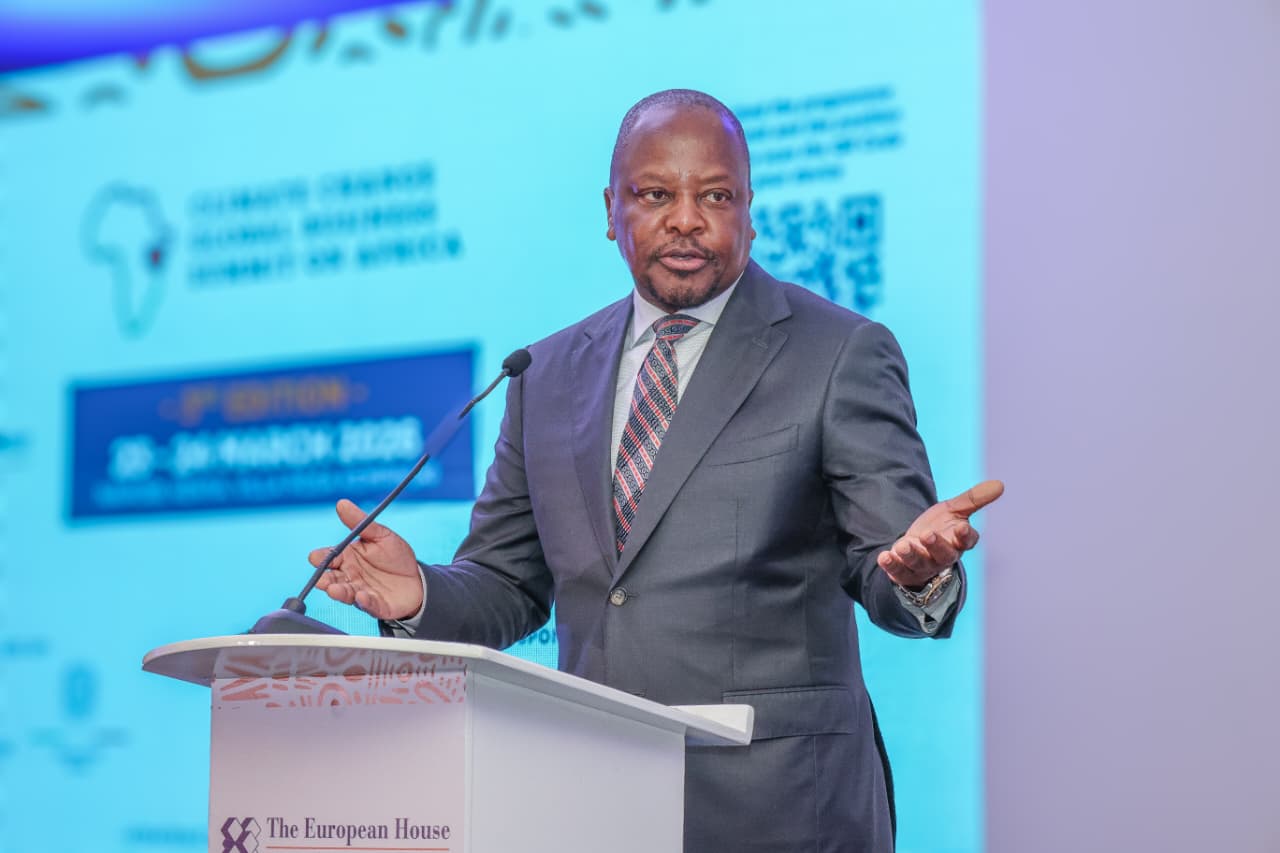
 Agriculture and Livestock Development Cabinet Secretary Mutahi Kagwe speaking on March 23, 2026/ HANDOUT
Kenya has issued a bold challenge to global investors and developed nations, warning that failure to finance climate-smart agriculture in Africa could trigger far-reaching consequences for global food systems.
Agriculture and Livestock Development Cabinet Secretary Mutahi Kagwe used the 3rd Climate Change Global Business Summit on Africa in Nairobi to shift the conversation from vulnerability to urgency, positioning Africa not as a victim of climate change, but as the frontline of global food security.
Kagwe declared that climate change is already dismantling traditional agricultural systems across Kenya, with extreme weather patterns now defining the country’s reality.
“Climate shocks are no longer future risks; they are present disruptions. If agriculture in Africa fails, global food systems will feel the shock,” Kagwe warned.
He revealed that Kenya’s heavy reliance on rain-fed agriculture, accounting for 98 per cent of farming, leaves millions exposed to climate variability.
The consequences have already been severe: five failed rainy seasons between 2020 and 2023, 4.4 million people pushed into food insecurity, and the loss of over 2.5 million livestock. Even in 2026, the crisis persists.
While some regions face deadly floods, others are battling drought and extreme heat, with over two million Kenyans currently in need of emergency food and livestock support.
Kagwe said that Africa must no longer be sidelined in climate decision-making or subjected to externally designed solutions.
“There is no one-size-fits-all solution. Climate change is a lived experience for our farmers. The answers must come from the ground, not from boardrooms in Brussels, New York or Paris,” he said.
CS Kagwe called for the enforcement of the “polluter pays” principle, urging developed economies to match commitments with real, accountable financing.
“For too long, responsibility has been diluted. Those most affected, farmers, pastoralists, women and youth have been left out of the equation,” he added.
At the same time, Kenya positioned itself as a leader in climate action, highlighting ongoing efforts to transform agriculture into a resilient and investment-ready sector.
CS Kagwe pointed to President William Ruto’s ambitious plan to plant 15 billion trees over the next decade, describing it as both an environmental and economic strategy aimed at restoring ecosystems while supporting livelihoods.
He also emphasised Kenya’s growing dominance in renewable energy, with up to 80 per cent of electricity generated from clean sources, a foundation the country is leveraging to green its agricultural value chains.
Kagwe outlined a sweeping transformation already underway in the agricultural sector, including the adoption of drought-resistant crops, expansion of irrigation, digital climate advisory tools, agroforestry, and livestock insurance schemes.
He revealed that Kenya has secured over USD 250 million in climate financing, though he stressed that significantly more capital is needed to unlock Africa’s agricultural potential.
CS Kagwe also highlighted the strategic role of public-private partnerships and regional trade frameworks such as the African Continental Free Trade Area (AfCFTA), IGAD and the African Union in unlocking cross-border agricultural growth and resilience.
The CS urged businesses to view climate-smart agriculture not as a risk, but as one of the biggest untapped opportunities of the decade.
“This is the moment for investors to step in not just for returns, but for impact. Climate-smart agriculture is the future of food, and Africa is central to that future,” he said.
“Africa has the opportunity to lead not as a victim but as a champion of climate solutions. Kenya stands ready to partner, innovate, and drive that transformation.”
The summit, bringing together global CEOs, policymakers, and development partners, is expected to shape new commitments toward industrial transformation and climate resilience across the continent, with agriculture firmly at the center of the agenda.