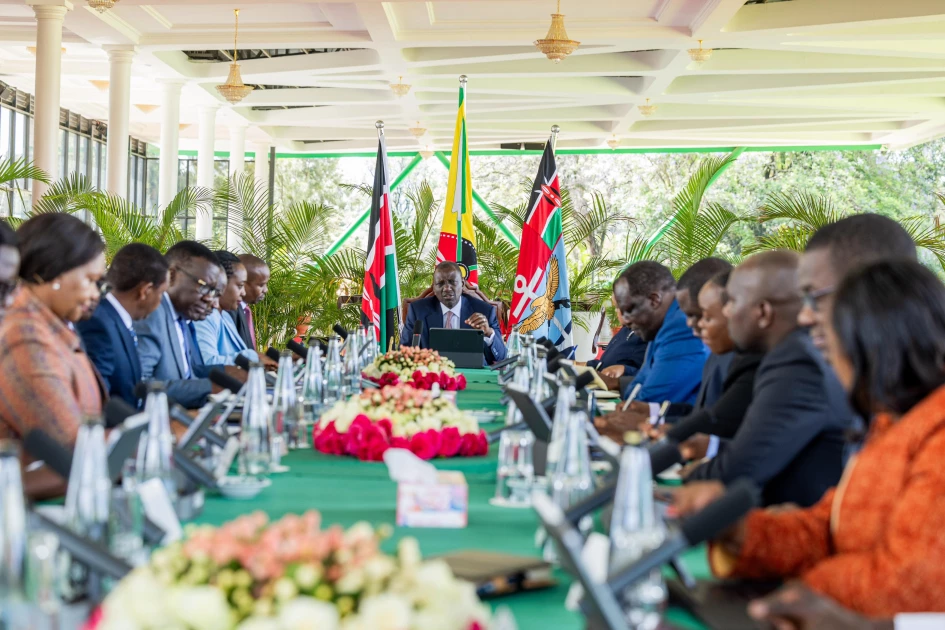
 President William Ruto with his cabinet members during a past meeting/PCS
The increasing visibility of Cabinet Secretaries in political mobilisation activities ahead of the 2027 General Election has sparked a national debate on the neutrality of senior state officials.
However, a combination of constitutional interpretation, statutory provisions and court rulings clearly explains why cabinet secretaries are legally allowed to participate in political campaigns.
In recent months, several Cabinet Secretaries, including Hassan Joho, John Mbadi, Geoffrey Ruku and Opiyo Wandayi, have been seen accompanying President William Ruto at political events or engaging in activities viewed as part of early re-election campaigns.
Prime Cabinet Secretary Musalia Mudavadi has also been captured campaigning for UDA candidates in the recent Kakamega by-elections.
Their involvement has drawn criticism from some political leaders and members of the public who argue that state officers should remain impartial.
Embakasi North MP James Gakuya is among those who have questioned the trend, warning against what he termed growing sycophancy within the administration.
His remarks come at a time when Cabinet Secretaries and other senior public officials are facing heightened scrutiny over alleged participation in partisan political mobilisation ahead of the next election cycle.
The debate intensified recently after Treasury Cabinet Secretary John Mbadi hosted a delegation of Luo elders at his office.
The meeting reportedly focused on unity within the Luo community and the future of ODM politics within the context of the broad-based government.
“I think the elders, first and foremost, are concerned about the unity of the Luo community, then the unity of ODM,” Mbadi said.
“And I will tell you that the things that you are seeing happening today did not start yesterday; they started when Raila was alive, although they were muted.”
Mbadi added that he would continue advancing the interests of the Luo community and the ODM within the Kenya Kwanza administration.
Energy Cabinet Secretary Opiyo Wandayi has also defended his political engagement, saying some ODM leaders were implementing what he described as the late Raila Odinga’s final political direction to work with President Ruto under a broad-based government framework.
While such actions have attracted criticism, the legal framework governing political participation by state officers draws a clear distinction between Cabinet Secretaries and the rest of the public service.
Under Section 12(1) of the Political Parties Act and Section 23 of the Leadership and Integrity Act, public officers are generally prohibited from engaging in political activities that may compromise or be seen to compromise the political neutrality of their offices.
They are barred from holding party positions, publicly supporting candidates, or acting as political agents.
However, these restrictions expressly exclude Cabinet Secretaries and County Executive Committee Members.
This position was affirmed by the High Court in a judgement delivered on December 16, 2022, by Justice Anthony Mrima.
“A declaration hereby issues that with an exception of Cabinet Secretaries and County Executive Committee Members, the rest of the State officers and public officers be and are restrained from engaging in political activities such as may compromise, or be seen to compromise the political neutrality of their office,” ruled Justice Mrima.
The case arose from a petition filed by Nazlin Omar Fazaldin Rajput, who had challenged the role of state officers in political campaigns during the 2022 General Election.
Among other prayers, the petitioner sought orders restraining the President, Cabinet Secretaries, public officers and even administrators such as chiefs and sub-chiefs from engaging in political campaigns.
The court was therefore called upon to determine whether it was constitutional for state officers and public officials to campaign for political candidates.
In its analysis, the court emphasised that neutrality is a fundamental principle for the public service because career civil servants serve the government of the day regardless of political changes.
The Supreme Court had earlier addressed the issue in Fredrick Otieno Outa vs Jared Odoyo Okello & Others (2017), noting that public officers must avoid political activities that could compromise the neutrality of their offices.
However, the apex court drew a different conclusion regarding Cabinet Secretaries.
In the 2017 Presidential Petition, the Supreme Court observed that Cabinet Secretaries are political appointees who serve at the pleasure of the President and are expected to help implement the political agenda of the administration.
“The law, therefore, is clear that Cabinet Secretaries are exempt from the prohibition that public officers should not engage in the activities of a political nature, and for good reason,” the judges stated.
“It is to be observed that Cabinet Secretaries and County Executive Committee Members do serve at the pleasure of either the President or Governor.
They are political appointees with the express purpose of delivering the manifesto of their appointing authority or his or her political party.”
The court further explained that this arrangement is inherent in democratic governance.
“This is an essential part of a political government in any democracy. A change in the Presidency signals the immediate resignation or replacement of these political appointees; not so with the rest of the civil service, whose tenure is protected against the vagaries of politics.”
The judges emphasised that the distinction exists to preserve professionalism within the career civil service.
“This is also the reason why civil servants do not and should not participate in active politics, as they should remain apolitical,” the ruling stated.
Based on this reasoning, the High Court concluded that participation by Cabinet Secretaries in advancing the government’s political agenda cannot, by itself, be faulted.
At the same time, the court cautioned that the exemption does not extend to other categories of state officers and public servants.
Principal secretaries, county commissioners, chiefs and other administrators remain bound by strict neutrality requirements.
“Other than Cabinet Secretaries and County Executive Committee Members, the rest of the State officers and public officers must comply with the dictates of the Political Parties Act and the Leadership and Integrity Act,” the court held, adding that any violations should attract appropriate sanctions.
The ruling also underscored the importance of evidence when alleging misuse of public office for political purposes, noting that claims must meet the legal burden of proof.
As the political season gradually takes shape ahead of 2027, the judgement continues to shape the legal and political landscape.
While critics may question the optics of Cabinet Secretaries engaging in political mobilisation, the courts have affirmed that their role as political appointees allows them to actively support the administration’s agenda.